Toronto Star
· collected 2026-09-23 · by Victoria Milko And Sibi Arasu The Associated Press
Story summary
Nepal's Prime Minister Balendra Shah, addressing the 81st session of the UN General Assembly on September 24, 2026, proposed establishing a Himalayan Climate Resilience Mechanism led by Nepal, India, and China. The initiative aims to enhance cooperation in sharing satellite data, monitoring glacial lakes, and strengthening early-warning systems to address climate-related disasters, particularly after the devastating flash floods that killed over 1,450 people and displaced thousands in August 2026.
Shah emphasized these measures as a response to environmental challenges affecting mountainous regions. The proposed mechanism would help mitigate risks from glacial lake outburst floods (GLOFs) and other climate-related threats impacting millions of people across the Himalayan region.
The floods, triggered by a glacial and rock collapse on the Nepal-China border, severely impacted tourism and local economies, with hotels and trekking companies experiencing significant cancellations. According to tour planner Pushpraj Rimal in Kathmandu, "It is still a lockdown kind of situation," reflecting ongoing challenges for recovery.
Additionally, there are pressing needs for humanitarian aid and long-term rebuilding efforts. Dr. Nimesh Dhungana from the University of Manchester's HCRI highlighted the importance of governance and accountability in disaster response and recovery processes. With around 5,285 people still missing and numerous displaced families struggling to find stable housing, initiatives like Shah’s proposal are crucial for sustainable development and resilience against future disasters. The mechanism aims not only at immediate relief but also at long-term planning to protect communities from similar catastrophic events in the future.
Written for “Nepal Floods Climate Impact” on 2026-10-05,
grounded in this article and the 20 other(s) covering the same event.
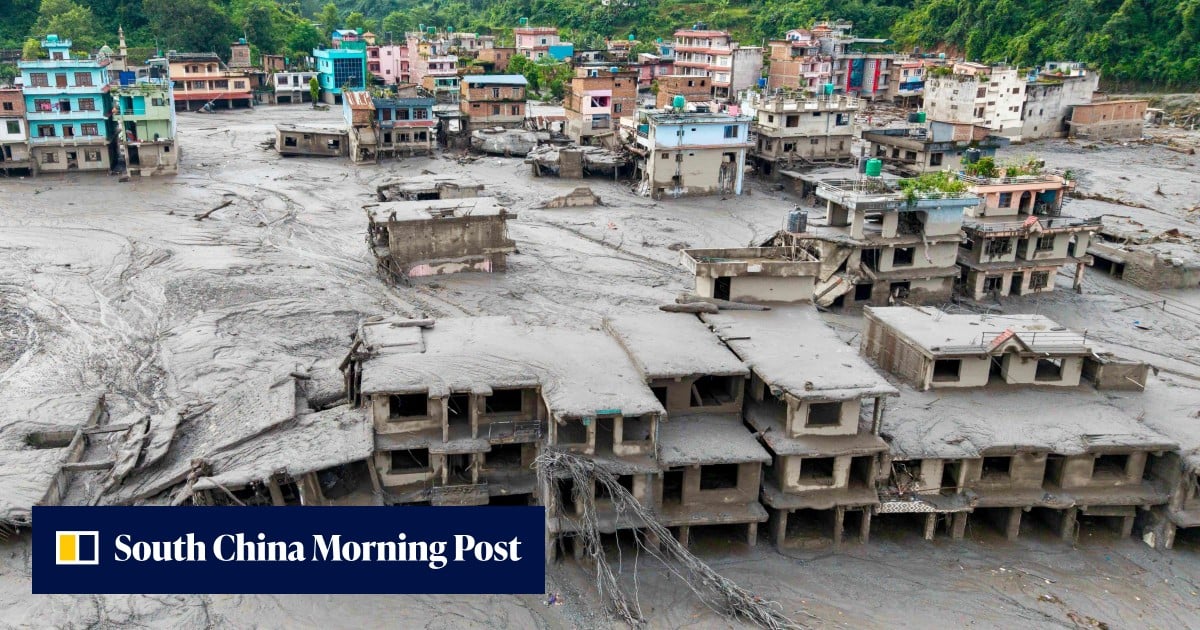
Sitting on the floor of a makeshift shelter for survivors of Nepal’s deadly recent floods, Tenzin Dolma Ghale said she had nothing left but the clothes she was wearing.
asserted
she → sit → clothes
Her entire village and members of her family were washed away by the surge of water and debris that killed over 1,450 people and left more than 6,000 missing.
asserted
that → wash → 6,000
After speaking, she waved a hand and looked at the ground.
asserted
she → speak → ground
“It’s all finished,” she said.
asserted
she → finish → ?
Ghale is among millions of people living with the deadly consequences of climate-related disasters.
asserted
Ghale → live → disasters
As such disasters intensify, international climate adaptation and disaster preparedness aid programs have been slashed, leaving countries facing billions of dollars in avoidable damage and dwindling recovery funds.
“The reality is that we need trillions of dollars every year, but developed countries have not met their obligation,” said Harjeet Singh, founding director of New Delhi-based Satat Sampada Climate Foundation.
asserted
Singh → intensify → Foundation
Aid cuts weaken disaster monitoring in the Himalayas
asserted
cuts → weaken → Himalayas
The Trump administration’s abrupt cuts to U.S. foreign aid in 2025 eliminated or sharply curtailed programs serving millions of people worldwide, with devastating consequences for many communities.
asserted
cuts → eliminate → communities
Reductions by other major donor countries deepened the funding crisis.
asserted
Reductions → deepen → crisis
Among the programs shut was SERVIR-Hindu Kush Himalaya, a joint initiative of the U.S. Agency for International Development, NASA and the Kathmandu-based International Centre for Integrated Mountain Development, or ICIMOD.
asserted
Himalaya → shut → Development
Covering Afghanistan, Bangladesh, Myanmar, Nepal and Pakistan, the program used satellites and geospatial analysis for disaster risk reduction, water resources and land cover.
asserted
program → cover → reduction
It facilitated flood risk services, collaboration with the Nepal Red Cross Society on risk communication and more than 170 public data sets on glaciers, disasters and vulnerability.
asserted
It → facilitate → glaciers
Glacial and disaster preparedness experts praised the organization for its extensive research, cross-border coordination and support of local disaster reduction measures.
asserted
experts → praise → measures
Before losing its funding due to USAID cuts, the program addressed mounting risks in a region where climate change has caused rapid glacier melt, shifting monsoons and increasingly frequent floods, landslides and glacial lake outburst floods, or GLOFs.
asserted
change → lose → melt
Those changes endangered food, water and energy security for nearly 2 billion people living in or downstream of the region, according to ICIMOD.
uncertain
changes → endanger → ICIMOD
Himalayan glaciers are losing mass 65% faster than they were a decade ago, according to a new report by global consultancy Systemiq, produced with ICIMOD.
uncertain
they → lose → ICIMOD
Yet only around 0.1% of the Himalaya’s estimated 40,000 glaciers are currently monitored in detail and on a sustained basis, the report said.
asserted
report → estimate → basis
When funding for SERVIR-HKH ended, so did programs that monitored landslide forecasting, daily flooding, training programs and regional collaboration between countries.
asserted
that → end → countries
With the program’s loss, millions now face a heightened risk of GLOFs, which can release millions of cubic meters of water and debris in just a few hours.
asserted
which → face → hours
In northern Pakistan, melting glaciers have created 3,044 glacial lakes, with over 30 identified as likely to result in such floods in areas where over 7 million people live, according to the United Nations Development Program.
uncertain
people → melt → Program
Afghanistan also faces an increased threat of GLOFs, according to research published by the University of Lausanne in Switzerland.
uncertain
Afghanistan → face → Switzerland
In India — which was not part of the SERVIR-HKH program but borders all of the countries that were and is also home to over half the Himalayas — over 130 high-altitude lakes are at risk of flooding.
asserted
lakes → border → flooding
South Asia is already experiencing deadly climate-related disasters.
asserted
Asia → experience → disasters
The 2022 Pakistan floods killed more than 1,700 people and caused an estimated $40 billion in damage.
asserted
floods → kill → damage
Flooding in Nepal in 2025 killed nine people and caused millions of dollars in damage.
asserted
Flooding → kill → damage
Cloudbursts, landslides, flash floods and extreme rainfall have wreaked havoc in the Indian Himalayas, resulting in the death of over 12,000 people and damage exceeding billions of dollars in the last 15 years.
asserted
Cloudbursts → wreak → years
The region suffered economic losses of at least $7 billion in 2025 due to climate-driven extreme weather, according to the Emergency Events Database maintained by the University of Louvain, Belgium.
uncertain
region → suffer → Louvain
This database itself is at risk of being shut down as a result of USAID funding cuts.
asserted
database → shut → cuts
In a statement to The Associated Press, the U.S. State Department said that the U.S. supports Nepal’s flood warning capacity through programs with the World Meteorological Organization and National Oceanic and Atmospheric Administration.
asserted
U.S. → say → Organization
The department noted that SERVIR-HKH ended in January 2025 but that its tools remain active through ICIMOD.
asserted
tools → note → ICIMOD
The impact extends beyond communities hit directly.
asserted
impact → extend → communities
Cuts to programs like SERVIR-HKH will have cascading effects for years, said Neha Rai, a climate finance expert at ICIMOD.
asserted
Rai → have → ICIMOD
Rai likened the cuts to climate programs to abruptly halting funds for cancer research, which needs years of sustained research for success.
asserted
which → liken → success
“Climate risk is also a generational challenge,” said Rai.
asserted
Rai → say → ?
“You need long-term observations, expertise, you need institutions that cannot simply be switched off and on as short-term priorities.”
asserted
that → need → priorities
Rai said cuts to cross-border programs have also impacted information sharing between governments, scientists and organizations across the region — a critical function in a region where what happens upstream directly affects countries downstream.
asserted
happens → say → countries
Climate finance shrinks as vulnerable countries face rising debt
These cuts are part of a larger trend.
asserted
cuts → shrink → trend
According to the Organization for Economic Cooperation and Development, official development assistance from its Development Assistance Committee members, which includes the U.S., fell 23% in 2025 — the largest annual contraction on record.
uncertain
which → accord → record
Traditionally large donors such as the United Kingdom, Germany, France, Japan and Canada have also announced massive reductions, reallocating funds to defense and other domestic priorities.
asserted
donors → announce → defense
Global South countries spend approximately 225 times more in debt repayments than what they receive in grant-based climate finance, according to a recent report by the advocacy group, ActionAid International.
uncertain
they → spend → group
…and 8 more, not listed.
 The Aporia