How one climate lawsuit could jack up prices for everyone

Read the original at Washington Examiner ↗
Washington Examiner · collected 2026-09-29 · by Phil Goldberg

Quick Summary

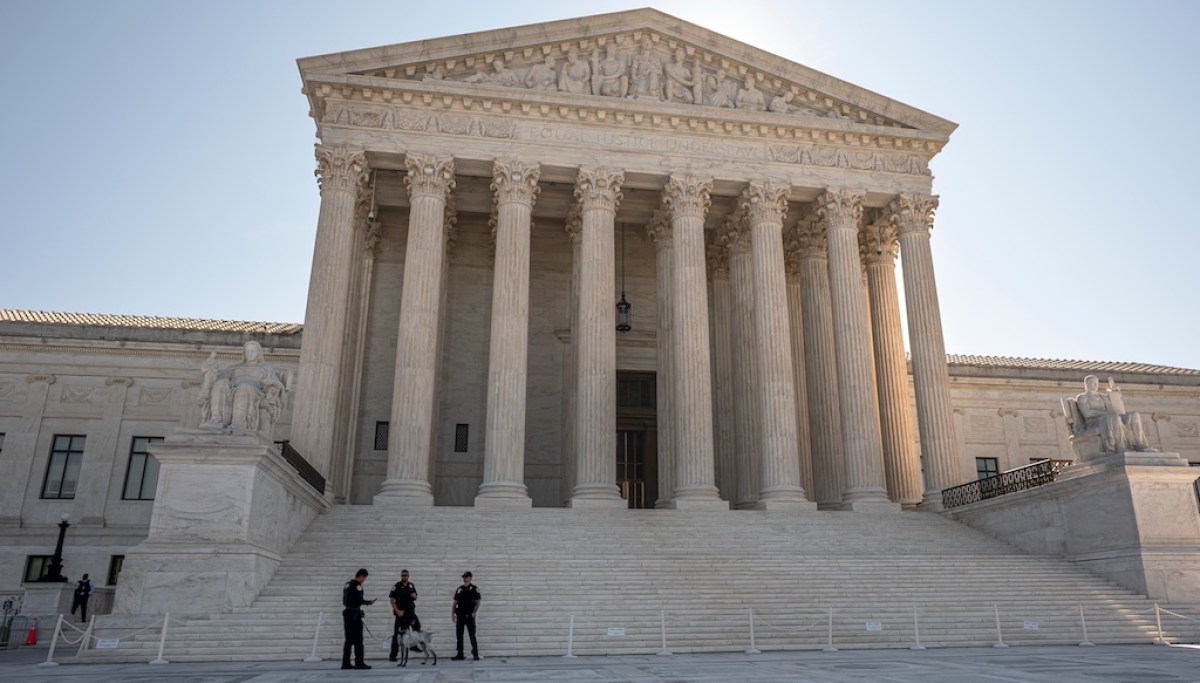
The Supreme Court will consider a case, Suncor Energy v. Boulder County, at the start of its new term, examining if state and local governments can sue specific companies for damages related to global climate change. This could affect manufacturers nationwide as similar lawsuits are pending across the country. Legal experts suggest these cases aim to increase energy prices indirectly through liability costs that would be passed on to consumers. The broader concern is whether states have the authority to address national issues like climate change through their courts, or if such matters should remain with federal policy makers.
Written locally by qwen2.5:14b on 2026-09-29, using this article's own text rather than the other coverage of the same event (that is the story summary below).

AI analysis runs on qwen2.5:14b, locally

Story summary

When the Supreme Court begins its new term on Monday, it will consider Suncor Energy v. Boulder County, a case that could determine if state and local governments can sue oil companies for damages caused by climate change. In 2018, Boulder County and the City of Boulder sued Exxon Mobil and Suncor Energy, alleging the companies engaged in deceptive practices regarding fossil fuel dangers and seeking compensation for associated environmental harms. The case has drawn significant attention from the manufacturing community, which fears that a ruling allowing such lawsuits could lead to a patchwork of legal actions against companies involved in complex national issues. Arguments before the Court on October 5 will provide insight into how aggressively the conservative-leaning justices may rule, with potential implications for job growth and business investment across America.

Written for “Climate Lawsuit Supreme Court Case” on 2026-10-05, grounded in this article and the 3 other(s) covering the same event.

Signals How these are calculated →

Claims extracted
33
claim-shaped sentences
Uncertain
6%
2 of 33 hedged
Leaning
withheld
no quote in the article backed the model's score
Correction & hedging signals
72.3
corrections and hedging in what we collected; not a measure of accuracy
Outlets on this story
4
Politics
Narrative spread
1
articles carrying this framing
Analyzed 2026-09-29 · how these are computed

Story

📰 Climate Lawsuit Supreme Court Case
Politics · 4 article(s) covering the same event. See how they differ ↓

How this is being covered How these are calculated →

Article leaning vs. publisher reliability
Source leaning vs. consistency

Compared with similar articles

This article reads unscored and hedges 6% of its claims. Each row says how that neighbour differs.
Washington Examiner
⚖️ Leans left 🔴 21% hedged 12 of 56 📰 publisher trust 72
“Both articles refer to the Supreme Court case Suncor Energy v. Boulder County which is set for arguments on October 5, 2026.”
New York Post
⚖️ leaning not scored 🔴 0% hedged 0 of 17 📰 publisher trust 64
“The articles discuss different legal cases related to climate lawsuits, not the same specific incident.”
Mother Jones
⚖️ Leans left 🔴 12% hedged 9 of 73 📰 publisher trust 95
“The articles discuss different court cases and rulings on climate-related laws: one involves Suncor Energy v. Boulder County, while the other is about New York’s Climate Change Superfund Act.”
Los Angeles Times
⚖️ leaning not scored 🔴 33% hedged 19 of 57 📰 publisher trust 95
“Both articles describe the Supreme Court's decision to hear the case Suncor Energy v. Boulder County on whether state and local governments can sue oil companies for climate damage, set to begin in the new term starting Monday.”
CBS News
⚖️ Leans left 🔴 23% hedged 13 of 57 📰 publisher trust 66
“Both articles refer to the Supreme Court case Suncor Energy v. Boulder County starting its new term on Monday, involving state and local governments suing energy companies for climate change impacts.”
Fox News
⚖️ leaning not scored 🔴 42% hedged 8 of 19 📰 publisher trust 69
“Article A discusses a broad range of potential lawsuits and costs associated with climate lawsuits, while Article B focuses on one specific case in front of the Supreme Court.”
Washington Examiner
⚖️ Leans strongly right 🔴 3% hedged 1 of 29 📰 publisher trust 72
“While both articles discuss the upcoming Supreme Court case Suncor Energy v. Boulder County, they do not describe the same specific occurrence (the case itself is an ongoing process with different phases).”
Mother Jones
⚖️ Leans left 🔴 10% hedged 5 of 49 📰 publisher trust 95
“While both articles discuss the Suncor Energy v. Boulder County case before the Supreme Court concerning climate lawsuits, they describe different aspects of the broader event (one focusing on implications and another on Justice Alito's recusal).”
Washington Examiner
⚖️ Leans strongly right 🔴 29% hedged 9 of 31 📰 publisher trust 72
“The articles discuss the Supreme Court case Suncor Energy v. Boulder County but do not describe the same specific occurrence or moment in time; rather, they provide different perspectives and summaries of the case's implications.”
CBS News
⚖️ leaning not scored 🔴 9% hedged 9 of 102 📰 publisher trust 66
“Article A focuses specifically on the Suncor Energy v. Boulder County case, while Article B mentions multiple cases including climate change but does not specify the Suncor case.”

Publisher

Washington Examiner · 1912 article(s) · 3 correction(s) detected
Running correction rate · 3 correction(s)
2026-10-03
Tennessee’s prison chief resigns after failed Christa Pike execution, Bill Lee says
2026-10-03
Alito says there’s no perfect time to retire while confirming he will reconsider next year
2026-10-01
Christa Pike was set to be the first woman to be executed in Tennessee in 200 years before botched attempts: What to know

Who wrote this

Phil Goldberg
1 article(s) here · 1 carrying a prediction
🔮 When the Supreme Court opens its new term on Monday, America’s manufacturers will be watching one case that will have massive implications for job growth and business investment in communities across the nation.
The only article under this byline in the corpus.

Topics

America Boulder County Colorado Suncor Energy the Supreme Court

Subjects

the Supreme Court ORG · 3× Boulder County GPE · 2× Suncor Energy ORG · 2× America GPE · 1× American Electric Power Co. ORG · 1× Boulder GPE · 1× Colorado GPE · 1× Connecticut GPE · 1× Exxon Mobil ORG · 1× the City of Boulder GPE · 1×

Narrative

In that case, the Obama administration also underscored a key problem with using liability law to decide these questions: climate change involves such broad categories of potential plaintiffs and defendants that no obvious limiting principle exists for deciding who should be liable.
framing: assertive · carried by 1 article(s) · first seen 2026-09-29
🔮 When the Supreme Court opens its new term on Monday, America’s manufacturers will be watching one case that will have massive implications for job growth and business investment in communities across the nation.
2026-09-29 · Washington Examiner
How one climate lawsuit could jack up prices for everyone · assertive framing

Claims (33 extracted, 2 hedged)

When the Supreme Court opens its new term on Monday, America’s manufacturers will be watching one case that will have massive implications for job growth and business investment in communities across the nation. asserted
that → open → nation
In this case, Suncor Energy v. Boulder County, the justices will consider whether state and local governments can use state lawsuits to make selected companies pay for harms attributed to global climate change. asserted
companies → consider → change
The stakes are high and extend well beyond climate change and the two energy companies the Colorado county has sued. asserted
county → extend → change
If individual states and municipalities can use their courts to assign financial responsibility for complex national and global policy challenges, manufacturers across sectors could face an expanding patchwork of lawsuits whenever policymakers struggle to resolve a difficult social, environmental, or economic issue. uncertain
policymakers → use → issue
That is why the manufacturing community is focused on how the Supreme Court decides this case and what it says in its ruling. asserted
it → manufacture → ruling
Boulder County and the City of Boulder contend that Suncor Energy and Exxon Mobil should be required to pay for their local climate-related harms because of their production, promotion, and sale of fossil fuels. asserted
Energy → contend → fuels
More than three dozen similar climate cases are pending across the country, with governments suing anywhere from one company to dozens. asserted
governments → pende → dozens
But climate change does not stop at state borders and is not caused by any one company or group of companies. asserted
change → stop → companies
Greenhouse gas emissions come from countless sources across the globe for generations, and are, in many respects, a byproduct of modern life. asserted
emissions → come → life
Assigning legal responsibility for climate change, let alone which companies should pay, how much they should pay, and which local governments should receive that money, are issues that state liability law is ill-equipped to address. asserted
law → assign → that
They raise national policy questions that state courts do not have the tools to resolve, particularly on a case-by-case basis. asserted
courts → raise → basis
Some of the attorneys involved in this litigation have acknowledged its broader economic implications. asserted
Some → involve → implications
One lawyer representing Boulder said part of the litigation’s intended effect is to “raise the price” of oil, gas, and other forms of energy. asserted
part → represent → energy
Another attorney associated with the litigation described the liability they are seeking as “an indirect carbon tax,” explaining that the cost would ultimately be passed on to consumers. asserted
cost → associate → consumers
Whether people should pay a carbon penalty, and if so, who should pay, how much, and how those resources should be used, is precisely the kind of question that belongs in the federal policymaking process. asserted
that → pay → process
It requires balancing energy affordability, reliability, economic competitiveness, environmental goals, and national security. asserted
It → require → affordability
The Supreme Court has recognized this before. asserted
Court → recognize → this
In 2011, the majority explained in American Electric Power Co. v. Connecticut that greenhouse gas emissions are inherently interstate and international in nature and that claims involving them are governed by federal law. uncertain
claims → explain → law
It cautioned that “borrowing the law of a particular state would be inappropriate” and emphasized that Congress and federal agencies, not judges, have the tools to weigh the competing scientific, economic, and policy considerations involved. asserted
Congress → caution → considerations
In that case, the Obama administration also underscored a key problem with using liability law to decide these questions: climate change involves such broad categories of potential plaintiffs and defendants that no obvious limiting principle exists for deciding who should be liable. asserted
who → underscore → plaintiffs
Governments can select “a handful of defendants from among an almost limitless array of entities” associated with greenhouse gas emissions. asserted
Governments → select → emissions
Similar litigation strategies are already being deployed outside the energy sector. asserted
strategies → deploy → sector
Governments and advocacy groups have pursued manufacturers over plastic waste and other widely used products, seeking to shift the costs of broader social or environmental problems onto selected businesses. asserted
Governments → pursue → businesses
Lawsuits involving chemicals, packaged foods, transportation equipment, and other products likewise demonstrate how quickly litigation can become a substitute for difficult policymaking. asserted
litigation → involve → policymaking
These cases carry real consequences. asserted
cases → carry → consequences
Legal uncertainty can discourage investment, constrain innovation, threaten jobs, and ultimately increase costs for consumers. asserted
uncertainty → discourage → consumers
Manufacturers do not oppose action on climate change or other major societal challenges. asserted
Manufacturers → oppose → change
Manufacturers are investing in technologies that reduce emissions, improve energy efficiency, strengthen infrastructure, and support resilience and adaptation. asserted
that → invest → resilience
Industries confronting waste and recycling challenges are likewise investing in better systems and technologies. asserted
Industries → confront → systems
The question in Suncor Energy v. Boulder County, therefore, is not whether climate change presents serious challenges. asserted
change → present → challenges
It is who should establish the rules for addressing those challenges and through what process. asserted
who → establish → challenges
The Supreme Court should reaffirm that the rights, responsibilities, and trade-offs associated with global climate change are matters for federal policymaking — not a patchwork of state lawsuits. asserted
rights → reaffirm → lawsuits
And it should make clear that courts cannot impose the costs of broad social and economic issues onto America’s manufacturers simply because policymakers in Congress and administrative agencies have struggled to resolve them. asserted
policymakers → make → them

💬Give feedback
🕘History 🎫Support