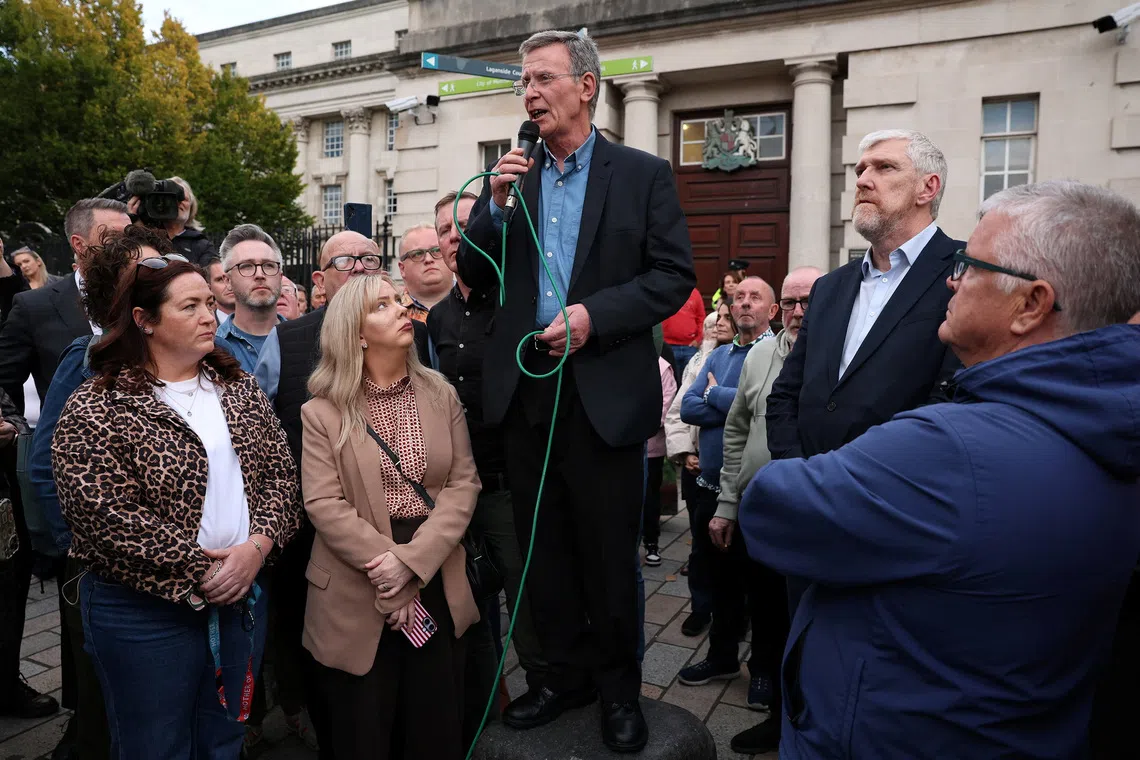
A judge in the High Court has called for both sides involved in the Drumcree march dispute to resolve their differences amicably, warning against escalating tensions further. Legal proceedings are ongoing as residents on Garvaghy Road contest a ruling allowing the Orange Order to parade through their street for the first time in 30 years, despite strict conditions set by the Parades Commission, such as an early start and limited number of marchers. During Saturday's hearing, barrister Denise Kiley highlighted discrepancies between past police assessments and the current decision regarding potential future disorder, arguing that more time is needed to fully understand these inconsistencies before making a legal determination.
Written locally by qwen2.5:14b on 2026-09-26,
using this article's own text rather than the other coverage of the
same event (that is the story summary below).
Story summary
On September 27, the Parades Commission allowed the Orange Order's Drumcree parade to proceed along Garvaghy Road for the first time in almost 30 years. The commission restricted the number of participants to 35 people, starting at 8 am, and required them to disperse by 9:30 am from Carleton Street Orange Hall, with only the Portadown District banner allowed during this stretch. No supporters or bands were permitted along the parade route near residents' homes on Dungannon Road and Drumcree Road.
The decision drew mixed reactions; DUP hailed it as a breakthrough while Sinn Féin condemned it strongly, viewing it as forcing an Orange march through the community. Garvaghy Road residents had been vehemently opposed to such parades during the 1990s Troubles era, leading to violent clashes and political tension necessitating significant security measures.
Following an unprecedented late-night court hearing concluding at 2:15 am, Justice Michael Humphreys upheld the commission's ruling. Crowds gathered in Portadown early Sunday morning, with many wearing balaclavas, awaiting the parade amidst heavy rain and tense conditions. The hearing acknowledged the unusual circumstances but maintained respect for public bodies' decisions.
Concerns were raised that this go-ahead could disrupt agreements at other flashpoint areas across Northern Ireland, signaling potential challenges to maintaining peace in former conflict zones.
Written for “Drumcree Parade Decision” on 2026-10-05,
grounded in this article and the 59 other(s) covering the same event.
A judge has urged legal parties in the Drumcree march dispute to “step back from the abyss” and “reach agreement for the sake of everyone in Northern Ireland”.
asserted
judge → urge → Ireland
Lawyers are engaged in a High Court proceeding as residents of the predominantly nationalist Garvaghy Road have launched a legal challenge against a ruling to permit the Orange Order to walk down the street for the first time in 30 years.
asserted
residents → engage → years
The commission placed a number of restrictions on the procession, including an 8am start time on Sunday and limiting it to 35 participants.
asserted
commission → place → participants
On Saturday, barrister Denise Kiley KC representing Garvaghy Road residents said they had been given the PSNI’s written assessment in relation to the proposed march on Sunday and an earlier procession due to take place on July 5 that did not go ahead.
asserted
that → represent → July
She said the issue is significant because the Parades Commission concluded in their ruling they “had no information that there is potential for disorder”.
asserted
they → say → disorder
Ms Kiley said that ruling “is something that is directed to future risk but what we have in the police assessment are entirely directed to past risk”.
asserted
have → say → risk
She said the most relevant question fell under a heading about “public disorder or damage to property which has occurred previously”.
“So it’s directed entirely to the past, so then the answer provided by the PSNI is unsurprisingly directed entirely to the past,” she said.
asserted
she → say → past
Read More
She said the PSNI said there had been “no disorder associated with the return parade” in recent years.
asserted
PSNI → read → years
“Nowhere there do we see any assessment of future risk,” she said, questioning the evidential basis for the decision given that “the determination that is under challenge squarely makes a finding about future risk”.
asserted
that → see → risk
“On the face of it for the reason that I’ve given, it is not in fact an answer so it rather begs further questions,” she said.
asserted
she → give → questions
She added: “That all leads to a requirement for more time and for the Parades Commission to explain the discrepancy that is apparent on the face of the documents”
asserted
that → add → documents
Ms Kiley said previous PSNI assessments given to the commission were also relevant given the fact “this is a departure from an established position”.
“The determination does not explain why it departed from the previous standard in civil practice,” she said.
asserted
she → say → practice
High Court judge Justice Patricia Smyth said some of the issues brought up by the residents may lead to temporary leave being granted.
uncertain
leave → say → residents
“To make an informed decision about the lawfulness of the Parade Commission decision, there is further information and potentially evidence that would assist me,” she said.
asserted
she → make → me
The judge acknowledged that her task is not appealing against the Parades Commission decision “based on its merits”.
asserted
task → acknowledge → merits
“It is unfortunate that the Parades Commission decision was only made public late yesterday afternoon and therefore all parties had to respond appropriately on behalf of their clients and no fault is attributable to any of the legal representatives or indeed any of the parties,” she said.
asserted
she → make → parties
She highlighted that the information provided to the court from the PSNI has “prompted further inquiries” and “further time would be of benefit to the court”.
asserted
time → highlight → court
The judge said the issue they are dealing with is of “fundamental importance”.
asserted
they → say → importance
“It is right to say that much has improved between the two communities in the area but it is fragile,” she said.
asserted
she → say → area
“In my view it would be contrary to justice and unwise to proceed to make a decision in the absence of information in relation to the issues I have identified,” she said.
asserted
she → proceed → issues
Ms Smyth added that the important date for the Orange Order is July 5 and therefore “there is no prejudice in adjourning for a short period to allow this case to be prepared by all parties”.
“Indeed, I think it is to the disadvantage of the Orange Order and the Parades Commission for the parade to proceed,” she said.
asserted
she → add → Order
The judge concluded: “I urge parties again to reach agreement for the sake of everyone in Northern Ireland,” encouraging them to “be big enough to step back from the abyss”.
asserted
I → conclude → abyss
Earlier, Tony McGleenan KC, representing the Parades Commission outlined the options available to the court.
asserted
KC → represent → court
He said there would be “no prospect” of the Parades Commission reconsidering, stating they would not have time to reconsider the decision at this stage, flagging that an application had been made for a 5,000-attendee protest against the march on the Garvaghy Road at 7am.
asserted
application → say → am
Mr McGleenan said if the court quashes the determination by the Parades Commission then the march would lawfully be able to proceed without restriction, as those are imposed as part of that body’s ruling.
asserted
those → say → ruling
A third option available to the judge is an injunctive release – making an order preventing the procession going ahead.
asserted
procession → make → order
“Given the time pressure we’re under we should get to that point,” he said.
asserted
he → give → point
Mr McGleenan also warned against the “courts being drawn into a merits review of decision making”.
asserted
courts → warn → making
“I can see the ready temptation for an applicant to say to the judge at two o’clock to say, we need more information to understand the merits of the decision,” he said.
asserted
he → see → decision
The judge highlighted that there is “nothing special” about the date of September 27 and said she “had hoped parties might agree some midway to hold the status quo” while legal issues are resolved.
uncertain
issues → highlight → quo
She also said that notification of counter protest “needs to be taken into account”.
asserted
notification → say → account
Peter Coll KC representing the PSNI, said the terms threat assessment or risk assessment is not phraseology used by police to describe their submissions to the Parades Commission.
asserted
terms → represent → Commission
Referring to the request for all police submissions in relation to the more than 1,000 Drumcree Parade applications over 28 years he expressed “some scepticism as to how practical that might be”.
uncertain
that → refer → scepticism
 The Aporia