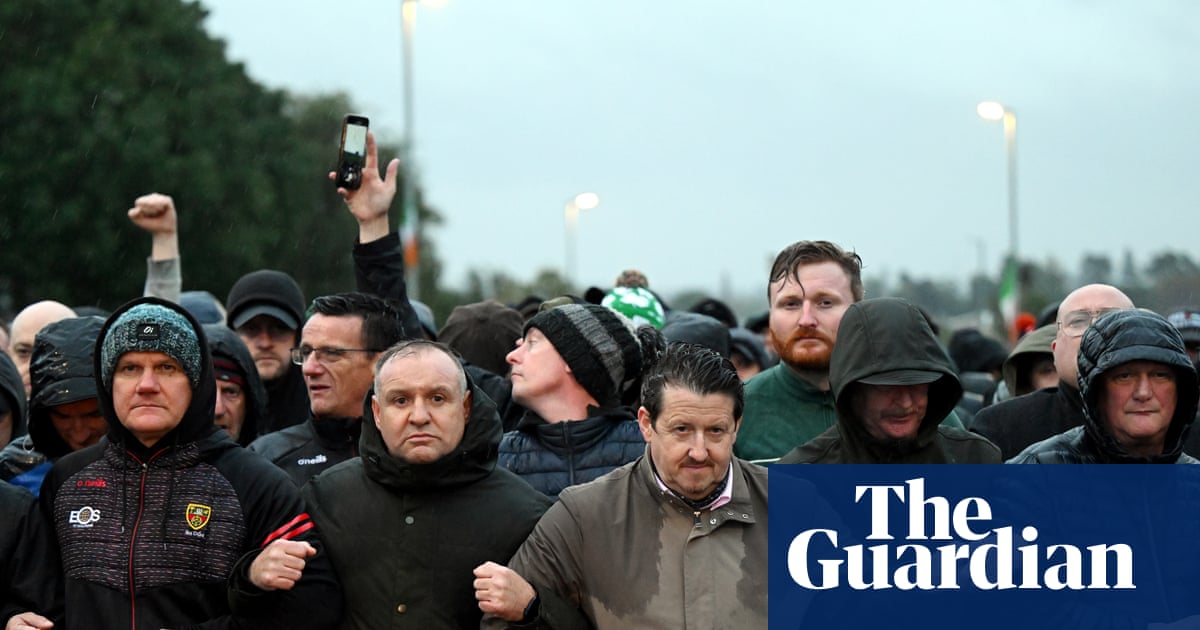
A Belfast high court judge has temporarily halted a planned Orange Order march through Garvaghy Road in Portadown, amid fears it could trigger sectarian violence. Justice Smyth issued an injunction after a five-hour hearing on Saturday, suspending the parade scheduled for Sunday morning and revoking previous approvals by the Parades Commission. The decision comes following 28 years of banned parades due to past clashes. Despite urging both sides to reach a voluntary agreement, the judge ruled that mistrust between the Loyalist Orange Order and local residents remains too high, necessitating further judicial review later this week.
Written locally by qwen2.5:14b on 2026-09-26,
using this article's own text rather than the other coverage of the
same event (that is the story summary below).
Story summary
On September 27, the Parades Commission allowed the Orange Order's Drumcree parade to proceed along Garvaghy Road for the first time in almost 30 years. The commission restricted the number of participants to 35 people, starting at 8 am, and required them to disperse by 9:30 am from Carleton Street Orange Hall, with only the Portadown District banner allowed during this stretch. No supporters or bands were permitted along the parade route near residents' homes on Dungannon Road and Drumcree Road.
The decision drew mixed reactions; DUP hailed it as a breakthrough while Sinn Féin condemned it strongly, viewing it as forcing an Orange march through the community. Garvaghy Road residents had been vehemently opposed to such parades during the 1990s Troubles era, leading to violent clashes and political tension necessitating significant security measures.
Following an unprecedented late-night court hearing concluding at 2:15 am, Justice Michael Humphreys upheld the commission's ruling. Crowds gathered in Portadown early Sunday morning, with many wearing balaclavas, awaiting the parade amidst heavy rain and tense conditions. The hearing acknowledged the unusual circumstances but maintained respect for public bodies' decisions.
Concerns were raised that this go-ahead could disrupt agreements at other flashpoint areas across Northern Ireland, signaling potential challenges to maintaining peace in former conflict zones.
Written for “Drumcree Parade Decision” on 2026-10-05,
grounded in this article and the 59 other(s) covering the same event.
A controversial loyalist parade down a nationalist street in Portadown has been temporarily injuncted after a high court judge urged all sides to “step back from the abyss” and take responsible decisions for “the sake of everyone in Northern Ireland”.
asserted
judge → injuncte → Ireland
The ruling was made amid rising fears that a parade could unleash fresh sectarian violence.
uncertain
parade → make → violence
After a five-hour hearing at a special sitting of the high court, Justice Smyth issued an order temporarily suspending the parade, which was due to take place at 8am on Sunday, until a judicial review application can be fully heard.
asserted
application → issue → Sunday
She has also suspended the determination by the Parades Commission on Friday that the event could take place, albeit with restrictions on numbers.
uncertain
event → suspend → numbers
However tensions remain with an appeal against her decision by loyalists to be heard at a second special hearing on Saturday night.
asserted
tensions → remain → night
Smyth arrived at her conclusions after several attempts to coax the parties, the Loyalist Orange Order and the Garvaghy Road Residents Coalition, to reach a voluntary agreement.
asserted
Smyth → arrive → agreement
After it was clear that was not possible, she said: “The level of mistrust between residents and Portadown Loyalist Lodge cannot be overstated.
asserted
level → say → residents
Neither side accepts any of the reassurances of the other.”
asserted
side → accept → other
The march down Garvaghy Road has been banned for 28 years due to widespread sectarian violence in 1998 outside Drumcree church.
asserted
march → ban → church
“It is also clear to me that this particular long-running dispute has the potential to escalate within Northern Ireland,” she said.
asserted
she → run → Ireland
The court was sitting on Saturday following a last-minute legal challenge by the Garvaghy Road Residents Coalition.
asserted
court → sit → Coalition
Smyth urged parties to reach a voluntary agreement to delay the march, given few had time to digest the reasoning behind the Commission’s decision.
asserted
few → urge → decision
It was important “to reach an agreement for the sake of everyone in Northern Ireland, not just for your sake” to have the issues “properly aired” so that “everybody knows they’ve had a fair hearing”.
asserted
they → reach → hearing
“Be big enough to step back from the abyss,” she told the parties in court.
asserted
she → step → court
This followed a high court ruling quashing the restrictions of the annual parade route.
asserted
This → follow → route
The Portadown loyalist Orange Lodge was not represented at the hearing.
asserted
loyalist → represent → hearing
But after a request from the judge for its view through the individual who had sought permission for the parade, the lodge made it clear it would not agree to suspending the procession.
asserted
it → seek → procession
Fears of clashes increased on Saturday after a request to the Commission for permission for a countermarch, a protest that, it was estimated, could be attended by up to 5,000 people, the court heard.
uncertain
court → increase → people
That was later revised to 300.
asserted
That → revise → 300
On Friday night, the British prime minister, Andy Burnham, appealed to leaders to “work calmly” through the weekend while the Northern Ireland secretary, Chris Bryant, called for “cool heads”, saying Northern Ireland had “withstood many moments of sharp disagreement over the years” and must do so again.
asserted
Ireland → appeal → years
Before her ruling, Smyth asked the parties in court, including the Police Service of Northern Ireland (PSNI) and the Parades Commission, to “consider carefully the very important issues to our society” raised in this case, and the importance that they were dealt with properly given the “importance of this case to community relations”.
asserted
they → ask → relations
She also noted that the issues of judicial review were of “such fundamental importance” that it could be unwise to hold a full hearing without all the facts.
uncertain
it → note → facts
Democratic Unionist MP Carla Lockhart insisted nationalist residents on the road had “nothing to fear” from the march on Sunday, but Sinn Féin leader Mary Lou McDonald described the decision as “utterly reckless”.
asserted
McDonald → insist → decision
The Parades Commission has placed a number of restrictions on the procession, including an 8am start and limiting the number of participants to 35 people, but not placing any restrictions on the route.
asserted
Commission → place → route
 The Aporia