Story summary
On September 27, the Parades Commission allowed the Orange Order's Drumcree parade to proceed along Garvaghy Road for the first time in almost 30 years. The commission restricted the number of participants to 35 people, starting at 8 am, and required them to disperse by 9:30 am from Carleton Street Orange Hall, with only the Portadown District banner allowed during this stretch. No supporters or bands were permitted along the parade route near residents' homes on Dungannon Road and Drumcree Road.
The decision drew mixed reactions; DUP hailed it as a breakthrough while Sinn Féin condemned it strongly, viewing it as forcing an Orange march through the community. Garvaghy Road residents had been vehemently opposed to such parades during the 1990s Troubles era, leading to violent clashes and political tension necessitating significant security measures.
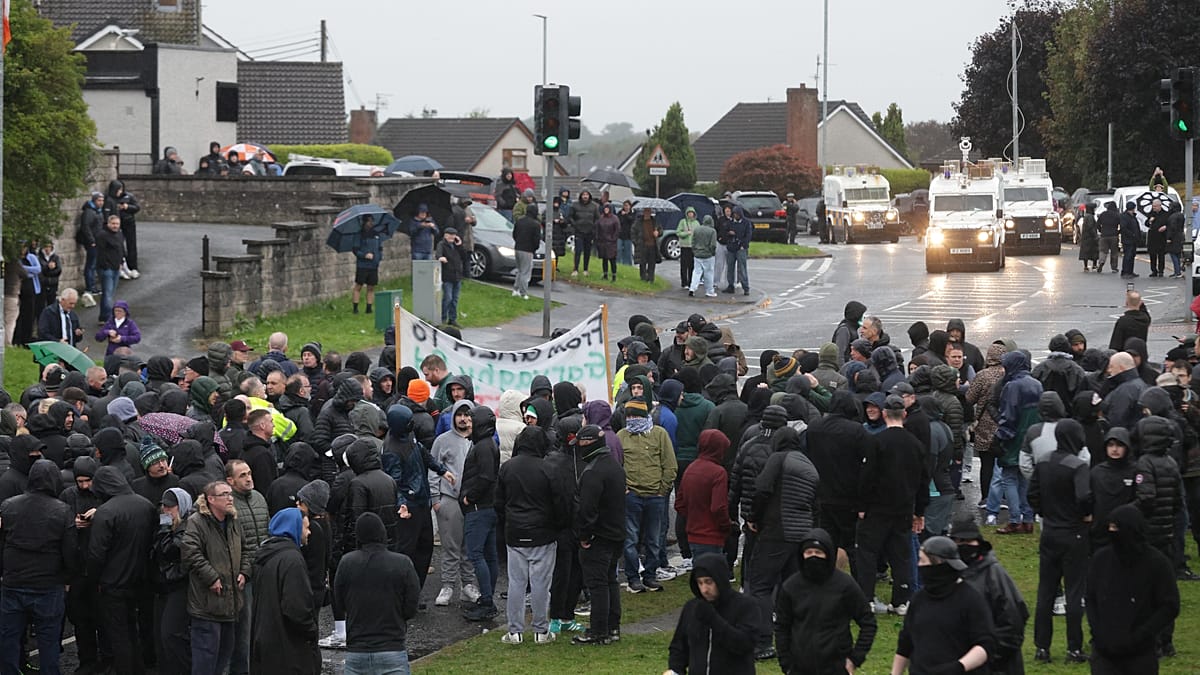
Following an unprecedented late-night court hearing concluding at 2:15 am, Justice Michael Humphreys upheld the commission's ruling. Crowds gathered in Portadown early Sunday morning, with many wearing balaclavas, awaiting the parade amidst heavy rain and tense conditions. The hearing acknowledged the unusual circumstances but maintained respect for public bodies' decisions.
Concerns were raised that this go-ahead could disrupt agreements at other flashpoint areas across Northern Ireland, signaling potential challenges to maintaining peace in former conflict zones.
Written for “Drumcree Parade Decision” on 2026-10-05,
grounded in this article and the 59 other(s) covering the same event.
- Published
The police prevented the Orange Order from making a controversial parade down a road which had previously been blocked by protesters.
asserted
which → publish → protesters
A group of men tried to march from Drumcree Church down the Garvaghy Road in Portadown in the early hours of Monday but a line of police Land Rovers stood in the way.
asserted
line → try → way
They had been unable to make the permitted parade on Sunday morning because protesters had gathered on the mainly-nationalist Garvaghy Road.
asserted
protesters → make → Road
The stand-off continued throughout Sunday, with the Orangemen waiting at the church, around a mile from the road, for the go-ahead from police.
asserted
off → continue → police
Sinn Féin First Minister Michelle O'Neill joined the protest, prompting Democratic Unionist Party (DUP) leader Gavin Robinson to accuse her of acting unlawfully.
asserted
O'Neill → join → her
Northern Ireland Secretary Sir Chris Bryant called for "compromise".
asserted
Bryant → call → compromise
Breandán Mac Cionnaith, from the Garvaghy Road Residents Coalition, said he was meeting the secretary of state and chief constable on Monday and that he would not prejudge those conversations
What happened on Sunday?
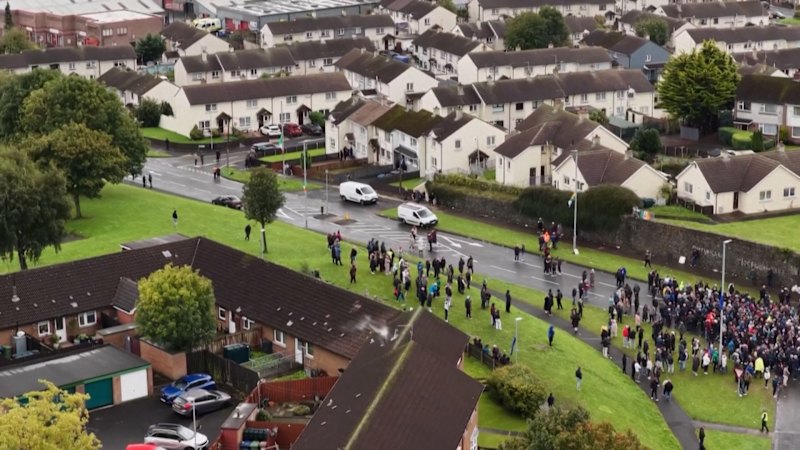
Protesters started gathering on the Garvaghy Road in the early hours of Sunday, after the final court decision.
asserted
Protesters → say → decision
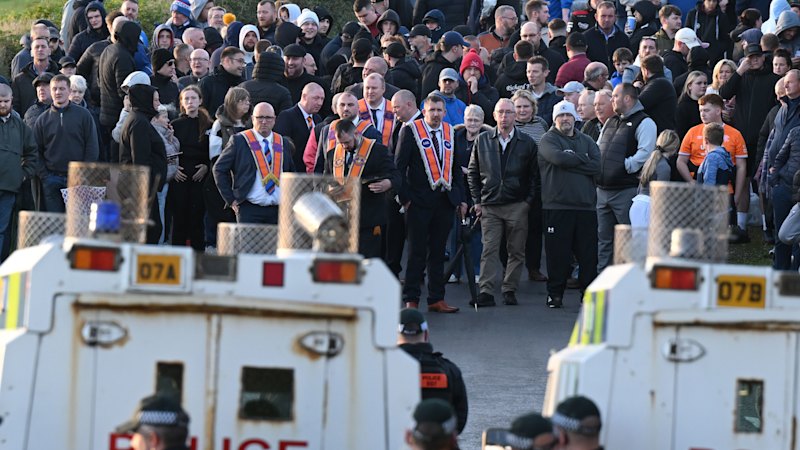
Dozens of armoured police vehicles arrived in the town, calling on them to clear the route while members of the Portadown District Lodge waited in a hall at Drumcree Parish Church.
asserted
members → arrive → Church
At one point Orangemen began walking down Drumcree Road before stopping and turning back.
asserted
Orangemen → begin → Road
On Sunday evening, a large group of people joined the Orange Order, and police blocked the road with Land Rovers.
asserted
police → join → Rovers
The Orange Order was warned that they were breaking the terms of the determination by having more than 35 people here, but loyalist activists argued they had not asked for a crowd.
asserted
they → warn → crowd
How did we get here?
asserted
we → get → ?
The Orange Order, the most prominent of the loyal orders associated with Protestants in Northern Ireland, holds thousands of parades every year and the vast majority pass off without incident.
asserted
majority → associate → incident
However, many Catholics see the marches as sectarian and object to them passing through, or close to, Catholic or nationalist areas.
asserted
them → see → marches
The Garvaghy Road had been part of the Drumcree route, but by the mid 1990s nationalist residents protested against the parade.
asserted
residents → protest → parade
The row sparked some of the most serious public disorder in Northern Ireland's history and was linked to several murders.
asserted
row → spark → murders
The row reemerged after a court case in which a ruling by the Parades Commission - the organisation formed during the Drumcree dispute to decide on contentious marches during Northern Ireland's parading season - was overturned.
asserted
ruling → reemerge → season
On Friday, following 28 years of unsuccessful applications, the commission decided the march could go ahead with restrictions in place.
uncertain
restrictions → follow → place
Rather than start at 13:00 on Sunday as intended, the commission said it could begin no later than 08:00 and with 35 participants rather than the 60 the Orange Order requested.
However that decision was challenged in several Belfast courts on Saturday, before finally being given the go ahead just hours before it was due to take place.
uncertain
it → start → place
For most of Sunday, police maintained a sterile zone between the two sides, while officers repeatedly called on protesters to disperse.
asserted
officers → maintain → protesters
At Garvaghy Road, protesters were joined by members the Social Democratic Labour Party (SDLP) and Sinn Féin, with First Minister Michelle O'Neill urging the crowd to "stay the course" to "at least" midnight.
asserted
O'Neill → join → midnight
Meanwhile other political leaders engaged with the Northern Ireland Secretary.
asserted
leaders → engage → Secretary
Sir Chris Bryant, who returned from the Labour Party conference for talks, urged both sides to "double down on compromise" and said "nobody should be attending an unlawful protest".
asserted
nobody → return → protest
However, he added, it was not his job "to decide whether somebody has or hasn't broken the law".
asserted
somebody → add → law
Earlier, the first minister said the decision to permit the march "brings into question how the peace process works".
asserted
process → say → question
DUP leader Gavin Robinson accused O'Neill and other Sinn Féin politicians at the protest of being "lawmakers acting as lawbreakers".
asserted
Robinson → accuse → lawbreakers
After meeting Sir Chris at Hillsborough Castle, Robinson said the stakes for Stormont were high and "could get higher" if the Orange Order was unable to complete the parade, and there needed to be consequences for politicians he accused of breaking the law.
uncertain
he → meet → law
His party colleague, Carla Lockhart MP, warned of "profound" consequences if the Parade Commission's determination was not upheld.
SDLP leader Claire Hanna, who also attended the protest, called for de-escalation and said: "Whatever the legalities, it was never politically right or morally right to do this."
Following talks at Hillsborough, her party called for an international mediator to help resolve the dispute, with Sir Chris saying he is "giving consideration to anything that anybody comes up with".
asserted
anybody → warn → that
He said he is determined to keep on working and talking with people, but added that "we haven't got a solution yet".
asserted
we → say → solution
Also speaking after the meeting, UUP leader Jon Burrows said the rule of law needed to apply to "everyone", and that Stormont has been "put under threat".
asserted
Stormont → speak → threat
"It is vital that everyone obeys the law.
asserted
everyone → obey → law
I don't care who that is.
asserted
that → care → ?
I don't care how senior you are.
asserted
you → care → ?
The law applies to everyone.
asserted
law → apply → everyone
It cannot be enforced basically on the basis of it might be politically inconvenient," he added.
uncertain
he → enforce → basis
Justice Minister Naomi Long described the stand-off as an "entirely avoidable conflict" and said politicians risked delivering "misery" to the people of Northern Ireland.
asserted
politicians → describe → Ireland
The police operation continued throughout most of Sunday, with Police Service of Northern Ireland Chief Constable Jon Boutcher telling reporters that officers had been gathering evidence from the outset.
"So whatever's been happening, by whatever party, we've been gathering the evidence of what they've been doing," he said.
asserted
he → continue → what
"So we'll deal with that at the right time."
asserted
we → deal → time
Jon Boutcher said he had wanted a "sensible and peaceful conclusion" and hoped everyone involved could find "a place that they can, with dignity, walk away from the current situation".
uncertain
they → say → situation
He said success would mean "not one hair on one head gets harmed".
asserted
hair → say → head
…and 5 more, not listed.
 The Aporia