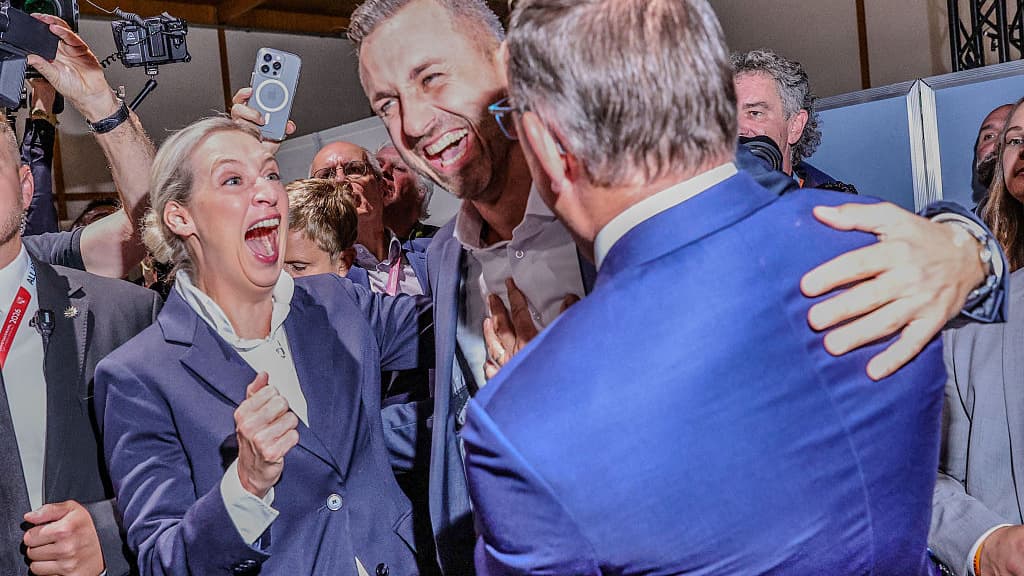
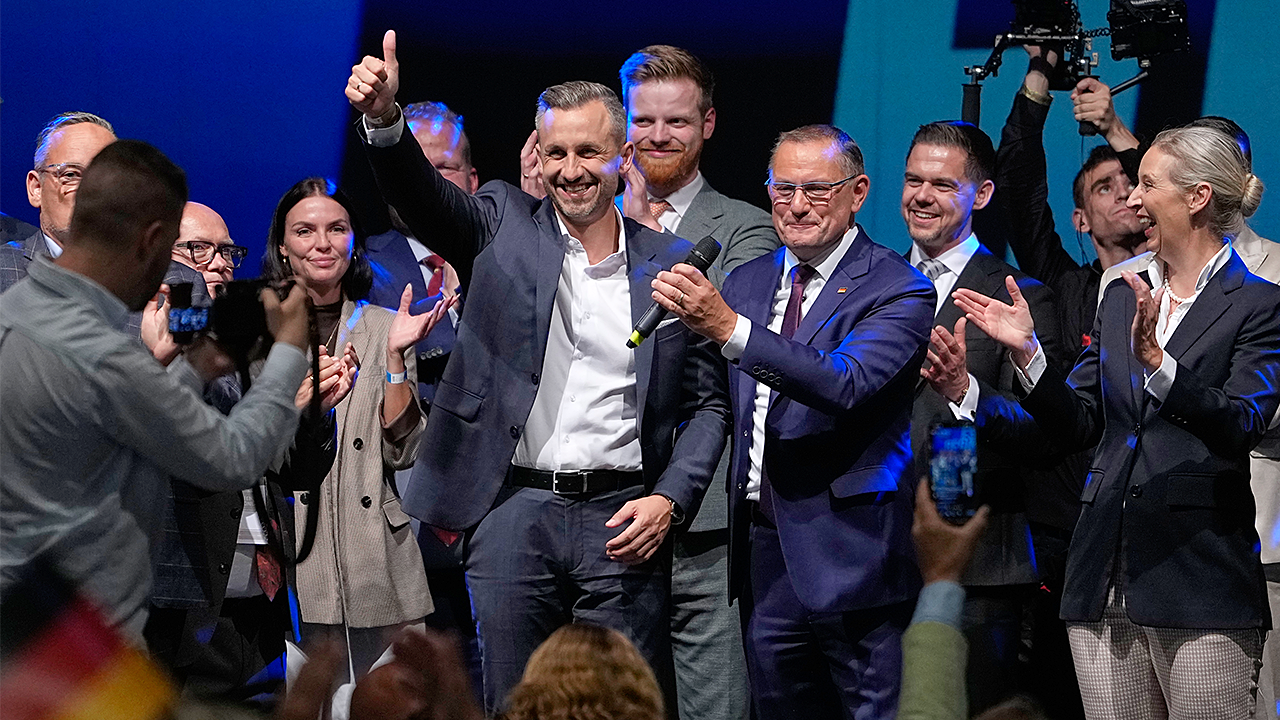
The populist, far-right, anti-immigration Alternative für Deutschland (AfD) has surged to a resounding victory in a crucial state election in Germany, but fell just short of winning a majority in its quest to form the country’s first far-right state government since the second world war.
asserted
Alternative → surge → war
The party of Germany’s unpopular chancellor Friedrich Merz, the Christian Democrats (CDU), slumped to a disastrous result in the eastern state of Saxony-Anhalt.
asserted
party → slump → Anhalt
AfD’s candidate for governor, Ulrich Siegmund, said “we have written history” and the party had a clear mandate to govern.
asserted
party → say → mandate
He told public broadcaster ARD that voters had sent a signal that “things cannot carry on like this”.
asserted
things → tell → this
“A very good campaigner for us in this election campaign was Friedrich Merz,” Siegmund said.
asserted
Siegmund → say → campaign
AfD was seeking an absolute majority in the state legislature to govern alone and overcome the so-called firewall of mainstream parties’ refusal to work with the party.
asserted
AfD → seek → party
AfD in Saxony-Anhalt has been classed as “rightwing extremist” by Germany’s domestic intelligence agency.
asserted
AfD → class → agency
Final results showed AfD falling three seats short, with 39 lawmakers in an 83-member parliament.
asserted
AfD → show → parliament
Siegmund, 35, said it would not engage in “games” such as a minority government.
asserted
it → say → government
But it was not evident how its divided opponents could assemble any stable government without it.
uncertain
opponents → divide → it
AfD won 43.8% of the vote, more than double its showing five years ago in the region of 2.1 million people west of Berlin.
asserted
AfD → win → Berlin
That was far ahead of Merz’s CDU , which polled 17.2% – losing about half its support – and won 15 seats.
asserted
which → poll → seats
The centre-left Social Democrats polled 9.3%, the Greens 8.9% and the Left party 8.6%, winning eight seats apiece.
asserted
party → poll → seats
The BSW party, which has said it would not elect either Siegmund or incumbent Sven Schulze as governor but criticises the “firewall” against AfD, took 5.3% and five seats.
asserted
it → say → %
Addressing jubilant supporters after exit polls had been published, Siegmund said his party was ready to reach out to all powers that strove for political change.
asserted
that → address → change
“We extend a hand to all democratic forces that wish to pursue better policies,” he said, adding that themes such as migration and domestic security were not up for debate.
asserted
themes → extend → debate
The CDU described its result as “bitter” but said it would not back down from its refusal to rule together with AfD, which the far-right party has also ruled out.
asserted
party → describe → which
Franziska Hoppermann, general secretary of the CDU, called it a “defeat overall” for the Christian Democrats.
asserted
Hoppermann → call → Democrats
“And it is also a defeat for all those who have borne responsibility in the democracy in Saxony-Anhalt over the past 35 years,” she added, in reference to the difficult post-communist era.
asserted
she → bear → era
She ruled out any discussion over Merz’s future, which analysts have suggested will increasingly become a topic of debate after his party’s defeat.
uncertain
analysts → rule → defeat
In one recent poll, only 9% of voters in Saxony-Anhalt said they were satisfied with Merz’s politics.
asserted
they → say → politics
Alice Weidel, AfD’s co-leader, said the result gave her party a “clear government mandate” and that it would “talk to all the parties” to work out a strategy as to how AfD could rule.
uncertain
AfD → say → strategy
About 1.7 million people were eligible to vote in the east-central state.
asserted
people → vote → state
Final polls had shown AfD to have about 40-41% of support, and the party appears to have almost doubled its 2021 result of 23.7%.
asserted
party → show → %
The number of undecided voters in advance of the vote was much lower than at previous elections, polling showed.
asserted
polling → show → elections
The small state has been governed since 2002 by Merz’s conservative CDU, together with two smaller parties.
asserted
state → govern → parties
The Saxony-Anhalt election had been seen as the biggest test yet for Merz, who is very unpopular, along with his government, a coalition with the SPD.
asserted
who → see → SPD
Merz has thus far failed in his promises to reset Germany’s struggling economy or stop the rise of the AfD, which has been making regular and steady gains since it entered parliament in 2017 and is now the Bundestag’s leading opposition party.
asserted
it → fail → 2017
Irregular immigration has reduced since Merz has been in office, but not to an extent that has appeased the average voter.
asserted
that → reduce → voter
In national polls, the CDU has also been overtaken by the AfD, which has its eyes on victory at the next federal elections in 2029 or 2033.
asserted
which → overtake → 2029
If the AfD manages to form a government in Saxony-Anhalt, Siegmund has promised to immediately start a remigration and deportation offensive, ban rainbow flags in schools and halt the building of new windfarms.
asserted
Siegmund → manage → windfarms
He wants to change the slogan of the state from “Think Modern” to “Think German”, and to reintroduce the singing of the German national anthem in schools.
asserted
He → want → schools
Siegmund also sought in the campaign to capitalise on a mood of “ostalgie”, or nostalgia for communist East Germany, and to tap into discontent among east Germans.
asserted
Siegmund → seek → Germans
He has made repeated references to a rise in foreigner-related crime, even as the crime rate has fallen dramatically.
asserted
rate → make → crime
AfD is pro-Kremlin, urging a stop to support for Ukraine and pushing for Ukrainians to no longer receive refugee status.
asserted
Ukrainians → urge → status
Siegmund turned up to vote on Sunday morning with his wife, riding an East German-era moped in the party colours, which was also a prominent prop during the election campaign in rallies across the state.
asserted
which → turn → state
In a statement in front of the polling station, he voiced his optimism that the party would achieve “45%, and some”, and saying he wanted to “build bridges”.
asserted
he → voice → bridges
Tensions before the election were high, with a considerable police presence and a number of demonstrations taking place across the state.
asserted
presence → take → state
Thousands of opponents of the AfD gathered in the state capital, Magdeburg, on Saturday, for a “festival of democracy”.
asserted
Thousands → gather → democracy
On Saturday evening, a message beamed on to the facade of Magdeburg Cathedral read: “We do not abandon what we love.
asserted
we → beam → what
…and 8 more, not listed.
 The Aporia