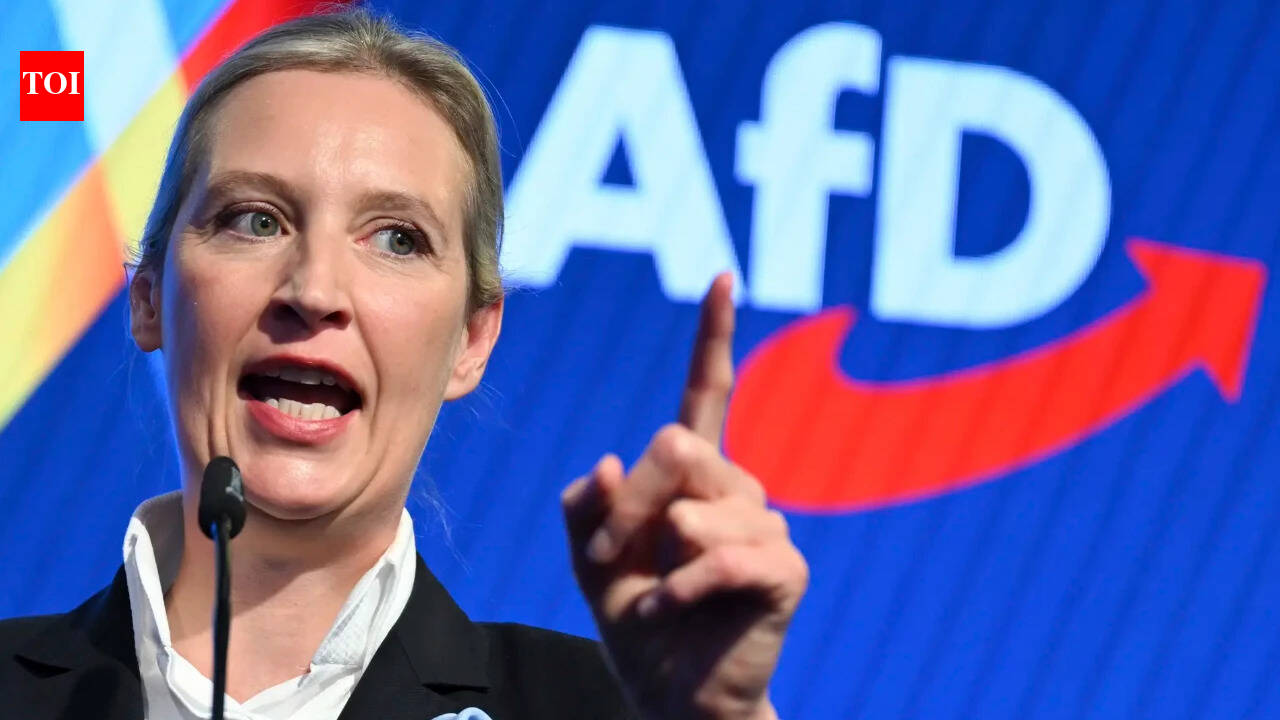
The right-wing Alternative for Germany (AfD) party won a historic victory in the Saxony-Anhalt state election on Sunday, securing 44.5% of the vote and leaving Chancellor Friedrich Merz's Christian Democratic Union party with 18.5%. The AfD's co-leader Alice Weidel predicted "explosive growth" for her party across East Germany and at the federal level. According to projections, the AfD would win between 39 and 41 seats in the state parliament, but would still be short of an absolute majority. The election result is seen as a vote of no confidence in the federal government by Marcel Fratzscher, president of the German Institute for Economic Research.
Written by the local model on 2026-09-07,
using this article's own text rather than the other coverage of the
same event (that is the story summary below).
Story summary
In a closely watched regional election, Germany's far-right Alternative for Germany (AfD) party is poised to gain power in the eastern state of Saxony-Anhalt. The AfD is expected to secure at least 44% of the vote, more than double its showing five years ago, according to exit polls. This would give the party a significant majority and potentially mark the first time a far-right party has held state-level power in Germany since World War II.
The AfD's rise to prominence is seen as a threat to mainstream parties, including Chancellor Friedrich Merz's Christian Democratic Union (CDU), which is currently leading the state. The party's success is attributed to its promise to restrict immigration and restore ties with Russia, as well as its charismatic leader, Ulrich Siegmund.
A victory for the AfD in Saxony-Anhalt would be a significant milestone for the party, which has been gaining momentum in recent years. It could also have broader implications for German politics, potentially leading to a shift towards a harder line on immigration and European integration.
Experts warn that an AfD government could lead to significant changes in areas such as education and foreign policy, including creating separate classrooms for refugees and promoting a patriotism agenda that focuses less on the country's Nazi past. The party has also been accused of adopting tactics inspired by President Trump, including casting doubt on the integrity of absentee voting.
The outcome of the election is still uncertain, but it is clear that the AfD's rise to power would be a historic event with significant implications for Germany and Europe.
Written for “Far-Right Party's Rise in Germany” on 2026-09-07,
grounded in this article and the 41 other(s) covering the same event.
Why this leaning score
The model judged this article politically coded and scored it +0.35, but none of the 2 quote(s) it offered could be found in the article text, so the score is not published.
Written under an earlier scoring contract, which gave a paragraph
rather than checkable quotes. Re-analysing this article replaces it.
Leaning score withheld for article 6170: no verified evidence · logged 2026-09-07
A right-wing German party scored a historic victory in a state election Sunday, dealing a blow to Chancellor Friedrich Merz’s conservative Christian Democratic Union party.
asserted
party → score → party
Exit polls in the Saxony-Anhalt state election saw Alternative for Germany — an “extremist” party backed by Elon Musk — secure 44.5% of the vote for its candidates, with Merz’s CDU party only netting 18.5%, the ARD broadcaster reported.
asserted
broadcaster → see → %
The right-wing party’s co-leader, Alice Weidel, hailed the turnout as a “historic” result for her group as she vowed that Merz’s party would never win another election again.
“We are going to see explosive growth across all of East Germany — and at the federal level, too,” she told public broadcaster ZDF.
asserted
she → hail → ZDF
But the national general-secretary of Merz’s party, Franziska Hoppermann, was defiant in opposing the strengthening party.
asserted
secretary → oppose → party
It wants to leave the euro; that would be economic downfall. …
asserted
that → want → euro
It works closely together with Russia, it wants a completely different social model,” Hoppermann said.
asserted
Hoppermann → work → model
“We will not work with them.”
asserted
We → work → them
Either way, Marcel Fratzscher, president of the German Institute for Economic Research, told Reuters, “This election result is, above all, a vote of no confidence in the federal government.”
asserted
result → tell → government
The AfD is pro-Russia and anti-migration and supports such thing as the banning of rainbow flags in schools.
asserted
AfD → support → schools
Still it remains to be seen if the party will be able to create its own government in the state, as most other parties have ruled out joining an AfD-led coalition.
asserted
parties → remain → coalition
Projections of Sunday’s election suggest the AfD would win between 39 and 41 seats of Saxony-Anhalt’s 82-seat state parliament
That still leaves the AfD just short of absolute majority, although much further ahead of other parties.
The left-wing populist Sahra Wagenknecht Alliance (BSW), a potential AfD coalition partner, could make AfD governance possible if it clears the threshold to grab a seat.
uncertain
it → suggest → seat
The right-wing party remains a controversial group in Germany, with the country’s domestic intelligence service dubbing the group as “right-wing extremist,” a classification that the AfD rejects.
asserted
AfD → remain → that
No right-wing party has ever won control of a single German state since World War II.
asserted
party → win → II
Voter turnout in Saxony-Anhalt was particularly high at an estimated 78%.
asserted
turnout → estimate → %
Saxony-Anhalt has the sixth smallest population in the country at just 2.1 million people, with only 7.9% identifying as foreigners, among the smallest percentages in all of Germany, according to national data.
uncertain
% → have → data