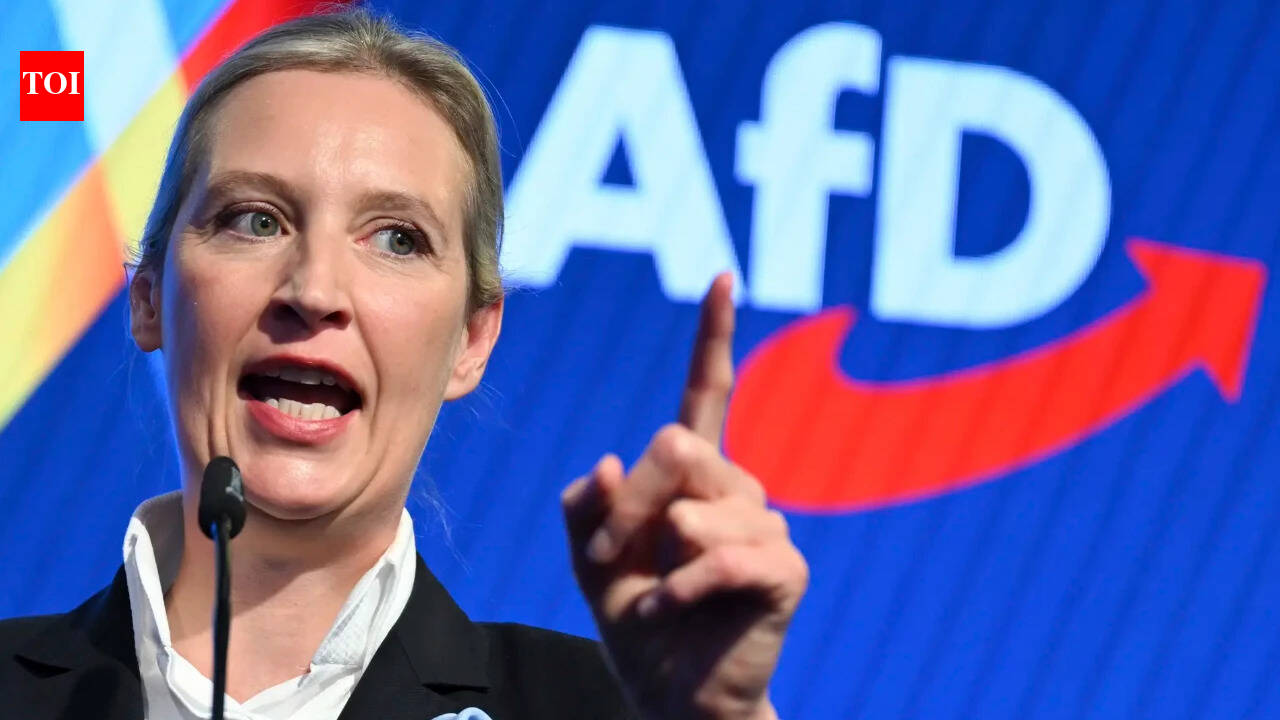
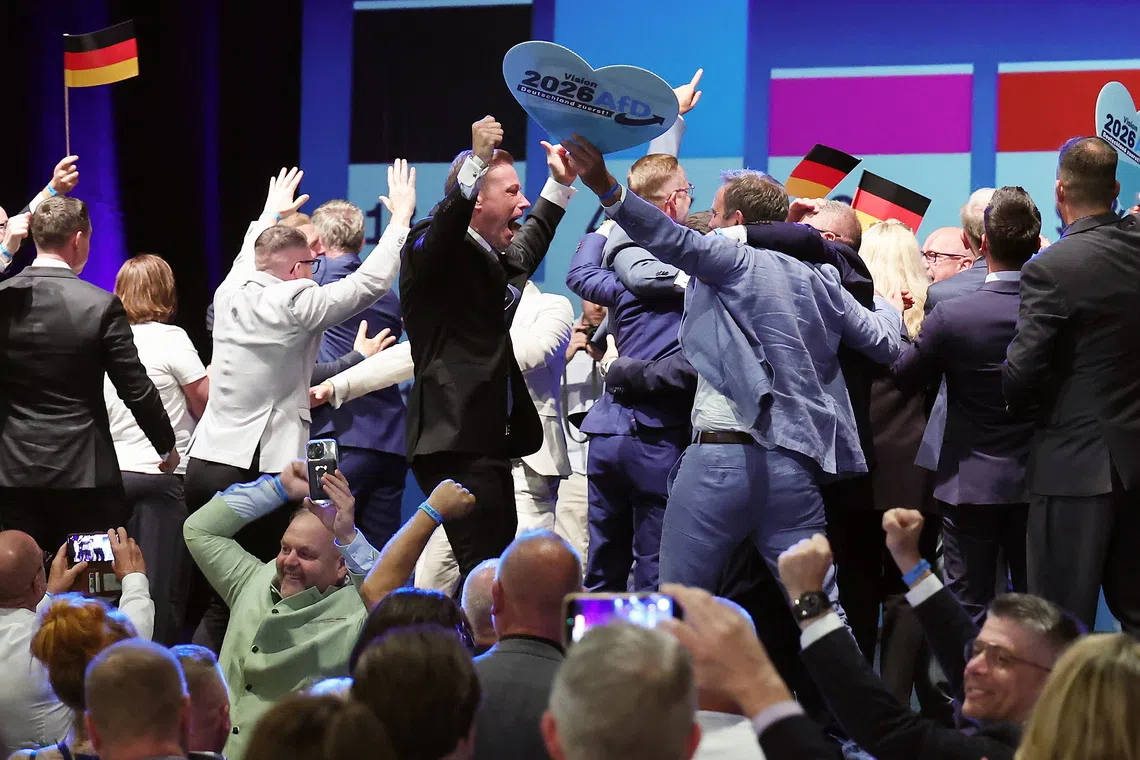
Voting began in Saxony-Anhalt on Sunday in a closely watched state election that could see Germany's far-right Alternative for Germany (AfD) make history by becoming the first far-right party to take power at state level since World War Two, with the party's 35-year-old lead candidate Ulrich Siegmund declaring its rise "can no longer be stopped".
uncertain
rise → begin → War
Around 1.7 million voters in the eastern German state have until 6pm (1600 GMT) to cast their ballots, with initial results expected soon after polls close.
asserted
polls → have → ballots
The election is being closely watched as a test of Chancellor Friedrich Merz's strategy of countering the AfD by adopting a tougher stance on migration and security.
asserted
election → watch → migration
Recent polls have put the AfD at just over 40%, well ahead of Merz's Christian Democrats (CDU), who are on around 23%.
asserted
who → put → %
The result could determine whether the AfD merely emerges as the strongest party or secures the outright majority it needs to break through the political firewall that has kept it out of government.
uncertain
that → determine → government
AfD targets outright majority
asserted
AfD → target → majority
Speaking at the party's final rally in Magdeburg on Saturday evening, Siegmund said the AfD had already achieved a historic breakthrough, regardless of Sunday's result.
asserted
AfD → speak → result
"No matter the outcome of tomorrow's election, we have already made history," said Siegmund.
asserted
Siegmund → make → history
"Because what we have started here in Saxony-Anhalt — that is currently sweeping across all of Germany — can no longer be stopped," he told the crowd.
asserted
he → start → crowd
The AfD has spent months leading the polls in Saxony-Anhalt and is hoping to secure 45% or more of the vote.
asserted
AfD → spend → vote
Siegmund has ruled out entering a coalition with mainstream parties, arguing that those parties have driven Germany into the ground over the past three decades.
asserted
parties → rule → decades
An outright majority would be a major breakthrough for the AfD, allowing it to govern without relying on another party and bypass the longstanding "firewall" under which mainstream parties refuse to cooperate with it.
asserted
parties → allow → it
Such a result, however, remains difficult in Germany's proportional electoral system, which is designed to encourage coalition governments and make it harder for a single party to govern alone.
asserted
party → remain → governments
Coalition arithmetic could decide who governs
If the AfD falls short of a majority, the CDU is expected to have the best chance of forming the next administration under incumbent state premier Sven Schulze.
uncertain
CDU → decide → Schulze
But the composition of any government could depend heavily on which smaller parties manage to cross Germany's 5% threshold.
uncertain
parties → depend → threshold
The Free Democratic Party, currently a coalition partner of the CDU at the federal level, is polling below the threshold, while the Social Democratic Party (SPD) is struggling to reach 10%.
asserted
Party → poll → %
The far-left Sahra Wagenknecht Alliance (BSW), meanwhile, is also expected to miss out despite being the only party that has not ruled out working with the AfD.
Schulze remains the voters' preferred choice for state premier in opinion polls.
asserted
Schulze → expect → polls
A CDU alliance with the SPD and Greens, however, may not secure enough seats for a majority.
uncertain
alliance → secure → majority
The CDU has also ruled out cooperation with the Left Party.
asserted
CDU → rule → Party
One possibility could therefore be a minority government led by Schulze, relying on the Left's passive support, similar to an arrangement used in neighbouring Thuringia.
uncertain
possibility → lead → Thuringia
Weeks of coalition negotiations could follow if no party secures enough seats to govern alone.
A test for Merz and a step towards 2029
The election has implications beyond Saxony-Anhalt.
uncertain
election → follow → Anhalt
For the AfD, a strong performance would reinforce its claim that it is no longer a protest force confined to Germany's eastern states and would provide momentum ahead of the next federal election, scheduled for 2029.
uncertain
it → reinforce → 2029
The party has been classified as "far-right extremist" by the state security service.
asserted
party → classify → service
Without an outright majority, however, its ability to translate its electoral strength into government would remain constrained by the political firewall.
asserted
ability → translate → firewall
If it does take power, the AfD has said it would push schools and cultural institutions towards more traditional values, marginalise immigrants and carry out sweeping reforms of Germany's public broadcasting system.
asserted
it → take → system
Siegmund arrived to cast his vote in his hometown of Tangermuende on a blue Simson moped, drawing crowds of enthusiastic supporters, as voters began deciding whether the AfD's claim that its rise "can no longer be stopped" would become a political reality.
uncertain
rise → arrive → supporters
 The Aporia