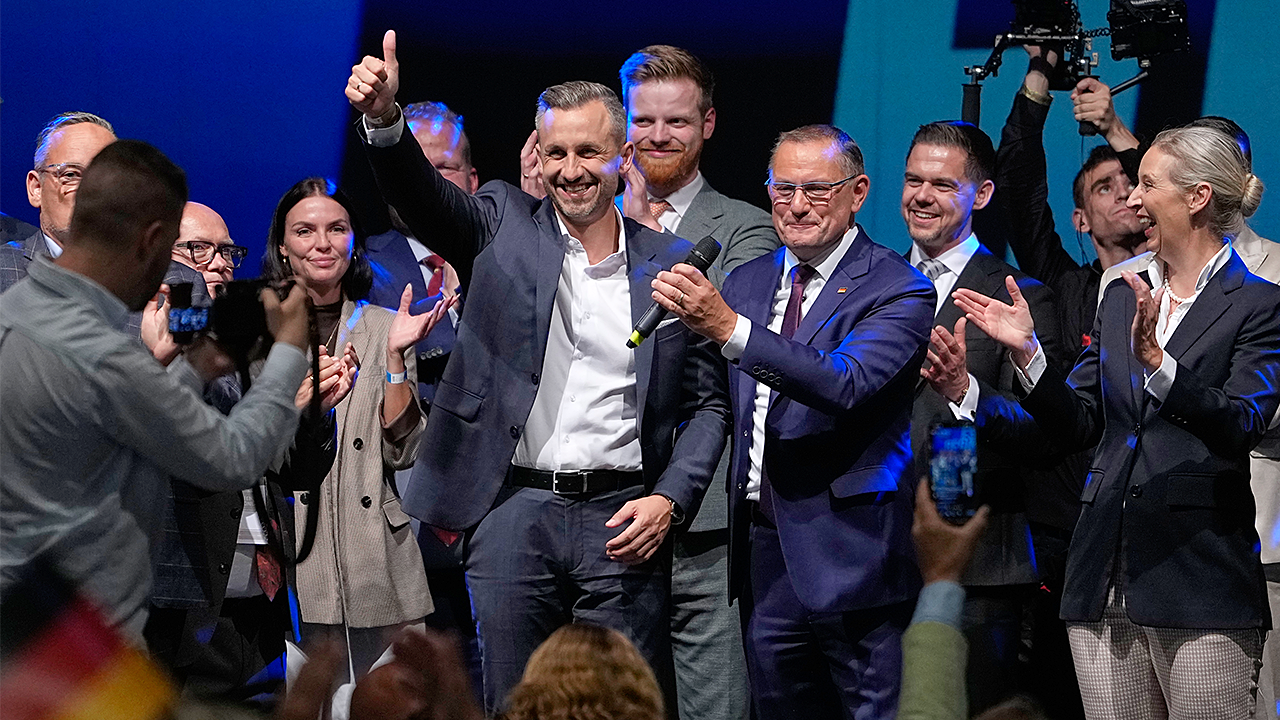
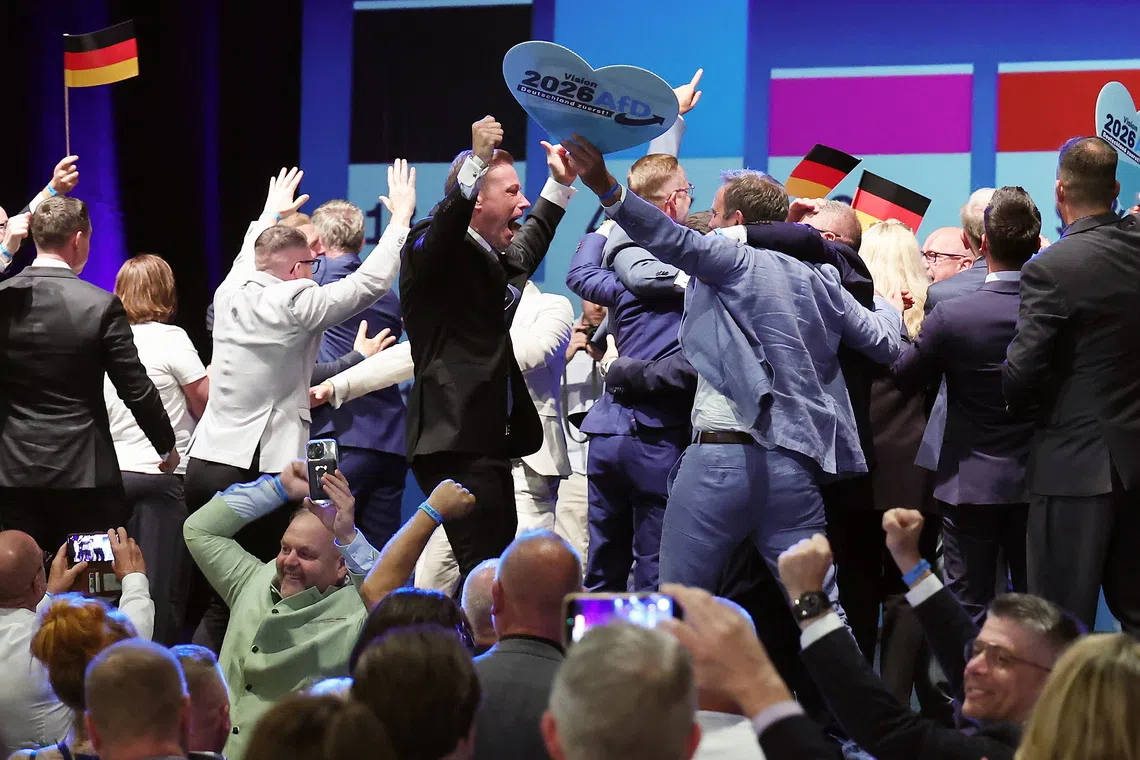
The far-right party Alternative for Germany, or AfD, was projected to win a strong victory in a regional election on Sunday, in a major blow to German Chancellor Friedrich Merz's center-right party, the Christian Democratic Union.
asserted
party → project → party
Merz's party was projected to be hit with a disastrous result in the eastern state of Saxony-Anhalt.
asserted
party → project → Anhalt
AfD had sought to form the country’s first far-right state government since the end of World War II in 1945, although it was not immediately clear whether it would be able to fulfill that ambition.
asserted
it → seek → ambition
Ulrich Siegmund, AfD's anti-migration candidate for governor, said that "we have written history."
Siegmund, 35, told public broadcaster ARD that voters had sent a message that "things cannot carry on like this," adding that it was "also a signal toward Berlin."
"A very good campaigner for us in this election campaign was Friedrich Merz.
asserted
campaigner → say → campaign
Every day this man is in the chancellery is one too many," he said of Germany's unpopular leader.
asserted
he → say → leader
The election comes amid widespread public discontent with the national government, which has yet to convince many voters it can get the country's sluggish economy back on track.
asserted
it → come → track
AfD aimed for an absolute majority in the state legislature to govern on its own and overcome the so-called firewall of mainstream parties’ refusal to work with it.
asserted
AfD → aim → it
But it was unclear long after polls closed whether that goal would become reality.
uncertain
goal → close → ?
It wants to leave the euro; that would be economic downfall ...
asserted
that → want → euro
it works closely together with Russia, it wants a completely different social model," said Franziska Hoppermann, the national general-secretary of Merz's party.
asserted
Hoppermann → work → party
"We will not work with them.
asserted
We → work → them
"
Achieving its first state government would be the biggest victory in the anti-migration party’s 13-year history.
asserted
Achieving → achieve → history
Regardless of whether AfD forms its own government, the projected result is still a blow to Merz, whose center-right party has led Saxony-Anhalt for 24 years.
asserted
party → form → years
Unlike several other European countries, modern Germany has not had a far-right or right-wing populist party leading a national, state or major-city government.
asserted
Germany → have → government
AfD is the largest opposition party in Germany’s national parliament and is strongest in the formerly communist and less prosperous east, where Saxony-Anhalt sits.
asserted
Anhalt → sit → east
Its regional branch in Saxony-Anhalt is one of several classified as a confirmed right-wing extremist group by the domestic intelligence agency, which cites members' disparagement of migrants from Muslim countries among other things.
asserted
which → classify → things
The party promotes "remigration," which pushes for the deportation of immigrants.
asserted
which → promote → immigrants
Siegmund has said his top priorities include "a deportation offensive" and ending incentives for people to come to Germany and "exploit our social system."
asserted
people → say → system
He also wants to initiate a process to pull Saxony-Anhalt from the regional public broadcaster over allegations of "disinformation."
asserted
He → want → disinformation
Germany’s 16 states have extensive powers, including overseeing security matters and running the education system.
asserted
states → have → system
An AfD leader in a neighboring state appealed two convictions for knowingly using a Nazi slogan.
asserted
leader → neighbor → slogan
The party has pushed back on accusations of extremism as politically motivated.
asserted
party → push → extremism
Projections for ARD and ZDF public television, based on exit polls and partial counting, have AfD at just over 44% of the vote, more than double its showing five years ago in the region of 2.1 million people west of Berlin.
asserted
Projections → base → Berlin
Merz's Christian Democratic Union was significantly behind, polling 18% and losing about half its support.
asserted
Union → poll → support
The Left Party, the center-left Social Democrats and Greens were seen polling around 9% each.
asserted
Party → see → %
It was unclear whether the BSW party would reach the 5% of the vote needed to win seats.
uncertain
party → reach → seats
The projections put AfD at least marginally short of an absolute majority for now, but that could change.
uncertain
that → put → majority
The Associated Press contributed to this report.
asserted
Press → contribute → report
 The Aporia