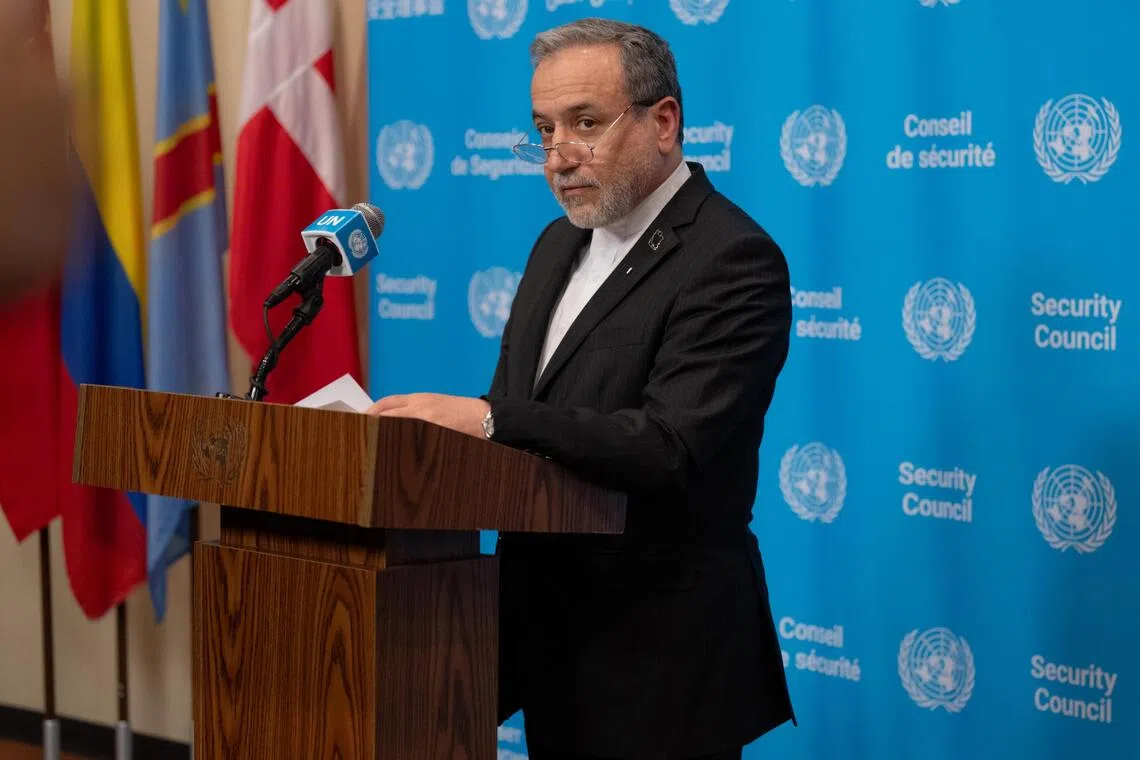
Photo via Al Jazeera

US-Iran talks in New York: What’s the latest?

Read the original at Al Jazeera ↗
Cite

Khalili-Tari, D. (2026, September 29). US-Iran talks in New York: What’s the latest? Al Jazeera. https://www.aljazeera.com/news/2026/9/29/us-iran-talks-in-new-york-whats-the-latest?traffic_source=rss

Dated when The Aporia collected the article, usually within hours of publication. Check the original for its exact date and byline.

Al Jazeera · collected 2026-09-29 · by Daniel Khalili-Tari

Quick Summary

US and Iranian officials continue indirect talks through Qatari mediators during the United Nations General Assembly in New York to resolve a seven-month-long conflict. Iran proposed reopening the Strait of Hormuz in exchange for the US lifting its naval blockade, waiving sanctions, releasing frozen assets worth around $12 billion, and enforcing a regional ceasefire. Despite President Trump’s public rejection, Iranian Foreign Minister Abbas Araghchi says he awaits an official response from Washington. Talks have reportedly become more serious but Iran maintains its stance without showing flexibility on other issues like the nuclear program.
Written by AI on 2026-09-29, from this article's own text only (the story summary below draws on all the coverage).
See how they differ ↓

AI analysis

Story summary

As of October 2, 2026, Donald Trump rejected Iran's offer to reopen the Strait of Hormuz within seven days, deeming it "simply not enough." This proposal was made by Iranian President Masoud Pezeshkian in an effort to ease tensions and open dialogue. However, Trump warned that military action against Tehran could resume after the U.S. midterm elections, suggesting ongoing hostility despite Iran's willingness to negotiate. The offer came amidst international pressure for a resolution to the conflict; Russian President Vladimir Putin expressed hope that the strait would reopen, while also noting Russia’s proposal to receive enriched uranium from Iran remains on the table.

The U.S. has imposed new sanctions on Iranian carmakers and rail operators in response to Tehran's threats and actions. In parallel, Trump dismissed previous claims suggesting his administration was preparing to provide significant concessions to Iran, instead emphasizing a strategy focused on economic pressure through sanctions that have severely impacted Iran’s currency, with the rial trading at an unprecedented 2.5 million to the dollar.

The situation remains tense, with multiple international stakeholders advocating for dialogue and peace but facing resistance from both sides, particularly as the U.S. continues its aggressive stance towards Iran despite diplomatic efforts by other nations like Russia. Ed Miliband, UK Foreign Secretary, also met with his Iranian counterpart in New York during the UN General Assembly to discuss reopening the Strait of Hormuz and address threats posed by Iranian-linked groups on British soil. However, Miliband reiterated that Britain will not tolerate any form of intimidation or hostile activity linked to Iran. This complex diplomatic scenario underscores the challenges in achieving a peaceful resolution without further escalation.

Written for “Trump's Iran Policy And Pardons Talks” on 2026-11-18, grounded in this article and the 132 other(s) covering the same event.

How they differ

28 outlets covered “Trump's Iran Policy And Pardons Talks”.

What each outlet says

One AI summary per outlet of its latest article on this story, written from that article alone and checked against it. Open the article for the outlet's own words.

Al JazeeraThis outlet29 Sep

Iran's foreign minister proposed opening the Strait of Hormuz within seven days if the US lifts certain sanctions and releases frozen assets, presenting it at the United Nations General Assembly. However, the offer includes Iran dictating shipping routes through the strait and demands an end to hostilities in Yemen as part of the deal. Tehran aims to leverage current geopolitical tensions and economic pressures…

Hormuz and Yemen: Iran offers de-escalation at a price others will pay →16 articles from Al Jazeera on this story
CBS News1 Oct

President Trump provided conflicting statements to TIME Magazine regarding the timeline of events related to Iran, contradicting previous comments he had made. According to CBS News reporter Weijia Jiang and expert Joseph Cirincione from the Council on Foreign Relations, these inconsistencies suggest that Trump is attempting to justify his actions or decisions concerning Iran.

Trump "trying to explain his failure" on Iran with comments to TIME, Joseph Cirincione says →22 articles from CBS News on this story
The Straits Times29 Sep

Iranian Foreign Minister Abbas Araghchi stated that he expects a formal response from the United States by September 29 regarding Iran’s proposal to reopen the Strait of Hormuz, according to state media reports. The proposal is being mediated through Qatar, and Iran’s conditions for reopening the strait include a seven-day Middle East ceasefire, unfreezing Iranian assets, lifting sanctions on its oil sector, and…

Iran Foreign Minister expects US answer on Sept 29 on plan to open Hormuz →18 articles from The Straits Times on this story
Dawn2 Oct

President Donald Trump rejected Iran’s proposal to reopen the Strait of Hormuz as insufficient, warning that military action could resume after midterm elections. In an interview with Time Magazine, he dismissed Iran's offer and reiterated his stance on maintaining a strong military presence. Meanwhile, Iranian President Masoud Pezeshkian stated Tehran is open to dialogue but emphasized its right to self-defense…

Trump calls Iran’s Hormuz offer ‘not enough’ →8 articles from Dawn on this story
New York Post1 Oct

In an interview with Time magazine, President Trump stated his willingness to pardon administration officials before leaving office in January 2025. He criticized former President Joe Biden’s use of pardons, including those given to Dr. Anthony Fauci and members of the House Select Committee on January 6th. Democrats have called for investigations into some of Trump's officials, which could lead to prosecutions if a…

Trump suggests he’ll pardon admin officials before leaving office: ‘Sure I’d do that’ →7 articles from New York Post on this story
NBC News1 Oct

In an interview with Time magazine, President Donald Trump indicated that he is considering issuing preemptive pardons to members of his administration before leaving office. When asked about this, he referenced how President Joe Biden had pardoned several individuals at the end of his term. Additionally, The Wall Street Journal previously reported that Trump promised pardons to top officials who were within 200…

Trump says he’d consider issuing pardons to administration officials before he leaves office →5 articles from NBC News on this story
Show 22 more outlets
Daily Mail1 Oct

In an interview with TIME, President Donald Trump discussed the possibility of pardoning his family members and administration officials if Democrats win control of Congress in upcoming midterms. Democrats have indicated they would investigate Trump's Cabinet and family should they gain power; current predictions give Democrats a 91 percent chance of winning the House and a 62 percent chance of taking the Senate…

Trump's darkest midterms fear laid bare in extraordinary TIME interview as he vows to pardon his inner circle to shield them from Democrats →5 articles from Daily Mail on this story
Washington Examiner2 Oct

This article criticizes mainstream media for inaccurately portraying President Trump's approach to Iran as capitulation when it is actually a strategic tightening of economic sanctions. The author argues that recent sanctions targeting Iranian weapon suppliers in China, Hong Kong, and Pakistan have significantly weakened the Iranian economy, with the rial dropping to an all-time low of 2.5 million to the dollar. Dr…

Media got Iran dead wrong: Trump isn’t capitulating — he’s starving the beast →5 articles from Washington Examiner on this story
The Guardian27 Sep

Mike Waltz, the U.S. ambassador to the UN under the Trump administration, told CNN’s State of the Union that Iran was not negotiating "in good faith" to end the war because it demanded immediate sanctions relief without committing to future concessions. He stated that President Trump rejected Iran's proposal at the recent UN general assembly due to skepticism about Iran's genuine intentions regarding their nuclear…

UN ambassador Waltz says Iran was not negotiating ‘in good faith’ to end war →4 articles from The Guardian on this story
South China Morning Post27 Sep

US President Donald Trump stated in an interview with Axios on Sunday that despite rejecting Iran’s recent truce proposal at the UN General Assembly, he expects negotiations between the two countries to resume soon. Iranian officials had offered a seven-day ceasefire and reopening of the Strait of Hormuz as part of their deal proposal. However, Trump views these terms as unacceptable and believes that any new…

Trump expects new Iran talks despite rejecting deal offer →4 articles from South China Morning Post on this story
Euronews29 Sep

Qatar's foreign ministry spokesperson Dr Majed Al Ansari warned that the ongoing war between Iran and the US is causing an "unbearable" strain on the global economy, particularly affecting sectors beyond energy such as agriculture and petrochemicals. At a press briefing in Doha, Al Ansari stated that Qatar continues to mediate talks between Washington and Tehran, emphasizing the need for regional security based on…

Global economic impact of Iran war ‘unbearable,’ Qatar warns as talks continue →3 articles from Euronews on this story
National Post27 Sep

Iran remains committed to its conditions for reopening the Strait of Hormuz, which include a cessation of hostilities in the Middle East and lifting sanctions on Iran. This position was reaffirmed by Foreign Minister Abbas Araghchi despite U.S. President Donald Trump's rejection of the proposal. The strait is crucial for global energy supply, with Iran requiring ships to obtain authorization before passage. Trump…

Iran resolute on Hormuz re-opening plan rejected by Trump →3 articles from National Post on this story
The Hindu28 Sep

U.S. and Iranian officials spoke separately with mediators on Monday, September 28, 2026, in an effort to end seven months of war that began with U.S. and Israeli attacks on Iran in late February. The talks focus on a revised version of Iran's seven-day ceasefire proposal presented last week at the United Nations General Assembly. Both sides have agreed to previous ceasefires which later failed. Iran expects the…

U.S., Iran separately talk with mediators in latest bid to end war →3 articles from The Hindu on this story
The Independent29 Sep

President Donald Trump denies offering Iran sanctions relief in exchange for curbing its nuclear program, contradicting reports from Axios and CNN citing US officials. Trump wrote on Truth Social that he offered "NOTHING" regarding sanctions or access to frozen funds, while also asserting the U.S. would soon win its war against Iran and that gas prices would drop post-war. Meanwhile, Iranian Foreign Minister Abbas…

Iran-US war latest: Trump denies offering Tehran sanctions relief to rein in its nuclear programme →3 articles from The Independent on this story
Fox News25 Sep

Iran’s president has denied the country's nuclear ambitions in response to a direct question about building nuclear bombs. He also criticized the United States for its role in Middle Eastern conflicts during an interview. The article is a roundup of headlines from Fox News' morning newsletter, covering various topics including politics, crime, and entertainment.

Iranian president denies nuclear ambitions while blaming US for Middle East conflict and more top headlines →2 articles from Fox News on this story
Deutsche Welle27 Sep

Iran’s Foreign Minister Abbas Araghchi reaffirmed Iran's conditions for reopening the Strait of Hormuz on Sunday, despite US President Donald Trump's rejection of the proposal at a press conference the day before. Araghchi stated that Iran will not compromise on its demands, which include an end to hostilities in the Middle East and lifting sanctions on Iranian oil. The strait remains largely closed to international…

Iran sticks to Hormuz plan after Trump rejects it →2 articles from Deutsche Welle on this story
BBC27 Sep

Iran has stated it will wait for a formal response from US officials after President Donald Trump rejected Tehran’s proposal to reopen the Strait of Hormuz to commercial shipping within seven days. Iranian Foreign Minister Abbas Araghchi acknowledged Trump's rejection but criticized him for inconsistent statements. Meanwhile, Oman has called for continued dialogue between the US and Iran to resolve the crisis in the…

Iran says it will wait for official US response after Trump rejects Strait of Hormuz proposal →2 articles from BBC on this story
Toronto Star1 Oct

President Trump stated in an interview with Time magazine that he may resume bombing Iran after the midterm elections if new peace offers do not meet his standards from a year ago. Additionally, fighting between Iran-backed Houthi rebels and Yemeni government forces escalated overnight, raising concerns about potential advances toward Taiz City. Reports suggest that Israeli Prime Minister Netanyahu might have been…

Trump says latest Iran peace offer not enough, may resume bombing, and other Mideast developments →2 articles from Toronto Star on this story
Times of India27 Sep

US Ambassador to the UN Mike Waltz told CNN’s State of the Union that President Donald Trump rejected Iran's recent proposal to end conflict because Tehran demanded sanctions relief before discussing its nuclear program. According to Politico, Iran’s plan included reopening the Strait of Hormuz in exchange for lifting US naval blockades and easing oil-related sanctions, which Trump deemed unacceptable due to lack of…

‘They wanted everything up front’: Trump’s UN envoy says Iran was not negotiating in good faith to end war →2 articles from Times of India on this story
Semafor28 Sep

Oil prices increased by over 2% as tensions between the United States and Iran continued without resolution. President Trump rejected a peace offer from Iran while suggesting potential military action post-midterm elections, complicating efforts to stabilize oil supplies from the Gulf region. The US has also been pressuring Iran’s trading partners with threats of sanctions, further disrupting global crude markets…

Oil prices rise as hope for a US-Iran truce fades →2 articles from Semafor on this story
Time1 Oct

In a September 28 interview with TIME, President Donald Trump discussed his re-election victory and made several claims about the economy in Iran and oil production through the Strait of Hormuz. He stated that he won all seven swing states and had an 86% popular vote margin, which is factually incorrect; he actually received 49.8% of the popular vote but secured more electoral votes. Trump also claimed Iranian…

Fact-Checking What Donald Trump Said in His Latest Interview With TIME →2 articles from Time on this story
Evening Standard25 Sep

Foreign Secretary Ed Miliband met with Iran's foreign minister Abbas Araghchi and warned against any intimidation or threats from groups linked to Iran on UK soil. During the meeting, Miliband discussed regional conflicts, the importance of reopening the Strait of Hormuz, and expressed concern over attacks on British Jews. He also emphasized Britain’s commitment to countering these threats and called for the…

Foreign Secretary tells Iran minister Britain will not ‘tolerate intimidation’ →
ABC News (AU)26 Sep

Iran’s Foreign Minister Abbas Araghchi has proposed a deal to the United States that would reopen the strategic Strait of Hormuz within a week. However, President Donald Trump has reportedly rejected this offer, even coining a new name for the waterway as "Trump Strait" on his Truth Social platform. The Iranian proposal seeks to build upon the memorandum of understanding signed in June as a foundation for future…

Iran offers deal to US to reopen Strait of Hormuz →
CBC26 Sep

President Trump rejected a proposal from Iran to open the Strait of Hormuz and end regional conflicts, according to remarks made at the White House on Saturday. The proposal was transmitted through Qatari mediators during the UN General Assembly and would have allowed for the reopening of the strategic waterway within seven days if accepted by the U.S., which currently has an economic blockade on Iran. Despite…

Trump rejects Iranian proposal to open Strait of Hormuz and end fighting →
Global News26 Sep

President Donald Trump rejected Iran’s proposal to reopen the Strait of Hormuz within a week if certain conditions were met by the U.S., including lifting the naval blockade and waiving sanctions. Trump said that Iran wanted to negotiate because they were losing, but he found their terms unacceptable. The incident occurred during ongoing tensions in the region with Saudi Arabia reporting another missile interception…

Trump rejects Iran’s proposal to reopen the Strait of Hormuz →
NPR26 Sep

President Trump rejected an Iranian plan to reopen the Strait of Hormuz, calling it "not acceptable," during a press conference at the White House on Saturday. The proposal, communicated through Qatar, would have allowed Iran to immediately reopen the strategic waterway in exchange for resuming negotiations with the U.S., similar to a previous memorandum that collapsed due to disagreements over its terms. Iranian…

Trump calls Iranian plan to reopen Strait of Hormuz not 'acceptable' →
Sydney Morning Herald26 Sep

Iran's foreign minister, Abbas Araghchi, stated on Sunday that diplomacy is essential for resolving conflicts with the United States and Israel, responding to US President Donald Trump's rejection of Iran’s proposal to reopen the Strait of Hormuz through diplomatic means. Despite Trump's public stance against the Iranian peace plan, mediators facilitating talks between the two countries have not officially relayed a…

Iran insists on diplomatic solution after Trump rejects peace plan →
The Bulwark1 Oct

Catherine Rampell and Andrew Egger analyze Donald Trump's recent interview with Time Magazine, focusing on his statements about having the highest IQ and fluctuating claims regarding the duration of potential military conflict in Iran. They also highlight Trump’s argument that destroying Iran would lead to peace, his dissatisfaction with what he perceives as negative questioning, and his preoccupation with White…

Trump Crashes Out: You Haven't Asked "One F**king Positive Question" →

Compared with similar articles

This article reads unscored and hedges 7% of its claims. Each row says how that neighbour differs.
Al Jazeera
Hedges 1 of 34 claims Outlet record 60/100
The Straits Times
Leans left Hedges 4 of 28 claims Outlet record 64/100
New York Post
Hedges 2 of 13 claims Outlet record 66/100
Progress at UNGA Same event
Dawn
Leans strongly left Hedges 3 of 21 claims Outlet record 67/100
The Independent
Hedges 2 of 33 claims Outlet record 59/100
The Hindu
Hedges 4 of 14 claims Outlet record 60/100
The Straits Times
Hedges 3 of 13 claims Outlet record 64/100
The Straits Times
Leans right Hedges 3 of 23 claims Outlet record 64/100
The Straits Times
Leans left Hedges 0 of 11 claims Outlet record 64/100
Al Jazeera
Leans strongly right Hedges 9 of 59 claims Outlet record 60/100

Story

Trump's Iran Policy And Pardons Talks
Politics · 133 article(s) covering the same event. See how they differ ↑
How this article was measured signals, leaning charts, publisher record, byline, topics and claims

Signals How these are calculated →

Claims extracted
69
sentences that state something as happening or true
Uncertain
7%
5 of 69 hedged ("reportedly", "may", "according to")
Leaning
not political
takes no side on a contested political question
Publisher signals
60/100
Al Jazeera's corrections and hedging, across everything collected from it. Not a measure of accuracy.
Outlets on this story
133
Politics
Same framing elsewhere
1
articles that frame the event the way this one does
Analyzed 2026-09-29 · how these are computed

How this is being covered How these are calculated →

Article leaning vs. publisher reliability
Source leaning vs. consistency

Publisher

Al Jazeera · 6027 article(s) · 4 correction(s) detected
Running correction rate · 4 correction(s)

Who wrote this

Daniel Khalili-Tari
12 article(s) here · 1 carrying a prediction
Recommended Stories list of 3 items- list 1 of 3Netanyahu may fall, but his far-right legacy in Israel is going nowhere - list 2 of 3Israel takes measures to crush Palestinian business in occupied West Bank - list 3 of 3As
Recommended Stories list of 3 items- list 1 of 3UK charities, protest groups: Israeli ban threat ‘will not intimidate us’
Huda Ammori, cofounder of Palestine Action – which the UK has proscribed as a “terrorist” group – is also due to appear on the panel, which will be chaired by Hala Hanina of Palestine Deep Dive.
Healey said the budget would give the country “breathing space” after years of economic stagnation fuelled by austerity, Brexit, the coronavirus pandemic, privatisation and rising energy prices.
2026-10-28 · assertive framing · Five key takeaways from the UK Autumn Budget
Recent headlines in the British press have claimed she was “friends” with an “al-Qaeda terrorist”, as she reportedly offered to testify in defence of Minh Quang Pham, a UK citizen who had planned an attack at Heathrow Airport. “This tactic of guilt by association will not be dignified with a response,” Speitan said of the reports.
The proposal, which Iran said would see the strait reopened within seven days, was first passed to the US via Qatari mediators last week.
2026-09-29 · assertive framing · US-Iran talks in New York: What’s the latest?
More than 55,000 Sudanese refugees have fled to neighbouring Chad this year, compounding a humanitarian crisis that will only deteriorate further unless there is a significant increase in funding, the United Nations has warned.
Recommended Stories list of 3 items- list 1 of 3Andy Burnham apology for Labour stance on Gaza: Is UK’s position shifting? - list 2 of 3The British state has recast protest as terrorism - list 3 of 3UK charities, protest groups: Israeli ban threat ‘will not intimidate us’
Recommended Stories list of 3 items- list 1 of 3India warns new US tariffs over Russian oil could impact ties - list 2 of 3At least 19 injured in Russian attacks across Ukraine - list 3 of 3US tariffs against Russian oil buyers pass: What it means for China, India Greenpeace Ukraine and London-based McKenzie Intelligence Services (MIS) analysed satellite imagery of the site and found no evidence of Russian claims that Ukrainian attacks had occurred. “The satellite imagery and evidence is clear – Ukraine did not attack its own Zaporizhzhia nuclear plant electricity system,” said Shaun Burnie, a nuclear specialist at Greenpeace Ukraine.
Irish public broadcaster RTE said in a statement on Thursday that the country’s participation could not be justified “given the appalling and ongoing loss of lives in Gaza” and that the humanitarian crisis in the enclave “continues to put the lives of so many civilians at risk”.
Also by Daniel Khalili-Tari
Nothing else under this byline is closely related to this article, so these are simply their most recent.
All 12 articles by Daniel Khalili-Tari →

Topics

Iran New York Qatar Qatari Tehran

Subjects

Iran GPE · 9× Tehran GPE · 7× Araghchi PERSON · 6× Trump PERSON · 6× Iranian NORP · 4× Qatari NORP · 4× New York GPE · 3× Qatar GPE · 3× American NORP · 2× Washington GPE · 2×

Narrative

Ali Salehian, director of the Center for Intellectual Diplomacy at the Governance and Policy Think Tank in Iran, told Al Jazeera that Tehran does not believe Washington will honour any future deal as it did not honour what was agreed under the Pakistan-brokered June MoU. “For Iran, the bottom line of every negotiation with Trump, considering all of his misbehaving and [military] targeting of Iran during negotiations, is the Islamabad MoU,” Salehian said.
framing: assertive · carried by 1 article(s) · first seen 2026-09-29
The proposal, which Iran said would see the strait reopened within seven days, was first passed to the US via Qatari mediators last week.
2026-09-29 · Al Jazeera
US-Iran talks in New York: What’s the latest? · assertive framing

Claims (69 extracted, 5 hedged)

Indirect talks between the United States and Iran aimed at ending the seven-month-long war continue – most recently via Qatar as mediator on the sidelines of the United Nations General Assembly (UNGA) in New York – but the two sides still disagree about the agenda. asserted
sides → aim → agenda
Iranian Foreign Minister Abbas Araghchi left New York on Tuesday after telling state-run Islamic Republic of Iran Broadcasting (IRIB) that he expects an official response to Tehran’s proposal to reopen the Strait of Hormuz by the end of the day. asserted
he → leave → day
The proposal, which Iran said would see the strait reopened within seven days, was first passed to the US via Qatari mediators last week. asserted
strait → say → mediators
Recommended Stories list of 3 items- list 1 of 3Iran’s Araghchi meets Qatari mediators as US calls for nuclear talks - list 2 of 3US-Iran talks continue, but ‘deal unlikely’ before midterm elections - list 3 of 3Hormuz and Yemen: asserted
deal → meet → 3Hormuz
Iran offers de-escalation at a price others will pay United States President Donald Trump was reported to have rejected that offer, under which Tehran would reopen the strait in return for Washington lifting its naval blockade, waiving sanctions, releasing an estimated $12bn in frozen Iranian assets and enforcing a wider regional ceasefire that includes Lebanon. asserted
that → offer → Lebanon
Under Iran’s proposal, wider peace talks, including discussions of its nuclear programme, would begin only then Despite Trump’s public rejection, Araghchi says he has not yet received a formal response from Washington. asserted
he → include → Washington
Meanwhile, US media reports that Trump may well be willing to relax sanctions and unfreeze Iranian assets have been strongly denied by the US president. uncertain
Trump → relax → president
Instead, US officials say, the US wants a deal that resolves all outstanding issues, particularly Tehran’s nuclear programme, in one go, rather than pursuing a gradual, step-by-step approach. asserted
that → say → approach
Here’s what we know about the talks: asserted
we → ’ → talks
What happened in the Qatar-mediated talks? asserted
What → happen → talks
Qatari mediators met Araghchi in New York on Monday to discuss how to advance Tehran’s proposal for reopening the Strait of Hormuz and then progressing to wider peace talks. asserted
mediators → meet → talks
In a post on Telegram, Araghchi insisted that the talks focused solely on the Strait of Hormuz. asserted
talks → insist → Hormuz
He denied that the US had formally rejected the Iranian proposal. asserted
US → deny → proposal
“Despite what the US president said, I said that we were waiting for the official US response through the mediators … asserted
we → say → mediators
They [Qatar] had ideas, and we discussed them. asserted
we → have → them
They are going to raise this issue with the American side again, and then the final response from the American side will be conveyed to us through the Qatari mediator,” Araghchi said late on Monday. asserted
Araghchi → go → Monday
Araghchi also said negotiations had become more “serious”, but cautioned that Tehran’s position has not changed. asserted
position → say → ?
“I state firmly that there has been no change in Iran’s position. asserted
I → state → position
Our conditions for opening the strait are clear. asserted
conditions → open → strait
At present, there has been no discussion at all about flexibility,” he added. asserted
he → add → flexibility
Tehran’s proposal includes elements of the Islamabad memorandum of understanding (MoU), which was signed by both the US and Iran on June 17. asserted
which → include → June
Is Trump willing to accept some Iranian demands? asserted
Trump → accept → demands
A US official told The Associated Press news agency last week that Trump is not willing to make a final peace deal with Iran until the issue of its nuclear programme is addressed. asserted
issue → tell → programme
According to the official, who has not been named, the US president would be willing, however, to grant Iran sanctions relief and release some frozen funds if progress is made on the nuclear file. uncertain
progress → accord → file
Then, on Monday, US-based news outlet Axios also reported that Trump had offered Iran sanctions relief in return for concessions on its nuclear programme. asserted
Trump → base → programme
The report also cited US officials, one of whom told Axios that the indirect talks had been “positive and constructive”, adding that Tehran had indicated it was “flexible” on nuclear issues. asserted
it → cite → issues
Trump, however, angrily denounced the story as a “hoax” in a post on Truth Social, the social media platform he owns. asserted
he → denounce → Social
He said the story was “not true” and demanded Axios remove the article. asserted
Axios → say → article
Iran has been heavily sanctioned for decades. asserted
Iran → sanction → decades
The restrictions have severely affected Iranians’ quality of life, including their access to essential medicines and healthcare. asserted
restrictions → affect → medicines
In August, the US announced yet more sweeping economic sanctions on Iran and countries that trade with it as it sought to apply more economic pressure to isolate the country from the global economy during the diplomatic deadlock in their war. asserted
it → announce → war
US Treasury Secretary Scott Bessent described the campaign as the “economic asphyxiation” of Iran. asserted
Bessent → describe → Iran
It is difficult to quantify exactly how many Iranians have been killed by what Tehran views as “economic warfare”. asserted
Tehran → quantify → warfare
However, a study published last year by the highly regarded medical journal The Lancet Global Health concluded that more than 564,250 people worldwide die annually as a result of US sanctions. asserted
people → publish → sanctions
In late February, just before the US launched its first strikes on Iran, the two sides were already holding talks hosted by Oman, which included the issue of Iran’s nuclear programme. But before those talks could conclude, the US and Israel launched strikes, triggering the closure of the Strait of Hormuz, through which one-fifth of the world’s oil and natural gas is shipped in peacetime, by Iran. uncertain
fifth → launch → Iran
The closure of the strait has since become the primary point of contention between the two sides, when it had not been an issue before the war began. asserted
war → become → sides
Throughout the war, Trump has repeatedly expressed his desire to strike a deal with Tehran. asserted
Trump → express → Tehran
However, serious differences between the two sides will need to be resolved first, including the order in which issues are addressed for the purpose of peace talks. asserted
issues → need → talks
Iran wants to establish its control of the Strait of Hormuz, have sanctions lifted and assets unfrozen, as well as ensure an end to US-Israeli strikes before it will go back to negotiating other issues, such as its nuclear programme. asserted
it → want → programme
This was the order of events laid out in the MoU agreed between Iran and the US in June, but which quickly fell apart. asserted
which → lay → June
…and 29 more, not listed.
Give feedback · no sign-in needed

No sign-in needed for now. Your note is sent without a name, so it cannot be answered.

History Support