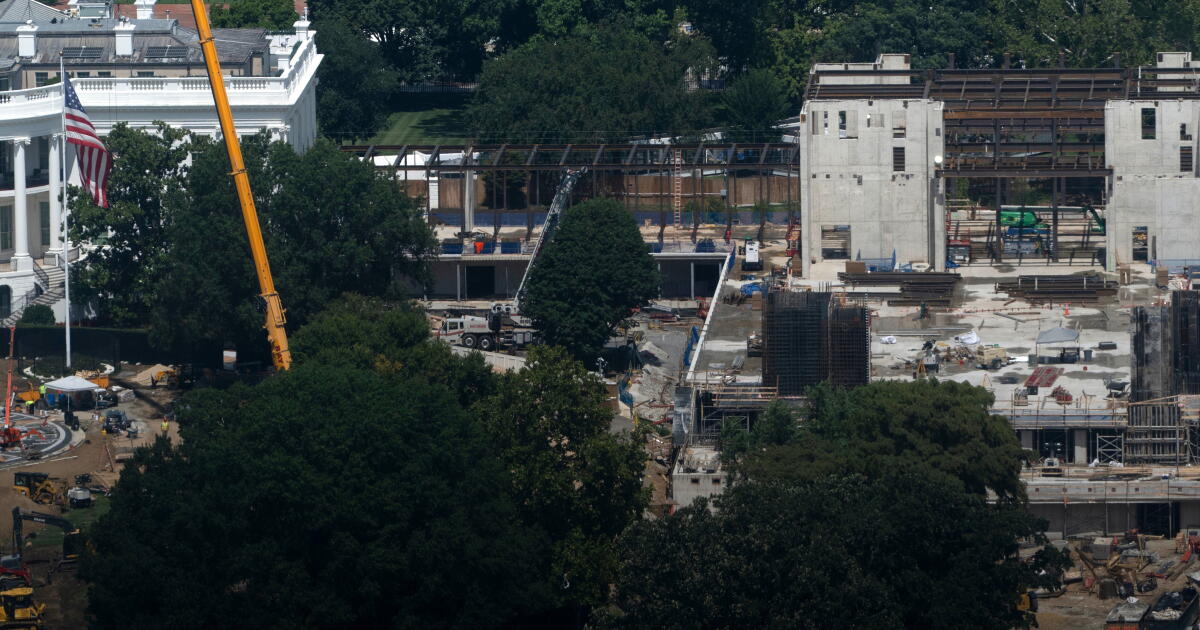
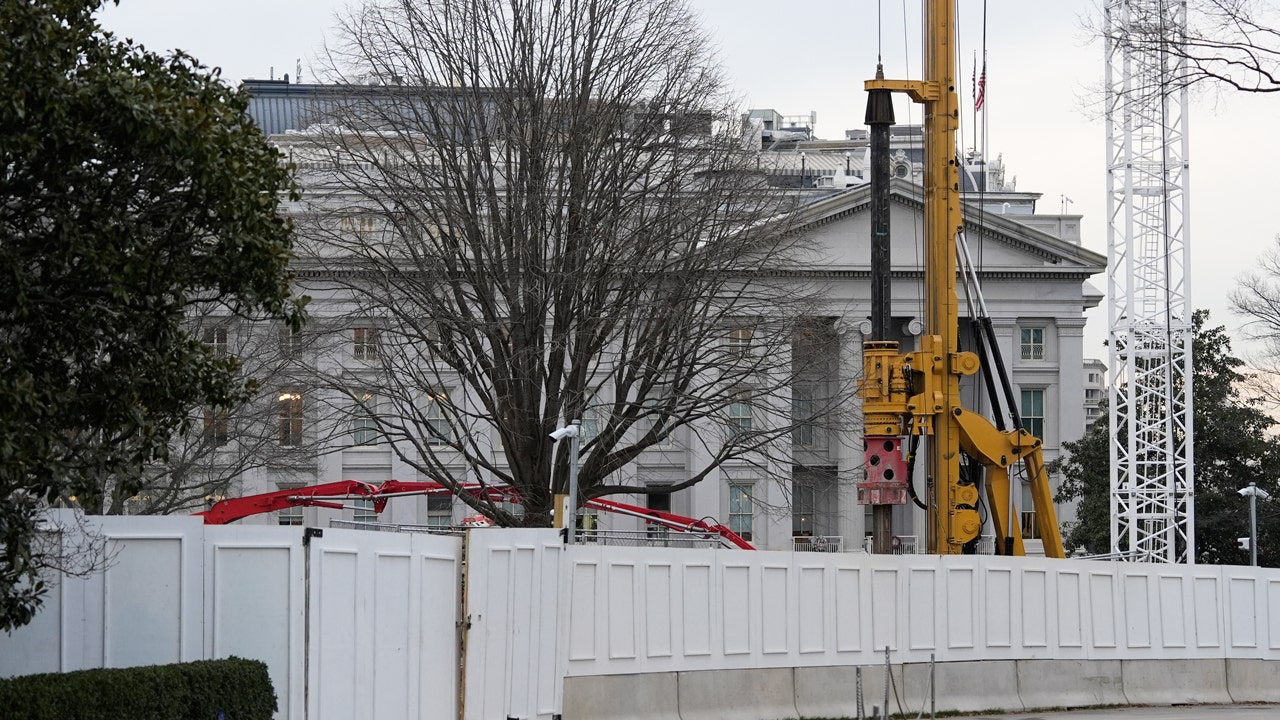
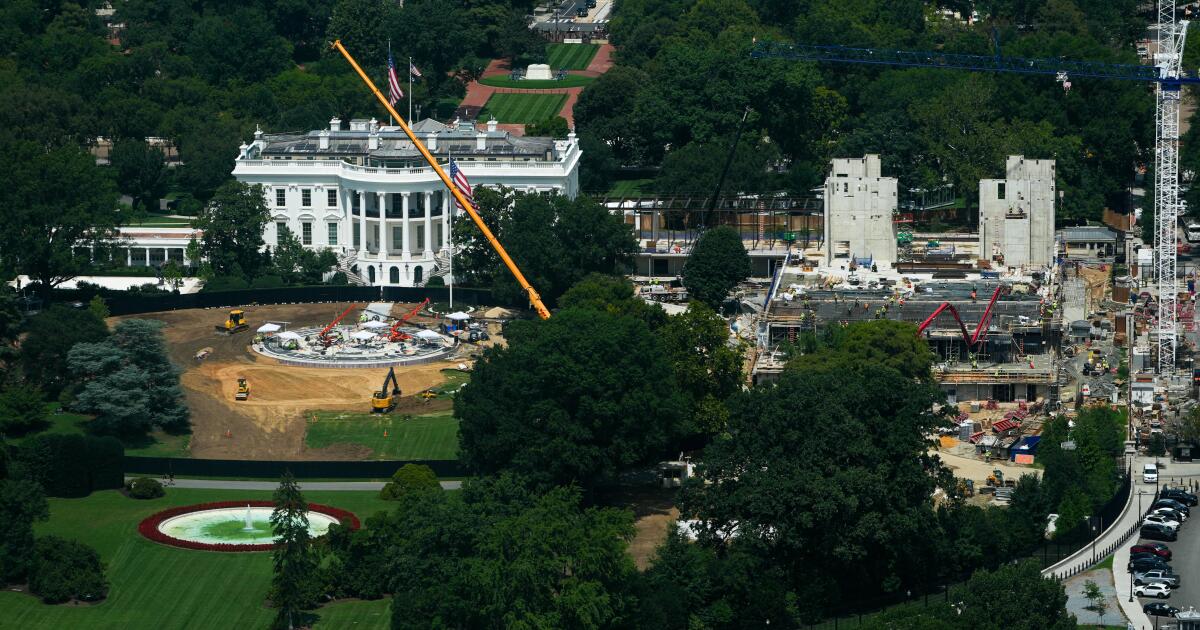
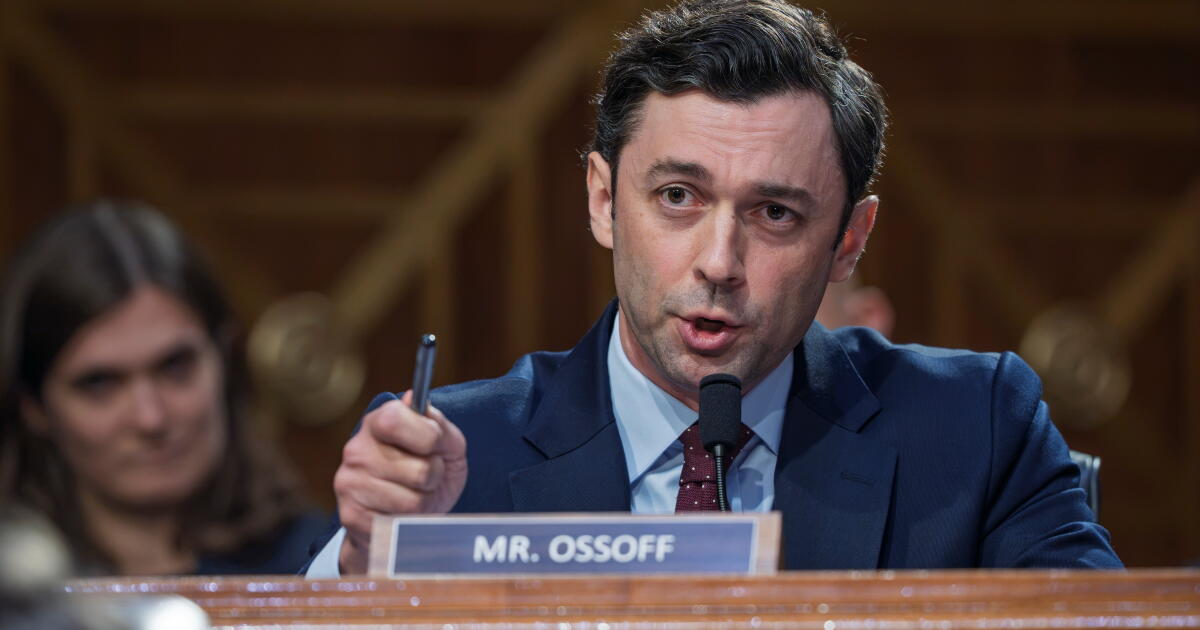
Supreme Court, in 5-4 vote, clears way for Trump's new ballroom

Read the original at Los Angeles Times ↗
Cite

Savage, D. G., & Wilner, M. (2026, September 4). Supreme Court, in 5-4 vote, clears way for Trump's new ballroom. Los Angeles Times. https://www.latimes.com/politics/story/2026-08-31/supreme-court-rules-for-trump-his-ballroom-dismisses-legal-challenge

Dated when The Aporia collected the article, usually within hours of publication. Check the original for its exact date and byline.

Los Angeles Times · collected 2026-09-04 · by David G. Savage, Michael Wilner

Quick Summary

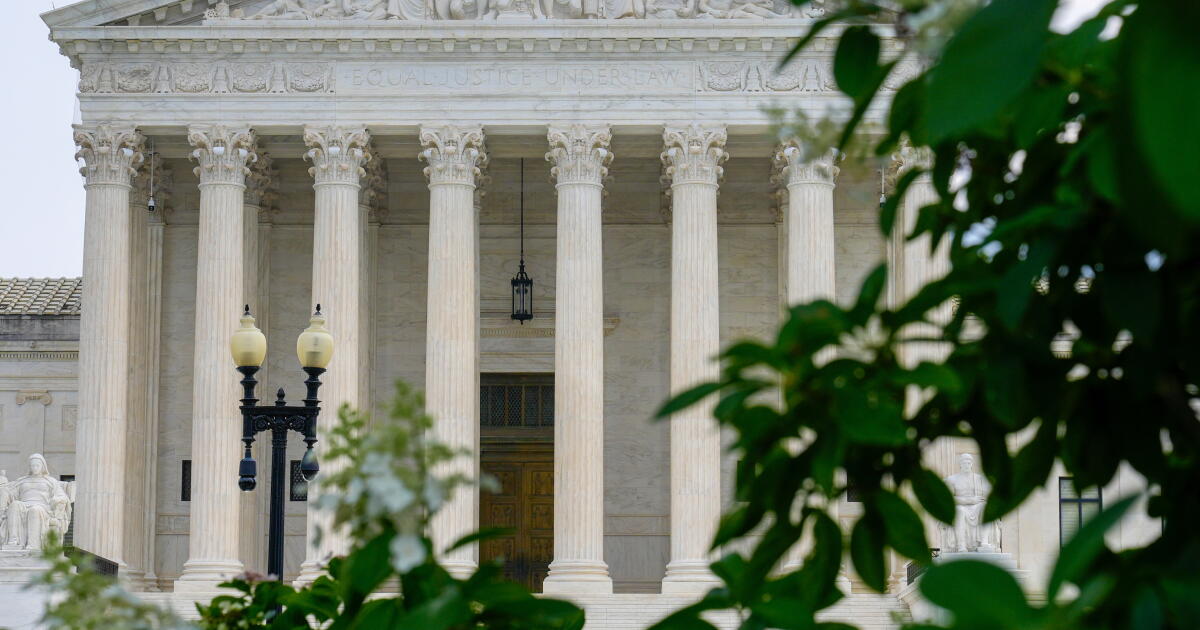
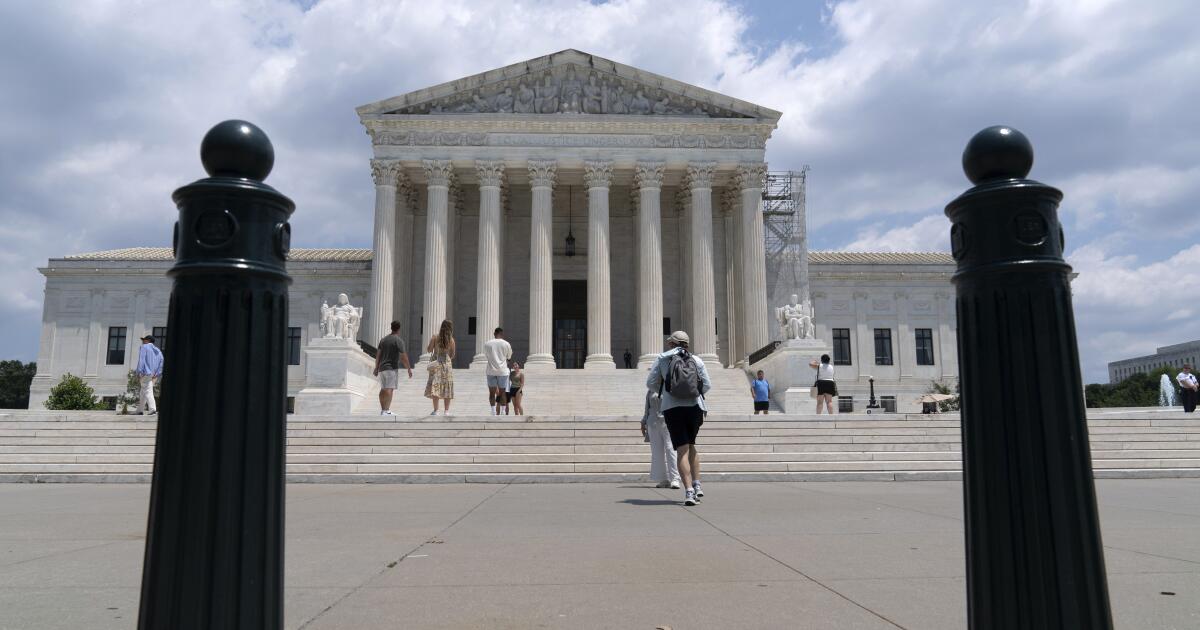
The Supreme Court has cleared the way for President Trump's new $400-million ballroom at the White House by a 5-4 vote, allowing him to finish the project with private funding without congressional approval. The court overturned lower-court rulings that said he needed Congress' approval, citing a lack of standing among preservationists who filed a lawsuit. In dissent, Chief Justice John G. Roberts Jr. wrote that the construction project was "likely unlawful" and should not be allowed to continue. The project is expected to be completed in 2028 and will be one of the largest structures on the White House grounds.
Written locally by qwen2.5:14b on 2026-09-05, using this article's own text rather than the other coverage of the same event (that is the story summary below).

AI analysis runs on qwen2.5:14b, locally

Story summary

President Trump's White House ballroom construction project has been allowed to continue despite concerns about its legality. A 5-4 Supreme Court decision cleared the way for the project, which is estimated to cost over $900 million and will be privately funded. Chief Justice John Roberts, in dissent, stated that the project is "likely unlawful" and should not be allowed to continue.

The White House ballroom is just one of several construction projects in Washington D.C. where Trump is hoping to leave his mark on the nation's capital. The projects include renovating golf courses, constructing a new military installation, and renaming landmarks after himself.

Trump has admitted that he is slapping his name on these projects because he knows nobody else will do it once he's gone. "That's true," Trump said, "Nobody will do it once I'm gone. When I leave here, nobody will." The president's comments follow an unprecedented blitz across Washington D.C. to put his name or leave a Trump-like imprint on buildings and landmarks.

The decision by the Supreme Court has sparked concerns about the unitary executive theory, which allows the president to take action without congressional approval. This has been criticized as an abuse of power, and some have raised questions about the independence of federal judges.

Written for “Trump Ballroom Dispute at Scotus” on 2026-10-22, grounded in this article and the 10 other(s) covering the same event.

Story

📰 Trump Ballroom Dispute at Scotus
Politics · 11 article(s) covering the same event. Compare every outlet's account →

Compared with similar articles

This article reads leans left and hedges 7% of its claims. Each row says how that neighbour differs.
The Dispatch
⚖️ Leans left 🔴 0% hedged 0 of 14 📰 publisher trust 61
“Both articles report on a 5-4 SCOTUS decision regarding Trump's new White House ballroom, with the same outcome and dissenting opinion from Chief Justice Roberts.”
September 1, 2026 same event · 100%
Letters from an American
⚖️ Leans strongly left further left than this 🔴 7% hedged 3 of 42
“Both articles describe a 5-4 Supreme Court decision on September 1, 2026, allowing Trump's ballroom construction to continue.”
Mother Jones
⚖️ Leans left 🔴 7% hedged 3 of 42 📰 publisher trust 95
“Both articles report on a single Supreme Court ruling with a 5-4 vote, specifically about Trump's new ballroom project in Washington DC.”
Reason
⚖️ Leans left 🔴 4% hedged 1 of 25 📰 publisher trust 94
“Both articles mention a Supreme Court vote with a 5-4 majority, clearing the way for Trump's new ballroom and referencing Chief Justice John Roberts' dissent.”
Fox News
⚖️ Leans strongly right further right than this 🔴 4% hedged 2 of 54 📰 publisher trust 67
“Both articles describe the same 5-4 Supreme Court vote clearing the way for Trump's new White House ballroom, with identical details and dates.”
The Bulwark
⚖️ leaning not scored 🔴 11% hedged 1 of 9
“Both articles report on the Supreme Court's 5-4 vote allowing Trump to build a new White House ballroom, with identical details about the ruling and its implications.”
Los Angeles Times
⚖️ leaning not scored 🔴 24% hedged 11 of 46 📰 publisher trust 95
“Both articles report on the Supreme Court's consideration of a challenge to Trump's new White House ballroom, with Article A covering the initial 5-4 vote and Article B covering the court's subsequent consideration of a challenge”
Los Angeles Times
⚖️ Leans right further right than this 🔴 4% hedged 1 of 25 📰 publisher trust 95
“Article A reports a 5-4 Supreme Court vote clearing the way for Trump's new ballroom, while Article B discusses an ongoing case where the Supreme Court is being urged to block construction of the ballroom”
How this article was measured signals, leaning charts, publisher record, byline, topics and claims

Signals How these are calculated →

Claims extracted
41
sentences that state something as happening or true
Uncertain
7%
3 of 41 hedged ("reportedly", "may", "according to")
Leaning
Leans left
of the writing, not the subject · beta estimate
Publisher signals
95/100
Los Angeles Times's corrections and hedging, across everything collected from it. Not a measure of accuracy.
Outlets on this story
11
Politics
Same framing elsewhere
1
articles that frame the event the way this one does
Analyzed 2026-09-05 · how these are computed

How this is being covered How these are calculated →

Article leaning vs. publisher reliability
Source leaning vs. consistency

Publisher

Los Angeles Times · 219 article(s) · 0 correction(s) detected
No corrections detected for this publisher. That may mean careful reporting, or simply that nothing has been checked.

Who wrote this

David G. Savage
10 article(s) here · 1 carrying a prediction
🔮 - Click here to listen to this article - - The Supreme Court gave political parties and their fundraising committees lower rates for broadcast campaign ads. - Justices Sonia Sotomayor and Ketanji Brown Jackson voted to deny the administration’s appeal.
🔮 Supreme Court sounds wary of state-based climate change suits against oil producers - Click here to listen to this article - - Several justices suggested that local and state claims against oil companies may be blocked by the federal Clean Air Act. -
🔮 In its new term, the court will also hear major cases on immigration and guns.
🔮 “At this late date, ordering reversion to the 2025 map in the midst of an ongoing election would usher in electoral chaos,” the justices wrote.
🔮 - The decision will aid states that seek to scrub their voter rolls and remove those who are not citizens.
🔮 - Click here to listen to this article - - The administration could try to impose new regulations for the 2028 elections.
🔮 Acting on his own, Trump had the East Wing of the White House torn down in October and ordered work to start on a massive new building that would dwarf the old executive mansion and seat 1,000 guests for dinner.
🔮 At issue is whether the president acting on his own may build a huge new ballroom complex that is expected to dwarf the historic Executive Mansion.
🔮 By a 5-4 vote, the justices granted an emergency appeal from Trump and his lawyers on Monday, setting aside a judge’s order that would stop the construction.
🔮 California leaders immediately noted the limits of the high court ruling and said they would file a lawsuit to prevent Trump’s desired changes from taking effect. “The Supreme Court just let the Trump administration move ahead (for now) with its plan to disenfranchise voters across the country.
Also by David G. Savage
Nothing else under this byline is closely related to this article, so these are simply their most recent.
All 10 articles by David G. Savage →
Michael Wilner
16 article(s) here · 1 carrying a prediction
🔮 Marco Rubio, the president’s secretary of state and national security advisor, has been silent on Trump’s decision to cut a deal with Moscow on diesel sales that could fuel Russia’s war against Ukraine.
🔮 Lawmakers and AI industry leaders have also called for guardrails on the nascent technology, which experts warn could soon surpass human understanding.
🔮 Xi Jinping’s remarks reflect growing concern within China over whether governments in Washington or Beijing will be able to contain a technology with potentially transformative capabilities, according to a U.S. official.
🔮 “Will a deal be made with Iran that lets them rebuild and create a far greater country than it ever was before — maybe one of the greatest in the Middle East or even the world?
🔮 Click here to listen to this article - - China’s spy chief warned that runaway AI capabilities could threaten Communist Party control. -
🔮 The president’s position has put him at odds with a growing chorus of industry leaders and bipartisan lawmakers warning that AI could soon advance beyond human control.
🔮 Chinese President Xi Jinping will visit Washington on Sept. 24 for an official summit and state dinner, with AI development expected to top the agenda.
🔮 Questions swirl over Trump’s pledge to give $5,000 payouts if GOP wins - Click here to listen to this article - - President Trump vowed to send every U.S. adult a $5,000 “Trump Dividend” if Republicans keep control of Congress, a stunning midterm gambit that would cost more than $1 trillion and need lawmakers’ approval.
🔮 But Americans may also confront higher costs at a time when inflation is already a stubborn problem for the Trump administration.
🔮 Trump’s economic agenda has emerged as an increasingly awkward liability for Republicans heading into the November elections, leaving lawmakers to defend policies that have delivered political pain at home, even as the White House argues they will pay off in the long run.
Also by Michael Wilner
Nothing else under this byline is closely related to this article, so these are simply their most recent.
All 16 articles by Michael Wilner →

Topics

Congress Supreme Court The White House WASHINGTON the National Trust for Historic Preservation’s

Subjects

Trump PERSON · 9× Supreme Court ORG · 3× WASHINGTON GPE · 3× John G. Roberts Jr. PERSON · 2× Roberts PERSON · 2× Congress ORG · 1× The White House ORG · 1× Winston Churchill PERSON · 1× the National Trust for Historic Preservation’s ORG · 1× the People’s House ORG · 1×

Narrative

“When completed in the Summer of 2028, the magnificent Ballroom and Military Complex will be something that the entire Country is very proud of.” The massive new structure, set to dwarf the historic White House mansion, is the president’s singular vision — one of a string of aesthetic projects Trump has pursued in a feverish effort to cement his legacy by putting his personal stamp on the nation’s capital.
framing: assertive · carried by 1 article(s) · first seen 2026-09-05
🔮 By a 5-4 vote, the justices granted an emergency appeal from Trump and his lawyers on Monday, setting aside a judge’s order that would stop the construction.
2026-09-05 · Los Angeles Times
Supreme Court, in 5-4 vote, clears way for Trump's new ballroom · assertive framing

Claims (41 extracted, 3 hedged)

Supreme Court, in 5-4 vote, clears way for Trump’s new ballroom - asserted
Court → clear → ballroom
Click here to listen to this article - - Supreme Court, 5-4, clears way for Trump to finish a privately funded $400-million White House ballroom, overturning lower-court rulings that said he needed congressional approval. asserted
he → click → approval
- Conservative majority tossed the National Trust for Historic Preservation’s lawsuit on standing grounds, saying preservationists weren’t personally harmed. - In a dissent, Chief Justice John G. Roberts Jr. said the construction project was ‘likely unlawful’ and should not be allowed to continue. asserted
project → toss → dissent
A divided Supreme Court has cleared the way for President Trump to finish building his new White House ballroom with mostly private money and without approval from Congress. asserted
Trump → clear → Congress
By a 5-4 vote, the justices granted an emergency appeal from Trump and his lawyers on Monday, setting aside a judge’s order that would stop the construction. asserted
that → grant → construction
But Chief Justice John G. Roberts Jr. dissented, along with the court’s three liberals. asserted
Jr. → dissent → liberals
Roberts said the construction project was “likely unlawful” and should not be allowed to continue. “The White House is not just any building ... when it comes to historic preservation,” Roberts wrote. asserted
Roberts → say → preservation
“Winston Churchill once remarked that ‘[w]e shape our buildings, and afterwards our buildings shape us.’ asserted
buildings → remark → us
All the more reason to ensure that those responsible follow the rules in deciding what to tear down and what to build up at the People’s House.” asserted
those → ensure → House
The outcome turned on the standing of the plaintiffs, the National Trust for Historic Preservation and its members. asserted
outcome → turn → Preservation
The conservative majority pointed to Alison Hoagland, one of its members, who said she lives in Washington, walks by the White House about once a month and said she found the “scale,” “height” and “massing” of the huge ballroom to be distasteful. asserted
scale → point → ballroom
“This court has not found standing in circumstances like these before. asserted
court → find → these
To the contrary, we have repeatedly held that mere offense, disagreement, or distaste does not qualify as a concrete and particularized injury,” the unsigned order said. asserted
order → hold → injury
Trump has responded to growing legal and political obstacles to his ballroom, arch and other projects by attempting to force approvals through faster than opponents can challenge them. asserted
opponents → respond → them
It is a major victory for Trump, whose ballroom project has become a signature effort of his second term and a political lightning rod in Washington, where Republicans have refused to fund it with public money. asserted
Republicans → become → money
Trump celebrated the victory with a post on social media, declaring the venue would now be built “without any further contingency, doubt, or threat.” “We are living in the Golden Age of America, and this Building will be one of the Greatest ever constructed in Washington, D.C.,” Trump wrote. asserted
Trump → celebrate → Washington
“When completed in the Summer of 2028, the magnificent Ballroom and Military Complex will be something that the entire Country is very proud of.” The massive new structure, set to dwarf the historic White House mansion, is the president’s singular vision — one of a string of aesthetic projects Trump has pursued in a feverish effort to cement his legacy by putting his personal stamp on the nation’s capital. asserted
Trump → complete → capital
But preservationists and architects have criticized the proposed ballroom as a garish, rushed project that ignored the input of experts. asserted
that → criticize → experts
The president has personally overruled his own chosen architects after being told the building would overwhelm the executive complex. asserted
building → overrule → complex
Democrats have seized on the president’s fixation on the ballroom as a symbol of vanity and detachment from the concerns of everyday Americans heading into November’s midterm elections. asserted
Democrats → seize → elections
According to recent polls, a bipartisan majority of voters disapprove of the president’s handling of the economy and say the country is facing an affordability crisis. uncertain
country → accord → crisis
The ballroom is projected to cost more than $400 million, excluding the undisclosed cost of underground security upgrades. asserted
ballroom → project → upgrades
Trump’s three appointees — Justices Neil M. Gorsuch, Brett M. Kavanaugh and Amy Coney Barrett — joined conservative Justices Clarence Thomas and Samuel A. Alito in an unsigned opinion ruling for the president. asserted
appointees → join → president
The conservative majority also said Trump and his appointees had stressed the new ballroom was needed for national security and said the lower courts judges should not have interfered. asserted
judges → say → security
California officials stressed that the court’s ruling does not allow final implementation of the new rules requested by Trump. asserted
ruling → stress → Trump
Administration officials have argued that an underground “integrated military complex” was the heart of the project and that the ballroom would merely be sit top of the facility “vitally required by national security.” asserted
ballroom → argue → security
The decision is not a final ruling, but it gives a green light to Trump’s go-it-alone approach, which is in keeping with his history as a hotel builder. asserted
which → give → builder
He believed the White House needed a grand ballroom that could seat hundreds of dignitaries. uncertain
that → believe → dignitaries
Acting on his own, he ordered the East Wing torn down in October to make room of his larger ballroom. asserted
Wing → act → ballroom
He also said most of the project would be paid for by private donations. asserted
most → say → donations
But the Constitution gave Congress the power to manage property belonging to the United States. asserted
Constitution → give → States
A 1912 law says new buildings “shall not erected ... on public grounds within the District of Columbia without express authority of Congress.” asserted
buildings → say → Congress
Trump chose to ignore the law and did not seek approval from Congress, which is led by Republicans. asserted
which → choose → Republicans
The Republican president’s lawyers had asked the justices to reconsider their refusal to hear his appeal. asserted
lawyers → ask → appeal
The court denied Trump’s petition along with several others. asserted
court → deny → others
The National Trust for Historic Preservation sued in December, contending Trump was a “temporary tenant, not the owner” of the White House. asserted
Trump → sue → House
U.S. District Judge Richard Leon ruled Trump had no authority to build a ballroom on the White House grounds without the approval of Congress, and he ordered a halt to the above-ground construction. asserted
he → rule → construction
The District of Columbia Circuit Court affirmed his decision by a 2-1 vote. asserted
Court → affirm → vote
“Congress has not ceded unfettered authority to the Executive Branch to dramatically redesign, reshape, and reconstruct the White House — the People’s House — to fit a particular President’s desires,” wrote Judge Patricia Millett for the appeals court. asserted
Millett → cede → court
Trump’s lawyers sent a fast-track appeal to the Supreme Court on Aug. 14. asserted
lawyers → send → Aug.
…and 1 more, not listed.

💬Give feedback
🕘History 🎫Support