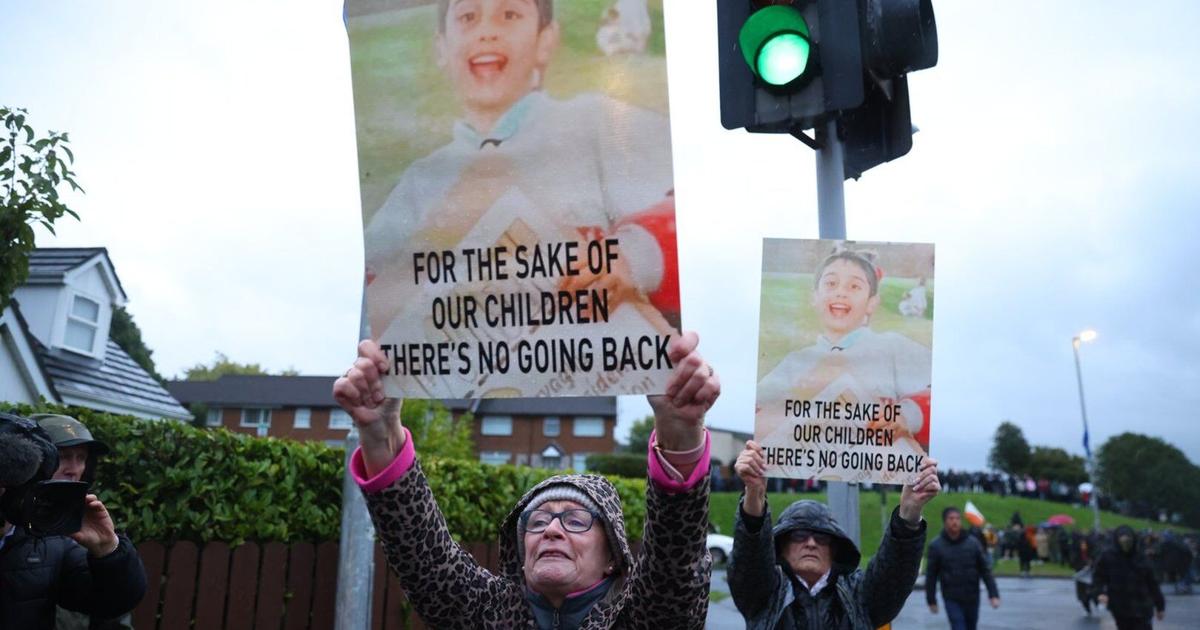
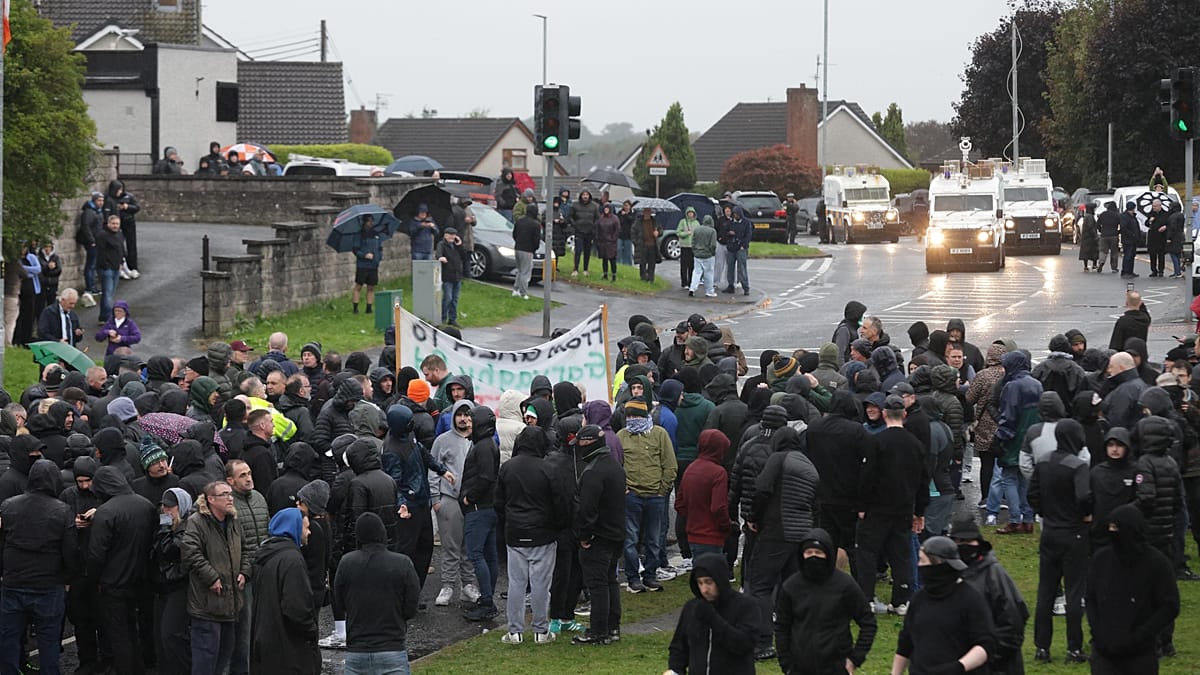
Photo via The Sydney Morning Herald

‘Madness’: Standoff in Northern Ireland town as protesters block first Orangemen march in decades

Read the original at The Sydney Morning Herald ↗
Cite

McNaughton, C., & Ferguson, A. (2026, September 28). ‘Madness’: Standoff in Northern Ireland town as protesters block first Orangemen march in decades. The Sydney Morning Herald. https://www.smh.com.au/world/europe/madness-standoff-in-northern-ireland-town-as-protesters-block-first-orangemen-march-in-decades-20260928-p610zb.html?ref=rss&utm_medium=rss&utm_source=rss_feed

Dated when The Aporia collected the article, usually within hours of publication. Check the original for its exact date and byline.

The Sydney Morning Herald · collected 2026-09-28 · by Cathal McNaughton, Amanda Ferguson

Quick Summary

In Portadown, Northern Ireland, about 2000 protesters blocked a Protestant parade from passing through a Catholic area on Sunday, following an almost 30-year ban. The attempt to march through the Garvaghy Road was opposed by local residents and Sinn Fein leaders Michelle O’Neill and Mary Lou McDonald. Despite the lifting of the ban by Northern Ireland’s Parades Commission after a procedural error in court rulings, police kept both sides apart with riot gear and warnings against criminal activity. The standoff continued into Sunday night, with protesters planning to remain on the streets indefinitely to prevent future marches from taking place along this contentious route.
Written by AI on 2026-09-28, from this article's own text only (the story summary below draws on all the coverage).
See how they differ ↓

AI analysis

Story summary

Northern Ireland's Parades Commission permitted the Drumcree parade to proceed on Garvaghy Road in Portadown for the first time in nearly 30 years. The decision sparked significant protests and security concerns, leading to an unprecedented late-night ruling by the High Court that upheld the commission’s determination. Despite this, thousands of protesters gathered, attempting to block the parade route. Police advised that allowing the procession could lead to serious injury, disorder, and wider unrest. As a result, Sir Chris Bryant intervened to ban the parade from returning along its traditional nationalist route on Garvaghy Road. This decision faced criticism from unionist politicians like Gavin Robinson of the DUP, who accused Bryant of "disgraceful appeasement." The legal challenge against Bryant's intervention is set to be heard in court. Meanwhile, First Minister Michelle O’Neill and her Sinn Féin colleagues face no confidence motions for backing the Garvaghy Road residents during protests. Sir Chris defended his decision, emphasizing peace and community support over violence.

Written for “Drumcree Parade Controversy” on 2026-11-18, grounded in this article and the 106 other(s) covering the same event.

How they differ

10 outlets covered “Drumcree Parade Controversy”.

What each outlet says

One AI summary per outlet of its latest article on this story, written from that article alone and checked against it. Open the article for the outlet's own words.

Sydney Morning HeraldThis outlet28 Sep

In Portadown, Northern Ireland, about 2000 protesters blocked a Protestant parade from passing through a Catholic area on Sunday, following an almost 30-year ban. The attempt to march through the Garvaghy Road was opposed by local residents and Sinn Fein leaders Michelle O’Neill and Mary Lou McDonald. Despite the lifting of the ban by Northern Ireland’s Parades Commission after a procedural error in court rulings…

‘Madness’: Standoff in Northern Ireland town as protesters block first Orangemen march in decades (this article)2 articles from Sydney Morning Herald on this story
Evening Standard14 Oct

Sir Chris Bryant defended his decision to ban an Orange Order parade in Portadown from its traditional route on the nationalist Garvaghy Road, citing concerns about violence despite near-agreement between conflicting sides. He denied succumbing to violent pressure and emphasized the need for moderate language and peace. Additionally, he announced a review of the Parades Commission's operations to ensure broader…

I did not succumb to violence over Drumcree ban – Sir Chris Bryant →72 articles from Evening Standard on this story
BBC10 Oct

Sir Chris Bryant, Northern Ireland's Secretary of State, announced on Friday that he banned the Orange Order’s Drumcree march due to concerns over potential violence. He received advice from the PSNI chief constable indicating serious risks if the parade proceeded. Speaking with BBC News NI and BBC Radio 4’s Today programme, Sir Chris defended his decision as necessary for maintaining peace, urging all parties…

Drumcree parade ban was in interests of peace, says Bryant →11 articles from BBC on this story
The Guardian9 Oct

Chris Bryant, Northern Ireland secretary, has banned the Drumcree parade after two weeks of standoff between the Orange Order and nationalist residents on the Garvaghy Road in Portadown. The Parades Commission had initially allowed the march with restrictions, but due to ongoing protests, Bryant decided it was not in the public interest for the procession to go ahead and thus banned it.

Northern Ireland secretary Chris Bryant bans Drumcree parade →5 articles from The Guardian on this story
Al Jazeera10 Oct

Residents in a predominantly Catholic area of Portadown, Northern Ireland, are celebrating following the UK's decision to ban a controversial Protestant parade through their neighborhood. The ban concluded a period of tension that began when local authorities had initially permitted the march along the main road.

Ireland Catholic residents react to UK ban on Protestant march →5 articles from Al Jazeera on this story
The Straits Times9 Oct

Northern Irish police plan to interview First Minister Michelle O'Neill regarding an ongoing protest that has prevented a Protestant parade from passing through a Catholic area in Portadown since September 26. The demonstration, led by Sinn Fein members including party leader Mary Lou McDonald, opposes the march's route, which had been banned under the Good Friday Agreement until this year. Police have initiated an…

Northern Irish police to interview First Minister O'Neill over parade protest →4 articles from The Straits Times on this story
Show 4 more outlets
Daily Mail10 Oct

Sir Chris Bryant, Northern Ireland Secretary, banned a contentious Orange Order parade from passing through a Catholic area in Portadown after two weeks of deadlock between the Orange Order and nationalist residents. This decision follows the Parades Commission's ruling that allowed the march with restrictions, but significant protests prevented it from taking place. The ban was met with approval from Sinn Féin and…

Orange Order vow legal action after minister bans Garvaghy Road march following two-week stand-off →4 articles from Daily Mail on this story
Toronto Star10 Oct

Chris Bryant, the UK's Northern Ireland Secretary, intervened on Friday night to prevent a contentious march planned by the Orange Order from proceeding along Garvaghy Road in Portadown, citing an inability to reach a compromise with local residents who oppose the parade due to sectarian tensions. The decision came after two weeks of negotiations between pro-union and pro-reunification groups in Northern Ireland.

UK government blocks Northern Ireland march after standoff fueled sectarian tensions →2 articles from Toronto Star on this story
CBC27 Sep

Tensions escalated in Portadown, Northern Ireland, after a late-night decision by the High Court allowed an Orange Order parade to proceed down Garvaghy Road for the first time in nearly three decades. This move has ignited protests from local residents who oppose the march and have blocked the street. British Prime Minister Andy Burnham urged calm, while Police Service of Northern Ireland's head Jon Boutcher…

Tensions run high in Northern Ireland after contentious march given go-ahead →
Euronews27 Sep

On Sunday morning in Portadown, Northern Ireland, about 2,000 protesters gathered to block an Orange Order march that was allowed by court order but controversially restricted after earlier legal challenges. Despite a Court of Appeal ruling permitting the limited parade without bands or supporters, police halted it due to safety concerns amid the large protest crowd. Nationalist leaders criticized the decision to…

Northern Ireland: 2,000 protesters block disputed Portadown march →

Where they agree and split

Agreed

AI · cited, from two or more outlets

  • The Parades Commission allowed the Orange Order to march on the Garvaghy Road for the first time in nearly 30 years, with restrictions.16
  • Protesters blocked the parade route and gathered to prevent the procession from taking place.24
Quoted from the coverage (3)

Burnham appealed for "calm on all sides" over the parade, saying there have been "big gains made in Northern Ireland, and we don’t want to see things go backwards."

4 outlets

The Irish taoiseach, Mícheál Martin, echoed that but described the Parades Commission decision as “incomprehensible and wrong”.

4 outlets

On Thursday, the police said they had begun issuing letters inviting people "reasonably suspected" of committing offences linked to the protests to interview.

4 outlets

Disputed

Picked by our model, which is sometimes wrong

  • The Evening Standard reported that the Parades Commission allowed the march with restrictions, while The Guardian noted that the decision was denounced as 'madness' by Sinn Féin.12
  • The BBC stated that police prevented the Orange Order from marching on Sunday morning due to protesters blocking the route, whereas CBC reported that thousands of protesters gathered in balaclavas to block the marchers.36

Framing

How the first headlines put it

  • CBC emphasized high tensions in Northern Ireland due to the contentious march being allowed, whereas BBC reported on the police preventing the procession from taking place.63
The full story: what happened, how it changed, and all 107 articles →

Compared with similar articles

This article reads leans left and hedges 0% of its claims. Each row says how that neighbour differs.
Al Jazeera
Leans right further right than this Hedges 0 of 8 claims Outlet record 60/100
Toronto Star
Centre further right than this Hedges 0 of 2 claims Outlet record 64/100
CBC News
Leans right further right than this Hedges 0 of 17 claims Outlet record 60/100
Euronews
Leans left Hedges 0 of 12 claims Outlet record 60/100
Evening Standard
Hedges 3 of 51 claims Outlet record 64/100
Evening Standard
Hedges 2 of 68 claims Outlet record 64/100
Evening Standard
Hedges 0 of 19 claims Outlet record 64/100
“Article A describes a specific standoff on September 28, 2026, involving protesters blocking an Orangemen march in Portadown. Article B discusses broader trends and statistics about race hate crimes over the past year without mentioning the same specific incident.”
Daily Mail
Hedges 1 of 24 claims Outlet record 70/100
The Guardian
Hedges 2 of 30 claims Outlet record 64/100
The Straits Times
Leans left Hedges 0 of 16 claims Outlet record 64/100

Story

Drumcree Parade Controversy
Politics · 107 article(s) covering the same event. Compare every outlet's account →
How this article was measured signals, leaning charts, publisher record, byline, topics and claims

Signals How these are calculated →

Claims extracted
35
sentences that state something as happening or true
Uncertain
0%
0 of 35 hedged ("reportedly", "may", "according to")
Leaning
Leans left
of the writing, not the subject · beta estimate
Publisher signals
61/100
The Sydney Morning Herald's corrections and hedging, across everything collected from it. Not a measure of accuracy.
Outlets on this story
107
Politics
Same framing elsewhere
1
articles that frame the event the way this one does
Analyzed 2026-09-28 · how these are computed

How this is being covered How these are calculated →

Article leaning vs. publisher reliability
Source leaning vs. consistency

Publisher

The Sydney Morning Herald · 7597 article(s) · 15 correction(s) detected
Running correction rate · 15 correction(s)

Who wrote this

Cathal McNaughton
1 article(s) here · 1 carrying a prediction
A senior member told the BBC they would wait for police to tell them the route was ready.
The only article under this byline in the corpus.
Amanda Ferguson
1 article(s) here · 1 carrying a prediction
A senior member told the BBC they would wait for police to tell them the route was ready.
The only article under this byline in the corpus.

Topics

British Catholic Northern Ireland Portadown Protestant

Subjects

Catholic NORP · 5× Northern Ireland GPE · 5× British NORP · 4× Protestant NORP · 4× BBC ORG · 3× Irish NORP · 3× Portadown GPE · 3× Britain GPE · 2× McDonald ORG · 2× Sinn Fein ORG · 2×

Narrative

Gavin Robinson, leader of the Democratic Unionist Party, told a news conference: “It is shameful ... that we see a first minister, a collection of ministers who are participating in an unlawful protest, who are blocking the road and who are giving two fingers to the police, the courts and the rule of law.”
framing: assertive · carried by 1 article(s) · first seen 2026-09-28
A senior member told the BBC they would wait for police to tell them the route was ready.

Claims (35 extracted, 0 hedged)

About 2000 protesters blocked a Protestant parade from marching through the Catholic area of a Northern Irish town, with both sides refusing to disperse and police keeping them apart. asserted
police → block → them
The attempt to hold the parade through Portadown on Sunday (Northern Ireland time) followed the lifting of an almost 30-year ban on the contentious route, but the marchers were halted by crowds including Northern Ireland First Minister Michelle O’Neill of Irish nationalists Sinn Fein. asserted
marchers → hold → nationalists
The protesters, also including Sinn Fein leader Mary Lou McDonald, gathered in the rain on the Garvaghy Road overnight after Belfast’s High Court in a late-night sitting dismissed an application by residents to stop the parade. asserted
Court → include → parade
Annual attempts by the Protestant Orange Order to march through the area triggered unrest across the British-run region before the route was banned in 1998, the same year the Good Friday Agreement largely ended the three decades of violence known as the “Troubles”. asserted
Agreement → march → Troubles
“This is madness,” McDonald told reporters on the road, a Catholic enclave in the largely Protestant town of Portadown. asserted
McDonald → tell → Portadown
The leaders of Ireland and Britain, who are co-guarantors of the peace accord, called for calm. asserted
who → call → calm
“There have been big gains made in Northern Ireland and we don’t want to see things go backwards,” British Prime Minister Andy Burnham said. asserted
Burnham → make → Ireland
Irish Prime Minister Micheal Martin shared Burnham’s concern but also called the ruling by Northern Ireland’s Parades Commission to allow the parade “incomprehensible” and “wrong”. asserted
Martin → share → parade
The commission, which regulates marches in the British-run region, on Friday permitted a smaller-than-usual 35 people to take part in the march on Sunday morning. asserted
people → regulate → morning
It had initially continued the ban for this year’s parade, but that decision was quashed by the High Court in August over a procedural error. asserted
decision → continue → error
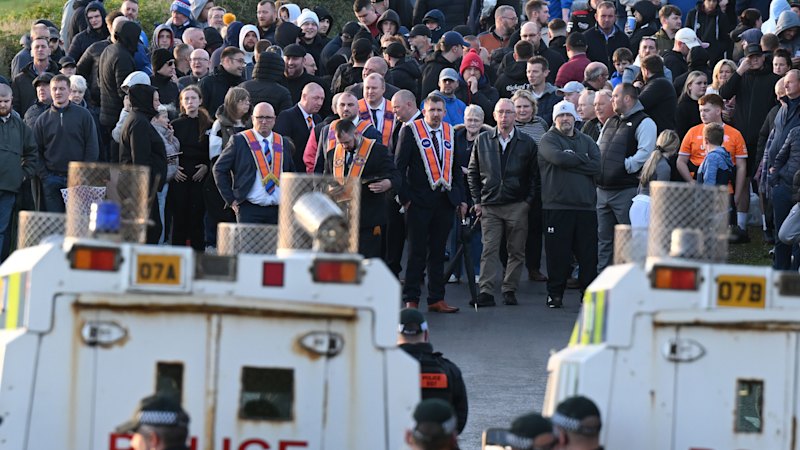
A small group of Orange Order members wearing traditional silk orange sashes and black bowler hats gathered at another part of the town, but the march did not start. asserted
march → wear → town
They were forced to retreat to Drumcree Church. asserted
They → force → Church
A senior member told the BBC they would wait for police to tell them the route was ready. asserted
route → tell → them
Police vans parked near the Garvaghy Road and flanked by officers in riot gear played out warnings that anyone taking part in the protest was committing a criminal offence. asserted
anyone → park → offence
While the protest crowd dwindled late on Sunday night, the road remained blocked. asserted
road → dwindle → night
The BBC reported that hundreds of people gathered at midnight to hear to Garvaghy Road Residents Coalition spokesperson Breandán Mac Cionnaith address the crowd. asserted
Cionnaith → report → crowd
He asked some people to stay out on the streets tonight and said it would “drag on for a while”. asserted
it → ask → while
“We’ve stopped them once, the process now is to make sure we stop them permanently,” he said. asserted
he → stop → them
“We’re not going in to deals with them. asserted
We → go → them
We’re not putting the clock back, we’re putting the clock forward.” asserted
we → put → clock
Likewise, some members of the Orange Order remained near the police vans. asserted
members → remain → vans
Earlier, they said they were determined to march their intended route. asserted
they → say → route
Shortly after midnight Garvaghy Road was largely cleared of protesters, but about 30 residents were maintaining a presence, the BBC reported. asserted
BBC → clear → presence
The Drumcree dispute exploded in the mid-1990s when, in the wake of ceasefires by Northern Ireland’s main guerrilla groups, it became a symbol of the wider dispute between mainly Catholic nationalists, who consider themselves Irish, and Protestants loyal to Britain. asserted
themselves → explode → Britain
The Orangemen, who take their name from Protestant King William of Orange who defeated deposed Catholic King James II at the Battle of the Boyne in 1690, say their parades are part of their Protestant cultural tradition. asserted
parades → take → tradition
Whilst most of the parades that take place across Northern Ireland each year are uncontroversial, nationalists say parades passing through Catholic areas are an offensive display of triumphalism designed to intimidate them. asserted
parades → take → them
McDonald and O’Neill called on the British government and police to intervene. asserted
McDonald → call → government
Britain’s minister for the region, Chris Bryant, has the power to revoke the Parades Commission’s ruling at the request of Northern Ireland’s police. asserted
minister → have → police
Bryant, who was returning to Belfast from his Labour party’s conference in Liverpool to meet political leaders, told the BBC he had not received any request from police following several conversations with its chief constable. asserted
he → return → constable
“Nobody wants to go back 28 years,” he said. asserted
he → want → ?
“The whole idea of us coming here is to be able to try and be able to talk specifically face-to-face to some of the political leaders and some of the community leaders to see if we can get to a settled position. asserted
we → come → position
“Everybody has to double down on compromise – that’s what life’s all about.” asserted
life → have → what
O’Neill, whose party shares power with the largest pro-British party in a devolved administration established as a key part of the 1998 peace deal, warned that the dispute brought into question how the peace process works. asserted
process → share → question
Gavin Robinson, leader of the Democratic Unionist Party, told a news conference: “It is shameful ... that we see a first minister, a collection of ministers who are participating in an unlawful protest, who are blocking the road and who are giving two fingers to the police, the courts and the rule of law.” asserted
who → tell → law
Reuters Get a note directly from our foreign correspondents on what’s making headlines around the world. asserted
what → get → world
Give feedback · no sign-in needed

No sign-in needed for now. Your note is sent without a name, so it cannot be answered.

History Support