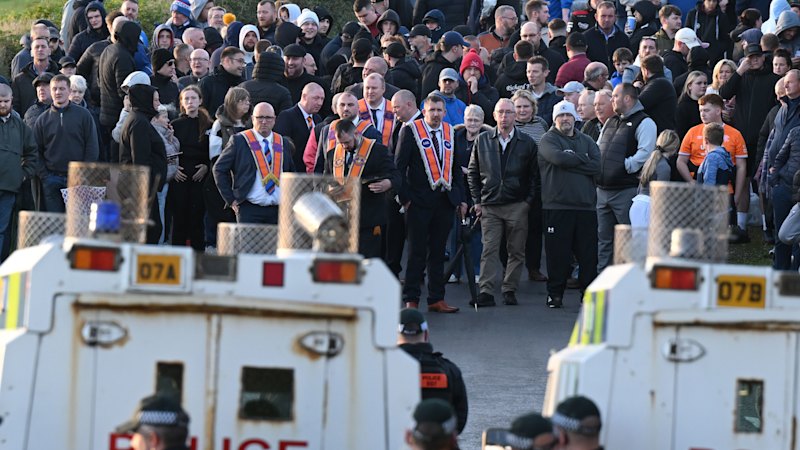
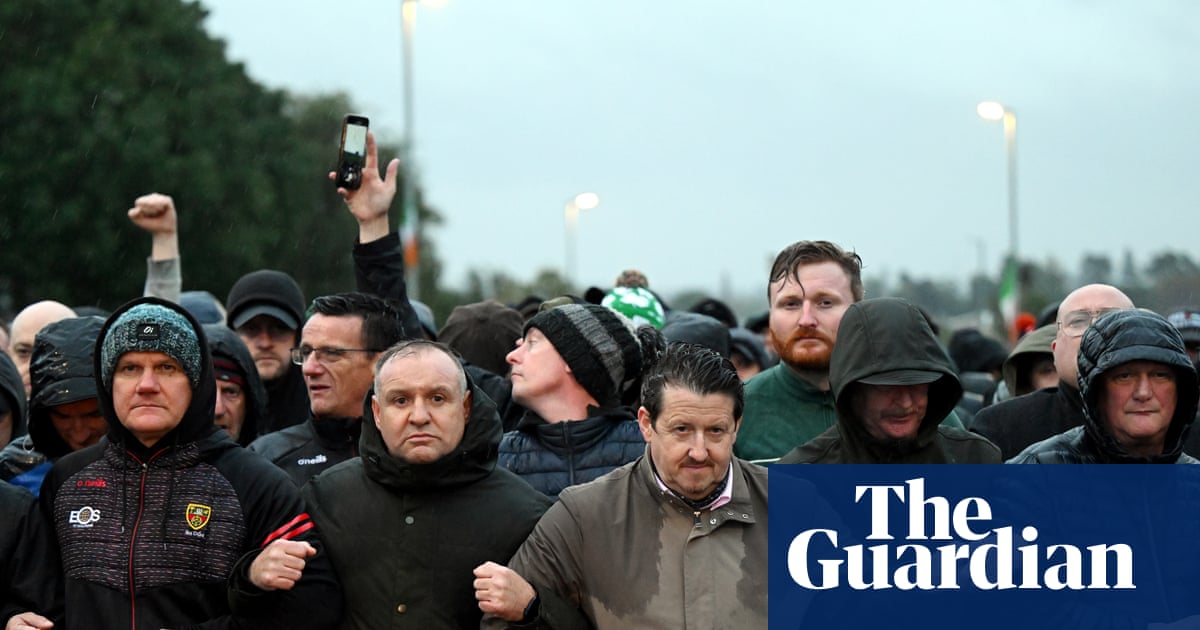
A tense standoff occurred in Portadown, Northern Ireland, on Sunday after a loyalist parade was allowed by the Parades Commission to proceed through a predominantly Catholic area for the first time since 1998. Thousands of protesters, including political figures like Michelle O'Neill and Gerry Adams, blocked Garvaghy Road to prevent the march, which is organized by the Protestant Orange Order. The decision to lift the ban was met with criticism from O'Neill, who described it as "disgraceful" and said the march would cause trauma for local families. Meanwhile, Gavin Robinson of the Democratic Unionist Party supported the decision and pledged his party's continued cooperation despite the legal defiance shown by protesters.
Written locally by qwen2.5:14b on 2026-09-28,
using this article's own text rather than the other coverage of the
same event (that is the story summary below).
Story summary
On September 27, the Parades Commission allowed the Orange Order's Drumcree parade to proceed along Garvaghy Road for the first time in almost 30 years. The commission restricted the number of participants to 35 people, starting at 8 am, and required them to disperse by 9:30 am from Carleton Street Orange Hall, with only the Portadown District banner allowed during this stretch. No supporters or bands were permitted along the parade route near residents' homes on Dungannon Road and Drumcree Road.
The decision drew mixed reactions; DUP hailed it as a breakthrough while Sinn Féin condemned it strongly, viewing it as forcing an Orange march through the community. Garvaghy Road residents had been vehemently opposed to such parades during the 1990s Troubles era, leading to violent clashes and political tension necessitating significant security measures.
Following an unprecedented late-night court hearing concluding at 2:15 am, Justice Michael Humphreys upheld the commission's ruling. Crowds gathered in Portadown early Sunday morning, with many wearing balaclavas, awaiting the parade amidst heavy rain and tense conditions. The hearing acknowledged the unusual circumstances but maintained respect for public bodies' decisions.
Concerns were raised that this go-ahead could disrupt agreements at other flashpoint areas across Northern Ireland, signaling potential challenges to maintaining peace in former conflict zones.
Written for “Drumcree Parade Decision” on 2026-10-05,
grounded in this article and the 59 other(s) covering the same event.
- See more Daily Mail on Google - save us as a Preferred Source
A tense stand-off threatened to return Northern Ireland to its embittered past on Sunday after a loyalist parade was allowed to go ahead for the first time in nearly 30 years.
asserted
parade → see → years
Thousands of protesters, including first minister Michelle O'Neill and former Sinn Fein president Gerry Adams, blocked Garvaghy Road in Portadown to stop the Protestant Orange Order marching through the Catholic area.
asserted
Order → include → area
The demonstration had been banned since 1998 due to repeated sectarian violence outside Drumcree Church which culminated in the firebombing that year of a Catholic home in which three children were killed.
asserted
children → ban → which
On Friday, the ban was lifted by the Northern Ireland Parades Commission, leading to a weekend of legal wrangling.
asserted
ban → lift → wrangling
At 2.15am on Sunday, Belfast's Court of Appeal ruled it would not interfere with the decision.
asserted
it → rule → decision
The Orange Order had been due to start the march at 8am on Sunday.
asserted
Order → start → Sunday
As of 8pm on Sunday, members of the order said they would continue to wait until police tell them the road is clear.
asserted
road → say → them
But Ms O'Neill urged protesters to stay to at least midnight to continue the stand-off.
asserted
O'Neill → urge → off
Ms O'Neill branded the decision to lift the ban as 'disgraceful' and said the march was 'steeped in a history of hate, sectarian violence and murder'.
asserted
march → brand → hate
She added: 'Families here feel traumatised.
asserted
Families → add → ?
Does anybody think that this is a good idea?
asserted
this → think → ?
No right-minded person would make this decision.
asserted
person → make → decision
Why, after 28 years, did the Parades Commission think it was right to bring this mess back on to this community?
asserted
it → think → community
A tense stand-off threatened to return Northern Ireland to its embittered past on Sunday after a loyalist parade was allowed to go ahead for the first time in nearly 30 years
The Orange Order lined up outside the hall at Drumcree Parish Church for the 8.00am parade start that was then delayed by a policing decision
Thousands of protesters blocked Garvaghy Road in Portadown to stop the Protestant Orange Order marching through the Catholic area
Sinn Fein president Mary Lou McDonald said: 'People have gathered in huge numbers because they are angry.
asserted
they → threaten → numbers
They cannot countenance the idea that anybody would set this place back almost 30 years and revisit the trauma this community endured.'
asserted
community → countenance → trauma
Democratic Unionist Party leader Gavin Robinson said there should be 'unanimous condemnation' of Ms O'Neill and her Sinn Fein colleagues for defying the court's decision.
asserted
Robinson → say → decision
He said: 'We are being plunged into difficult territory because people who are expected to be lawmakers in our country are breaking the law.'
Asked whether he would continue to work with Sinn Fein, he said: 'Our party is maintaining the dignity of the Portadown Orangemen.
asserted
party → say → Orangemen
As they have shown determination and patience, so will we.
asserted
we → show → determination
If it takes another 28 hours or 28 days, they will show the same steadfast determination, patience and willingness to uphold the law as they've demonstrated over the last 28 years.'
asserted
they → take → years
Prime Minister Andy Burnham appealed for calm on all sides, but Northern Ireland Secretary Sir Chris Bryant appeared to criticise Ms O'Neill, saying: 'I don't think any elected politician should be supporting an unlawful protest.'
asserted
politician → appeal → protest
He urged both sides to 'double down on compromise' so a 'settled position' could be reached.
uncertain
position → urge → compromise
Protesters were separated from the Orange Order by riot police on Sunday, but there was little trouble.
asserted
Protesters → separate → Sunday
One man who hurled a bottle at a police vehicle was reprimanded by fellow protesters.
asserted
who → hurl → protesters
Jon Boutcher, Chief Constable of the Police Service of Northern Ireland, said: 'We are determined to find a way through all of this.'
asserted
We → say → this
 The Aporia