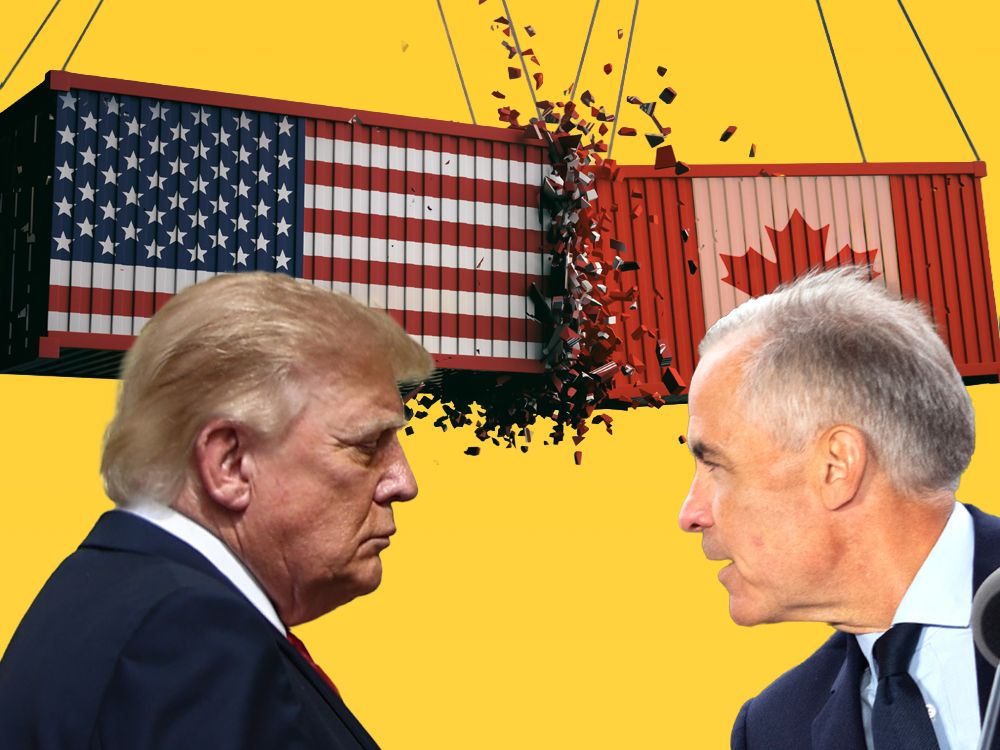
Prime Minister Mark Carney said his government is still studying whether to retaliate against the latest countermeasures from the United States in its trade war with Canada, but played down the severity of the most recent salvo from Washington.
asserted
government → say → Washington
“We’re looking closely at the measures that the Americans have just recently announced,” he told reporters in Banff, where his cabinet is holding a two-day retreat that wraps up on Friday.
asserted
that → look → Friday
Mr. Carney said he realized that for affected companies and sectors the reprisals are significant, but he added that in the context of previous retaliation taken by the U.S., “these are relatively modest measures and so we take that into context.”
asserted
we → say → context
Earlier this week, Canada’s former ambassador to the U.S. Kirsten Hillman told The Globe and Mail in an interview that she expected it would be months before Ottawa and Washington resume formal talks.
asserted
Ottawa → tell → talks
Canada walked away from negotiations in August and Mr. Carney has said the U.S. trade proposals would “destroy” large Canadian industries, including automobiles, steel and aluminum.
asserted
proposals → walk → automobiles
Mr. Carney, during a separate press conference Thursday with Ukrainian President Volodymyr Zelensky, said he maintains regular contact with U.S. President Donald Trump despite the trade conflict.
asserted
he → say → conflict
He said recent talks have focused on matters related to Ukraine and Iran.
asserted
talks → say → Ukraine
“We continue to work with the United States.
asserted
We → continue → States
We can compartmentalize,” he said.
asserted
he → compartmentalize → ?
On Tuesday, Mr. Trump issued a sweeping ban on imports of Canadian alcohol, motorcycles and some dairy products as Washington ratcheted up pressure in response to Ottawa’s latest countertariffs, heightening a trade war that has been ramping up since Canada walked away from the negotiating table last month.
asserted
Canada → issue → table
In addition, Washington adjusted a number of the levies it imposed last month using Section 338 of the Tariff Act of 1930 – adding 110 new items to the list, while removing a handful of others.
asserted
it → adjust → others
Mr. Trump also said he would order the U.S. General Services Administration to remove Canadian products from its Multiple Award Schedule program, which government agencies use to purchase things such as information technology and office supplies – a blow to companies selling from Canada.
asserted
agencies → say → Canada
These measures are expected to come into effect in the coming weeks.
asserted
measures → expect → weeks
Asked if the fact there is a delay before these new import bans take effect means the U.S. is leaving an option for talks to resume, the Prime Minister said it’s up to Washington to say.
asserted
it → ask → Washington
“It’s really for the Americans to answer the question, but I wouldn’t overinterpret a delay, if you will, or a lag,” he said.
asserted
he → ’ → delay
“We’re always ready to sit down in a professional way to negotiate.
asserted
We → ’re → way
We think there is a mutually beneficial deal possible that respects our sovereignty and is in the interest of both countries.”
asserted
that → think → countries
Separately, in New York, Conservative Leader Pierre Poilievre spoke out in support of tariff-free trade with the U.S. but declined to criticize Mr. Carney’s handling of the trade dispute when asked by CNBC.
asserted
Poilievre → speak → CNBC
“Look, I’m not going to attack my Prime Minister on foreign soil,” he told the network Thursday.
asserted
he → look → network
“It’s just not something I am going to do.”
asserted
I → ’ → ?
He said the U.S. started this war.
asserted
U.S. → say → war
“The administration hit us with tariffs first, and everything escalated thereafter.”
asserted
everything → hit → tariffs
Mr. Poilievre told CNBC that Canadians are feeling wounded over how their country ended up as a major target for Mr. Trump.
asserted
country → tell → Trump
“We’re kind of confused as to how it is suddenly that Canada ended up in the crosshairs.”
asserted
Canada → ’re → crosshairs
He said removing tariffs will help Americans.
asserted
removing → say → Americans
“We can save money and jobs for both our people if we get back to two-way tariff-free trade.
asserted
we → save → trade
That will bring down the cost of living for Americans.
asserted
That → bring → Americans
It will grow pay cheques on both sides of the border.”
asserted
It → grow → border
Ian Bremmer, president of the research and consulting firm Eurasia Group, was among the people briefing Mr. Carney’s cabinet retreat.
asserted
Bremmer → consult → retreat
Ahead of those meetings, Mr. Bremmer told reporters that the federal government needs to prepare for tariffs to be a permanent part of the trade relationship with the U.S. – no matter who is in the White House.
asserted
who → tell → House
“There’s almost no one in Washington that wants to stop taking in income from tariffs,” he said.
asserted
he → ’ → tariffs
“The United States is not going to be the architect or the proponent of a global free trading system, but rather we’re going to see more industrial policies, more subsidies, more tariffs.”
asserted
we → go → policies
Mr. Bremmer said Ottawa needs to separate out the permanent changes in U.S. policy that Mr. Trump has spearheaded and the President’s “unpredictability and unreliability.”
asserted
Trump → say → that
“I do not believe it will ever come back to what it was, but I also think there’s a great deal of repair that can and will be done.”
asserted
that → believe → repair
Mr. Bremmer has many ties to Mr. Carney and his advisers, and the Prime Minister’s wife, Diana Fox Carney, works for the Eurasia Group.
asserted
wife → have → Group
Mr. Bremmer said he was not paid to attend the retreat and does not do any lobbying work.
asserted
he → say → work
 The Aporia