Flock Taught Cops How to Surveil No Kings Protesters

404 Media · collected 2026-09-04 · by Jason Koebler
Read the original at 404 Media ↗

Summary

A company called Flock taught law enforcement officials how to surveil protesters during a webinar last year, showcasing its technology's ability to combine various forms of surveillance in real-time. The webinar demonstrated how police can use Flock's software platform, FlockOS, to monitor events like the No Kings protests and 4th of July fireworks displays through a single dashboard. According to the director of market management for Flock, Caity Peak, the platform allows officers to view live video footage, traffic information, and other data in one place, enabling them to respond quickly to potential issues. The webinar highlights how law enforcement agencies can use Flock's technology to monitor peaceful events with ease, raising concerns about the invasive capabilities of the company's surveillance network.
Written by the local model on 2026-09-04, using this article's own text rather than the other coverage of the same event (that is the story summary below).

Signals How these are calculated →

Claims extracted
43
claim-shaped sentences
Uncertain
5%
2 of 43 hedged
Leaning
Leans strongly right
of the writing, not the subject
Publisher trust
94.8
red-flag proxy, not a credibility rating
Outlets on this story
1
Crime & Law
Narrative spread
1
articles carrying this framing
Analyzed 2026-09-04 · how these are computed

AI analysis (generated at analysis time, not now)

Story summary

Flock, a company that provides automated license plate reader technology to law enforcement, taught police how to use its system to surveil protesters at the No Kings Protest, as well as "small parades" like the 4th of July fireworks displays and Mardi Gras, in a webinar last year. The webinar showed how Flock's cameras can be used in real-time crime centers, which are police surveillance centers that combine various surveillance feeds. According to Caity Peak, Flock's director of market management, these centers can be used not only for emergency response but also to monitor "established events", including protests and parades. The company has been downplaying the capabilities of its system while highlighting its use in solving violent crimes. However, the webinar reveals that Flock offers much more invasive capabilities, including using automated license plate readers, drones, gunshot detectors, 911 data, and other surveillance cameras to monitor various events. Peak explained that this information would eventually be shared with law enforcement agencies, including the Department of Homeland Security, federal fusion centers, and the FBI. This raises concerns about the extent to which law enforcement is using Flock's technology to monitor and surveil citizens at peaceful events.

Written for “Animal Activism and Police Tactics” on 2026-09-05, grounded in this article and the 0 other(s) covering the same event.
Why this leaning score
The article's own words the score was based on. Each is quoted verbatim and was checked against the article text before being stored, so you can find it in the original.
Score +0.85 Confidence high
Leaning score +0.85 for article 3691 (high confidence, 3 verified quotes) · logged 2026-09-04

Story

📰 Animal Activism and Police Tactics
Crime & Law · 1 article(s) covering the same event. This is the one the site leads with.

How this is being covered How these are calculated →

Article leaning vs. publisher reliability
Source leaning vs. consistency

Compared with similar articles

This article reads leans strongly right and hedges 5% of its claims. Each row says how that neighbour differs.
Latest & Breaking News on Fox News
⚖️ Leans right further left than this 🔴 7% hedged 2 of 28 📰 publisher trust 94
“Article A describes a webinar from last year where Flock taught cops how to surveil protesters, while Article B mentions Mark Beall's warning about AI surveillance tools without referencing any specific webinar or event”
Reason.com
⚖️ Leans left further left than this 🔴 16% hedged 32 of 203 📰 publisher trust 94
“Article A discusses a general warning by U.S. police departments about the potential risks of revealing sensitive information on car stickers, while Article B specifically mentions a Flock webinar on surveilling protesters and small parades”
404 Media
⚖️ Leans right further left than this 🔴 4% hedged 1 of 23 📰 publisher trust 95
“Article A discusses Axon's efforts to redesign their cameras due to vandalism, while Article B describes a webinar where Flock taught law enforcement how to use their technology for surveillance, with no mention of vandalism or camera design”
The Markup
⚖️ Leans left further left than this 🔴 14% hedged 12 of 87 📰 publisher trust 94
“Article A describes a webinar about Flock's technology, while Article B reports on a discovery of a hidden camera and surveillance network on California's border”
404 Media
⚖️ Leans left further left than this 🔴 26% hedged 10 of 39 📰 publisher trust 95
“The articles mention different uses and capabilities of the AI tool, indicating distinct events rather than a single occurrence.”
The Intercept
⚖️ Leans left further left than this 🔴 7% hedged 6 of 83 📰 publisher trust 97
“Article A discusses a webinar where Flock taught police how to surveil protesters, while Article B reports on donations by Flock to local politicians' groups amidst protests against AI cameras”
NPR Topics: News
⚖️ Leans left further left than this 🔴 4% hedged 1 of 26 📰 publisher trust 58
“Article B discusses the opposition to Flock cameras in general, while Article A specifically reports on a webinar where Flock taught law enforcement how to surveil protesters using their technology”
CBC | Top Stories News
⚖️ leaning not scored 🔴 0% hedged 0 of 2 📰 publisher trust 95
“Article A refers to a webinar that took place last year, while Article B mentions Flock Safety's technology being used in Canada but does not specify a recent development”

Publisher

404 Media · 36 article(s) · 0 correction(s) detected
SignalValueWeight
Correction rate 0.000 0.4
Uncertainty density 0.105 0.25
Assertive mismatch rate 0.000 0.35
No corrections detected for this publisher. That may mean careful reporting, or simply that nothing has been checked.

Who wrote this

Jason Koebler
7 article(s) here · 1 carrying a prediction
🔮 “It can detect if somebody’s laying on the ground so that means homeless people could be detected and police get triggered.”
🔮 Flock taught cops how they could surveil the No Kings protests and “small parades” using a mix of Flock’s technology and law enforcement’s own databases in a webinar last year.
2026-09-04 · assertive framing · Flock Taught Cops How to Surveil No Kings Protesters
🔮 404 Media first reported on the incident in May 2025 in which the Johnson County Sheriff’s Office in Texas searched Flock’s nationwide network for the whereabouts of a woman who self-administered an abortion, highlighting the threat of this AI-powered surveillance system being used to criminalize or track women seeking reproductive healthcare.
🔮 Moonbug’s Generative AI policy and its “Studio AI Bible,” a guide to using AI to help generate content, seen by 404 Media, explain in detail how its AI use will work.
🔮 A police department in Florida used “decoy” Flock cameras that an officer 3D-printed at home to “bait” would-be vandals.
🔮 I don’t think we’ll have much of a public post this year on the actual anniversary, but maybe some public celebrating closer to the party and panel we’re throwing.
2026-08-24 · assertive framing · Behind the Blog: Early Birthday Reflections
More on this subject from Jason Koebler
All 7 articles by Jason Koebler →

Topics

404 Media 4th of July Flock Mardi Gras this No Kings Protest

Subjects

Flock ORG · 11× Peak PERSON · 3× 404 Media ORG · 2× Caity Peak PERSON · 1× California GPE · 1× Denver GPE · 1× EFF ORG · 1× FlockOS ORG · 1× the Electronic Frontier Foundation ORG · 1×

Narrative

“We were able to use our network of cameras and license plate readers to map out what he did when he entered the city a day or two before the event, up until he executed the event and engaged the police and our shooting situation at the conclusion of it,” Flock's Patin said, adding that footage running through FlockOS were eventually shared with the Department of Homeland Security, federal fusion centers, and the FBI.
framing: assertive · carried by 1 article(s) · first seen 2026-09-04
🔮 Flock taught cops how they could surveil the No Kings protests and “small parades” using a mix of Flock’s technology and law enforcement’s own databases in a webinar last year.
2026-09-04 · 404 Media
Flock Taught Cops How to Surveil No Kings Protesters · assertive framing

Claims (43 extracted, 2 hedged)

Flock taught cops how they could surveil the No Kings protests and “small parades” using a mix of Flock’s technology and law enforcement’s own databases in a webinar last year. uncertain
they → teach → webinar
As Flock publicly downplays the power of its automated license plate camera network and highlights its use to solve violent crime, the company’s seemingly endless trove of webinars, training sessions, and blog posts show it offers far more invasive capabilities. asserted
it → downplay → capabilities
In the webinar, Flock’s director of market management Caity Peak explains how real time crime centers — which are police surveillance centers that utilize Flock cameras and other surveillance cameras — can be used for emergency response, but can also be used to surveil “established events” like 4th of July fireworks displays, parades, bike races, Mardi Gras, and protests. asserted
that → explain → displays
The webinar shows just how routine the idea of always-on surveillance has become, and how casually it is used during extremely innocuous events. asserted
it → show → events
Peak explains that police can use FlockOS, a software platform that combines Flock’s automatic license plate readers (ALPR), drones, gunshot detectors, 911 data, and other surveillance cameras (including ones Flock does not own) into a “single pane of glass” or single piece of software to look at various types of surveillance in one place during both emergencies and relatively mundane events in a city or town. asserted
Flock → explain → city
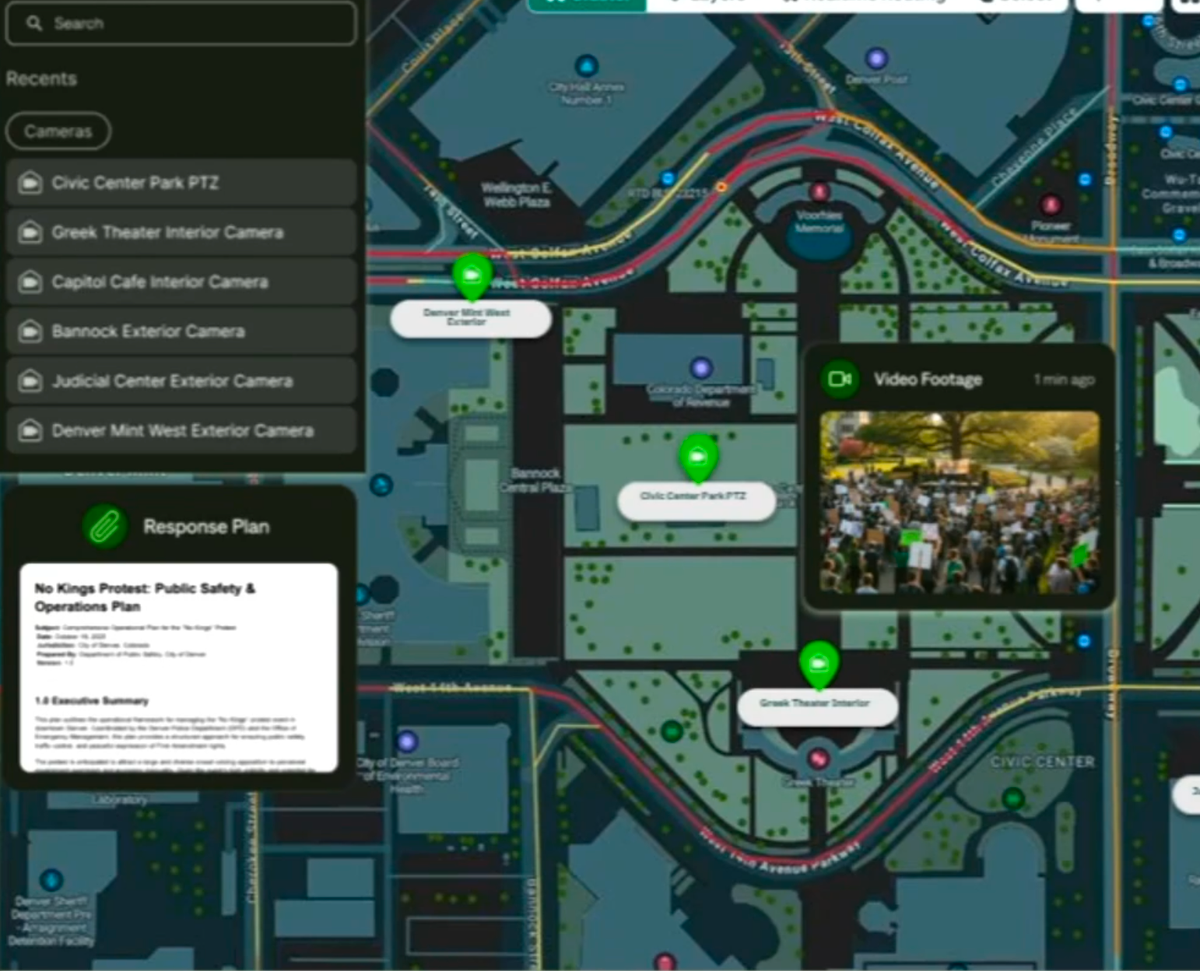
“Imagine that you’re an incident commander, and you’re working this No Kings Protest,” Peak explains while a dashboard shows a series of surveillance tools overlaying the city of Denver. asserted
dashboard → imagine → Denver
“If I’m somebody assigned a traffic post that’s working this No Kings Protest, I really don’t have time to go in […] and look at all these places [for different intelligence]. asserted
I → ’m → intelligence
This is an example of viewing all of that in one place. asserted
This → view → place
I’m an officer, I can see the response plan that’s included, I can pull that up if I need it, but I can also see live video footage as that protest moves throughout the park.” asserted
protest → ’m → park
Peak says the surveillance footage can be used to monitor the protests without having cops physically on the ground “making it worse, getting attention.” asserted
it → say → attention
“I’ve got the video footage to monitor when things go sideways, I know when the environment is starting to shift. asserted
environment → get → footage
But I also know a lot of other things as well. asserted
I → know → things
I can see traffic flow, so as people are blocking the roadway, maybe that’s OK for a while, but if I see that traffic has been stopped a while, I may need to send officers to that area because I know that road rage is imminent,” she continues. uncertain
she → see → area
The dashboard Peak shows includes traffic information, a “response plan” for the protest, the floor plans of nearby buildings, as well as a series of video feeds of both outdoor-mounted cameras and cameras inside businesses and government buildings. asserted
Peak → show → businesses
404 Media and the Electronic Frontier Foundation previously showed that police have specifically used Flock cameras to monitor the No Kings protests and other First Amendment-protected activity. asserted
police → show → protests
404 Media found California cops used Flock to monitor an “immigration protest.” asserted
cops → find → protest
The EFF found that the following law enforcement agencies ran Flock searches related to No Kings protests and rallies: asserted
agencies → find → protests
This webinar shows this type of surveillance is not anomalous, and is specifically taught by Flock. asserted
type → show → Flock
The webinar also shows that Flock’s latest public stance — that its ALPR cameras are noninvasive technology, that they take only static images at a single place and time, and that they are primarily used to solve the worst crimes — is wildly misleading. asserted
they → show → crimes
Flock has time and time again pitched itself to police as a sort of operating system to solve crime and do real-time surveillance and predictive policing. asserted
Flock → pitch → surveillance
ALPRs are just one part of this broader surveillance apparatus that Flock has created, markets to police, and teaches them how to use. asserted
Flock → create → them
These real time crime centers are proving increasingly popular with police; Flock now says on its website that more than 4,800 cities around the country are running FlockOS software. asserted
cities → prove → software
Matt Patin, a former New Orleans Police Department officer and current Flock employee, explains in the webinar that the dashboard can show ALPR data, body camera footage, and other data to “give me a full situational awareness of what’s going on.” asserted
what → explain → awareness
Peak explains that, back when she was a cop, she used to hope that people would plan events near intersections that had ALPR cameras. asserted
that → explain → cameras
“We’d have to pick which intersection is going to make sense [for an ALPR camera], where do we see the most traffic, where do we see the most events, and then I hoped that if an event happened in front of a camera, it’s one that’s in an intersection where I chose to put [the ALPR] and not one where I chose not to put an ALPR asserted
I → have → ALPR
,” she says, adding that she would try to think which types of cameras and drones to use to police a specific event. asserted
she → say → event
“I want to make sure I have as many tools to make myself dangerous if and when I need it,” she adds. asserted
she → want → it
Peak goes on to give another example, in which police would surveil a car sideshow near Sacramento using a mix of drones, surveillance cameras, ALPRs, and monitoring of social media posts. asserted
police → go → posts
“We knew it was likely to turn into nefarious activity based on who was promoting the car show,” she says. asserted
she → know → show
A list of “THINGS TO LOOK FOR” include “mismatched front and rear wheels, stickers representing car clubs, and covered up license plates with car club logos.” asserted
list → look → logos
Peak then demos Flock’s free-form search, which is “AI-powered video search and alerts.” asserted
which → demo → search
“Let’s take Flock’s free-form feature and say ‘hey, any time you see a car tonight with multi-colored wheels passing by any one of these five LPR cameras, I want you to send us an alert,’” she says. asserted
she → take → alert
She then explains how Flock Nova, the company’s deeper investigative tool, can be used to marry LPR information with “all of your agency data,” which in this example includes “person data, IP data, email data, sex offender data, license plate data, vehicle data, and OSINT [open source intelligence].” asserted
which → explain → data
A screenshot of the Flock system shows a “street racing suspect” complete with the man’s name, address, email, social media accounts, phone number, and various affiliations. asserted
screenshot → show → name
“It works like a Google Search,” she says, imagining a scenario in which cops pull someone over then use Nova. asserted
cops → work → Nova
“I run him through Nova. asserted
I → run → Nova
I can query CAD [computer aided dispatch], RMS [records management system], OSINT, jail records. asserted
I → query → CAD
All these things we have integrated to see that we have contacted him before for sideshows, he has been contacted for spinning cars in an intersection in the last 90 days, he is related to this car club, and now with that information, I have the justification I need to actually tow the car for 90 days instead of just issuing a citation.” asserted
I → integrate → citation
Later in the webinar, police from New Orleans and Flock representatives spoke about how its system was used by police in the aftermath of the Bourbon Street terror attack that killed 14 people on Jan. 1, 2025 and during the Super Bowl and Mardi Gras that year. asserted
that → speak → Bowl
The webinar highlights how this tech is used after a crime, and how the data often filters across agencies. asserted
data → highlight → agencies
…and 3 more, not listed.

💬 Give feedback
🕘 History 🎫 Support