Most US election seats are reliably won by one party, so control of Congress comes down to a few competitive "battleground" seats.
asserted
control → win → seats
Experts track these to predict overall results; if a party wins seats they were expected to lose, it often signals a successful night.
asserted
it → track → night
In the charts below, blue shapes on the right signal a good night for the Democrats, and red shapes on the left signal that the Republicans have done well.
asserted
Republicans → signal → left
- Lead
- Hold
- Flip
- Undeclared
- Lead
- Hold
- Flip
- Undeclared
House results
Republicans are defending a majority in the 435-member House.
asserted
Republicans → undeclare → House
Democrats hold 212 House seats and need 218 to win control.
asserted
Democrats → hold → control
Members of the House of Representatives serve two-year terms and face re-election every even year.
asserted
Members → serve → election
Election explainedSenate results
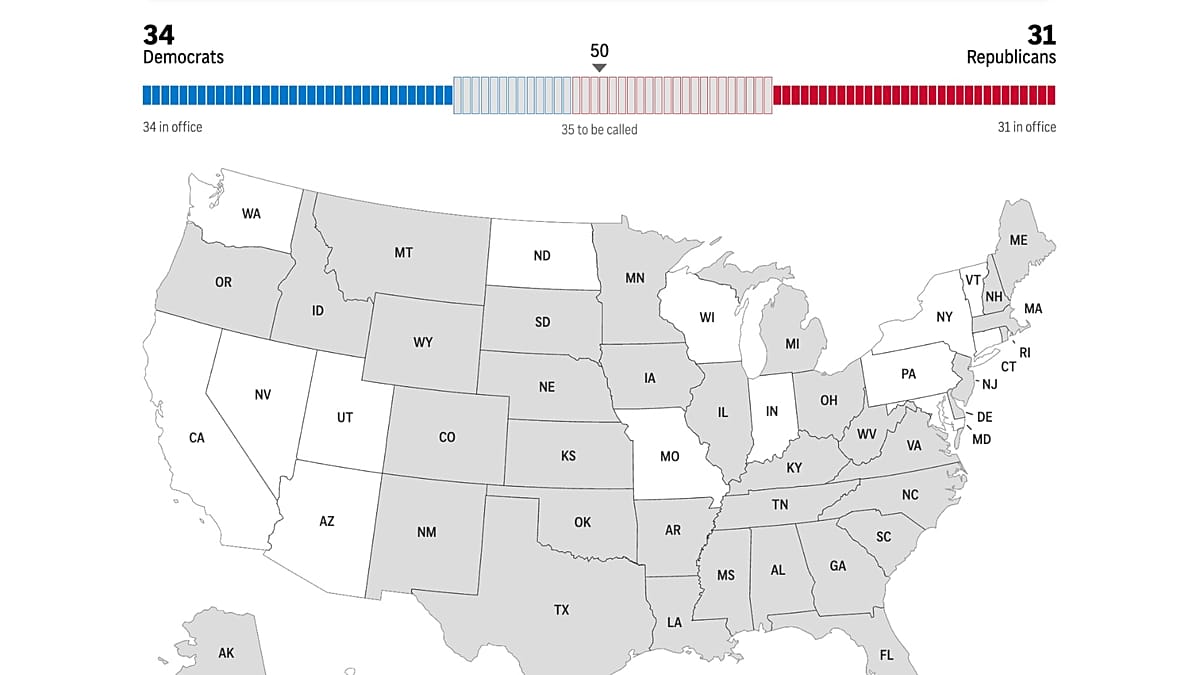
Thirty-three of the 100 members of the upper chamber are being elected regularly this year, along with two other special elections.
asserted
three → elect → elections
Republicans had the Senate majority before the election.
asserted
Republicans → have → election
Senators serve six-year terms.
asserted
Senators → serve → terms
Gubernatorial elections are taking place in 36 states, as well as three territories.
asserted
elections → take → territories
Republicans and Democrats held 18 of these state governorships each before the election.
asserted
Republicans → hold → election
Three incumbent governors are retiring.
asserted
governors → retire → ?
Election explainedElection explained
How the elections work
asserted
elections → explain → ?
The US legislature, Congress, has two chambers: the House of Representatives and the Senate.
asserted
legislature → have → Representatives
How is the House of Representatives elected and how do they work?
asserted
they → elect → Representatives
The lower chamber, the House of Representatives, has 435 voting seats, each representing a district of roughly similar size.
asserted
chamber → have → size
The speaker of the House is the chamber’s presiding officer, elected by the representatives.
asserted
speaker → preside → representatives
The House has several exclusive powers, such as the power to initiate revenue bills, impeach federal officials and elect the president in the case of an electoral college tie.
asserted
House → have → tie
How is the Senate elected and how do they work?
asserted
they → elect → ?
The upper chamber, the Senate, has 100 members, who sit for six-year terms.
asserted
who → have → terms
One-third of the seats come up for election in each two-year cycle.
asserted
third → come → cycle
Each state has two senators, regardless of its population; this means that Wyoming, with a population of less than 600,000, carries the same weight as California, with almost 40 million.
asserted
Wyoming → have → million
Most legislation needs to pass both chambers to become law, but the Senate has some important other functions, notably approving senior presidential appointments, for instance to the supreme court.
asserted
Senate → need → court
The Senate also has the sole power to provide advice to the president, consent to ratify treaties and try impeachment cases for federal officials referred to it by the House.
asserted
Senate → have → House
In most states, the candidate with the most votes on election day wins the seat.
asserted
candidate → win → seat
However, Georgia and Louisiana require the winning candidate to garner 50% of votes cast; if no one does, they hold a runoff election between the top two candidates.
asserted
they → require → candidates
Maine and Alaska use ranked-choice voting as opposed to the first past the post voting system in congressional elections.
asserted
Maine → use → elections
Voters rank candidates in order of preference.
asserted
Voters → rank → preference
If no candidate receives a majority of first-choice votes, the least-supported candidate is eliminated and their ballots are transferred to each voter’s next-ranked candidate.
asserted
ballots → receive → candidate
This continues until a candidate wins a majority.
asserted
candidate → continue → majority
In some states, an election can feature two candidates from the same party.
asserted
election → feature → party
Under top-two or “jungle” primary systems, candidates from all parties compete in the same primary and the two receiving the most votes advance, regardless of party.
asserted
two → compete → party
The congressional election candidates could both be Democrats or both be Republicans.
Florida and Ohio are having ‘special elections’ for the Senate because the previous holders of their seats – Marco Rubio and JD Vance – resigned to join the executive branch following the 2024 presidential election.
uncertain
holders → have → election
How are governors elected and how do they work?
Governors are elected by direct vote in their states.
asserted
Governors → elect → states
The candidate with the highest number of votes is declared the winner.
asserted
candidate → declare → votes
In every state, the executive branch is led by a governor.
asserted
branch → lead → governor
They serve for four years in office, with the exception of Vermont and New Hampshire where tenures are two years long.
asserted
tenures → serve → Vermont
Governors are responsible for implementing state laws, and have a range of powers available to them such as executive orders, executive budgets and legislative proposals and vetoes.
asserted
Governors → implement → orders
How are the results reported?
asserted
results → report → ?
The election results on this page are reported by the Associated Press.
asserted
results → report → Press
…and 4 more, not listed.
 The Aporia