Claims extracted
17
sentences that state something as happening or true
Uncertain
18%
3 of 17 hedged
("reportedly", "may", "according to")
Leaning
Leans right
of the writing, not the subject · beta estimate
Publisher signals
68/100
The Straits Times's corrections and
hedging, across everything collected from it. Not a measure of accuracy.
Outlets on this story
64
Politics
Same framing elsewhere
1
articles that frame the event the way this one does
After election triumph, German far-right seeks allies to form state government
MAGDEBURG, Germany, Sept 11 -
asserted
right → seek → government
After its triumph in Sunday's state election in Saxony-Anhalt, Germany's far-right AfD needs to attract defectors from other parties or reach an agreement with the small far-left BSW party that is setting difficult conditions in return for its support.
asserted
that → need → support
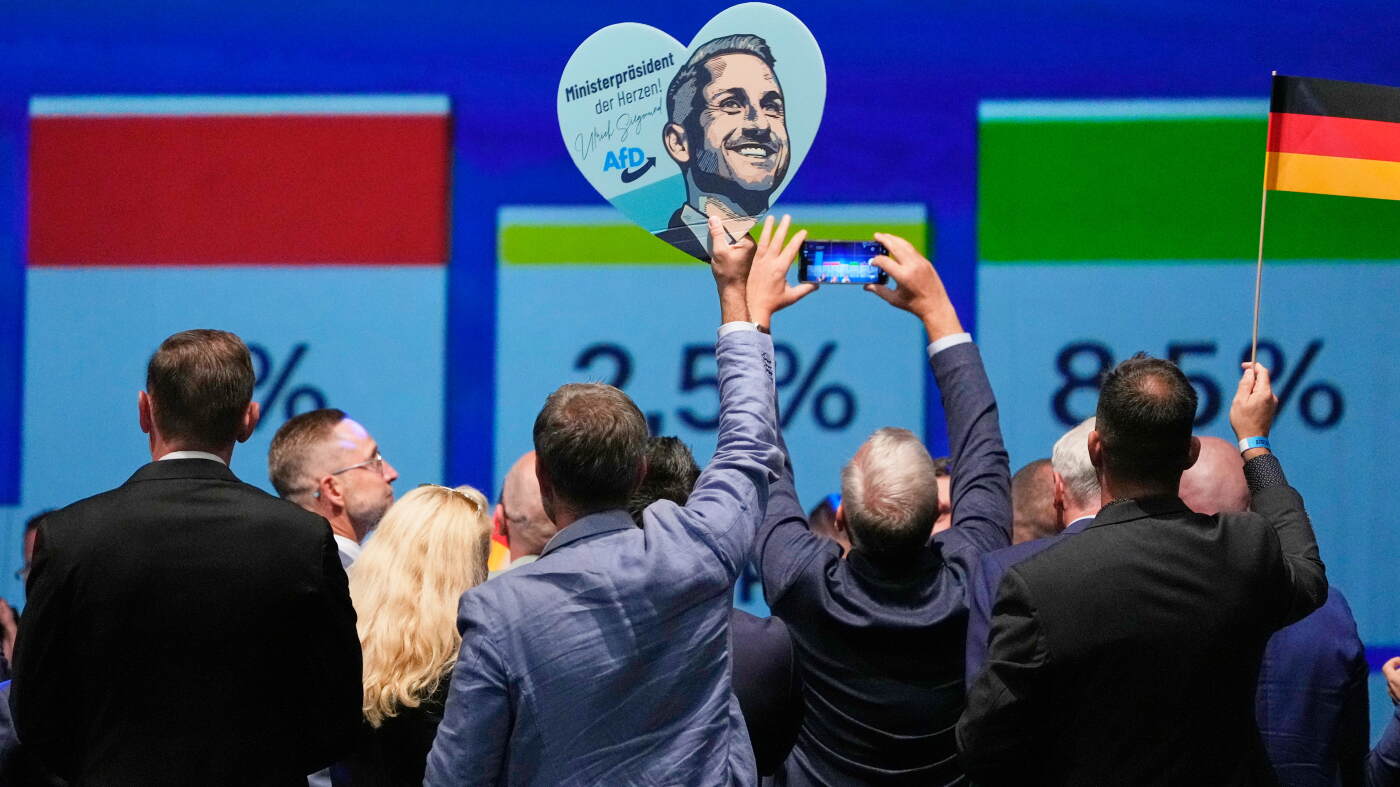
Ulrich Siegmund, the 35-year-old AfD leader who is expected to become state premier, said there were discussions with both the BSW and individual members of other parties "to see if there is any common ground that could help secure a stable majority".
uncertain
that → expect → majority
He said he wanted to form such a majority in the state legislature "as soon as possible".
asserted
he → say → legislature
However, there is nothing unusual in German politics about coalition negotiations that last for weeks or even months before a government can be formed.
asserted
government → be → weeks
The discussions underline the political realities now facing Siegmund, who said repeatedly during the campaign that he wanted an absolute majority to be able to govern alone, only to fall just short, winning 39 seats in the 83-seat parliament.
asserted
majority → underline → parliament
Even if he secures an agreement with another party that would allow him to become premier, his majority is likely to be a slim one, making governing more complicated than his record score in the election might suggest.
uncertain
score → secure → election
AFD SHUNNED BY GERMANY'S MAINSTREAM PARTIES
The Alternative for Germany (AfD) is already the country's most popular party at the national level and is seeking to secure a foothold for advancing its agenda, which includes heavy restrictions on immigration, restoring ties with Russia, cutting support to Ukraine and quitting the euro.
asserted
which → shun → euro
However, all the other parties in Saxony-Anhalt's state parliament - as at the national level - have refused to join forces with the far-right party, with the exception of the BSW, a small far-left party that, like the AfD, wants to restrict immigration and restore ties with Russia.
asserted
that → refuse → Russia
The BSW, which won five seats in the state parliament, has said it is interested in working with the AfD, which the Saxony-Anhalt office of Germany's domestic security agency classifies as extremist far-right.
asserted
office → win → right
But so far the BSW has said it does not want to enter a formal coalition and wants an independent state premier, a condition that Siegmund rejects.
asserted
Siegmund → say → that
"Just under 44% of people in Saxony-Anhalt voted for Alternative for Germany," Siegmund told reporters in Magdeburg, the state capital, on Thursday.
asserted
Siegmund → vote → Thursday
"Naturally, our aim should be to be able to name the Minister-President."
asserted
aim → name → President
If an agreement with the BSW cannot be reached, the most likely alternative would be to persuade some of the 15 members of Chancellor Friedrich Merz's conservative Christian Democrats (CDU) in the state parliament to switch sides and back the AfD.
Opinion within the CDU is divided over the German mainstream parties' so-called "firewall" strategy to isolate the AfD and it may be possible to induce some to switch parties.
uncertain
it → reach → parties
But so far, no confirmed defectors have been identified.
asserted
defectors → confirm → ?
If no agreement can be reached, Siegmund has even aired the prospect of calling a new election, saying it was "something we do not, in principle, shy away from".
asserted
we → reach → principle
"It would result from a situation where no one else is prepared to take on responsibility," he said.
asserted
he → result → responsibility
 The Aporia