That is 0 articles you have read today.
The Aporia is free and carries no advertising, so readers are the only
thing paying for it. If you are getting this much out of it, a small
donation is what keeps it independent.
Daily limit reached
You have read 0 articles today.
That is more than the 15 a day The Aporia gives away,
and well past what it can carry on nothing. Your allowance resets at
midnight.
There is no advertising here and nothing about you is sold, so readers
are the only thing paying for it. If the site is worth this much of
your day, it is worth a few dollars.
Everything else stays open: the
maps, the
directory and
search do
not count against this, and neither does re-opening something you have
already read today.
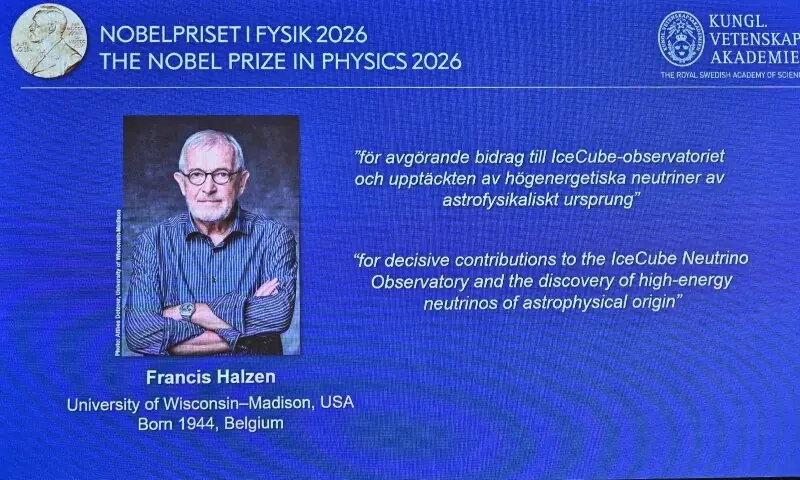
Francis Halzen, a University of Wisconsin-Madison professor, has been awarded the Nobel Prize in Physics for his pioneering work on the IceCube Neutrino Observatory at the South Pole. The observatory, completed in 2011 and using one cubic kilometer of Antarctic ice to detect high-energy neutrinos from space, marked a significant advancement in particle astrophysics. Halzen expressed surprise at winning, noting that many initially doubted the project's success when it began. This year’s prize follows previous recognitions for similar groundbreaking experiments, such as the 2015 award to Canadian scientist Arthur McDonald.
Written locally by qwen2.5:14b on 2026-10-06,
using this article's own text rather than the other coverage of the
same event (that is the story summary below).
Story summary
On Tuesday, the Nobel Prize in Physics was awarded to Francis Halzen, a Belgian physicist affiliated with the University of Wisconsin–Madison, for his pioneering work on detecting high-energy neutrinos from space using the IceCube Neutrino Observatory at the South Pole. The observatory uses one cubic kilometer of Antarctic ice as its detection medium to spot flashes of light caused by rare collisions between neutrinos and atomic nuclei. This discovery allows researchers to study extremely energetic processes in distant parts of the universe. Halzen first proposed his vision for detecting these particles in 1988, and the IceCube Observatory was completed in 2011. The prize, worth 12 million Swedish kronor (approximately $1.2 million), recognizes Halzen's "decisive contributions to the IceCube Neutrino Observatory" and his discovery of neutrinos with astrophysical origins.
Written for “Neutrino Research Nobel Prize” on 2026-10-06,
grounded in this article and the 8 other(s) covering the same event.
Francis Halzen, a University of Wisconsin-Madison professor who pioneered the detection of ghostly particles from outer space has been awarded the Nobel Prize in Physics.
asserted
who → pioneer → Physics
On Tuesday, members of the Royal Swedish Academy of Sciences announced that Dr. Halzen is the sole winner of this year’s physics prize.
asserted
Halzen → announce → prize
Dr. Halzen is best known for his work establishing the IceCube Neutrino Observatory at the South Pole.
asserted
Halzen → know → Pole
Using a one cubic kilometre volume of the Antarctic ice sheet as its detection medium, the experiment has been able to spot flashes of light that occur when high-energy neutrinos from the distant universe occasionally interact with atoms in the ice.
asserted
neutrinos → use → ice
Completed in 2011, the experiment ushered in a new era of particle astrophysics.
asserted
experiment → complete → astrophysics
“It was a great surprise,” said Dr. Halzen when reached by phone during the announcement.
asserted
Halzen → say → announcement
“When I reflect on this moment I have to emphasize how lucky I was because when we started this project, everybody realized this was maybe a good idea but very few thought it would work, including myself.
asserted
it → reflect → myself
Born in Belgium in 1944, Dr. Halzen received his PhD from KU-Leuven university in 1969.
asserted
Halzen → bear → 1969
In 1971, he began his research career in Wisconsin where he continues to lead the IceCube project
asserted
he → begin → project
This year’s physics prize recalls the 2015 physics Nobel when Canadian scientist Arthur McDonald was named a co-recipient for leading an earlier neutrino experiment built in a mine under Sudbury, Ont.
asserted
McDonald → recall → Sudbury
With today’s announcement, the physics prize has been awarded 120 times to 230 individuals since it was established in 1901.
asserted
it → award → 1901
The most recent Canadian winner was Geoffrey Hinton, a University of Toronto professor and pioneer of artificial intelligence who was awarded the physics Nobel in 2024 for is work on neural networks.
asserted
who → award → networks
 The Aporia