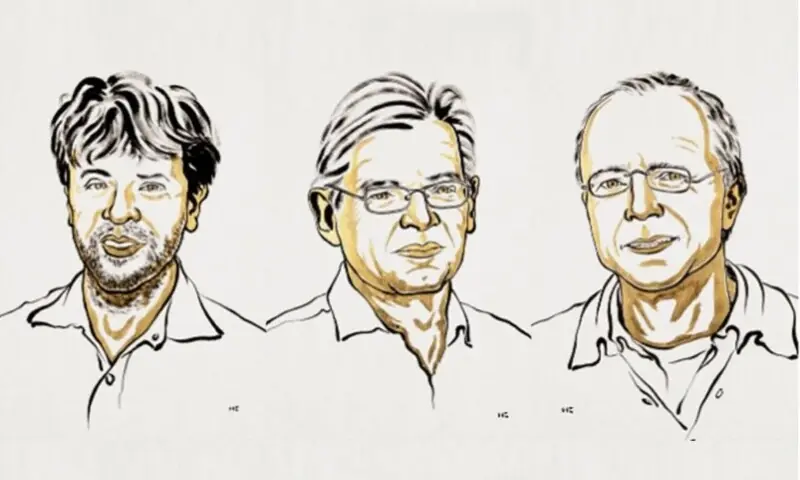
The Nobel Prize in Physics is set to be announced on Tuesday at 11:45 am in Stockholm. Speculations suggest that researchers involved in particle physics, astrophysics, or metamaterials like Britain’s John B. Pendry and David Smith might receive recognition for their work on an "invisibility cloak." Other potential nominees include Federico Capasso for his contributions to the quantum cascade laser and Pablo Jarillo-Herrero, Allan MacDonald, and Rafi Bistritzer for their research in twistronics. Additionally, Clarivate highlights Chihaya Adachi, Stephen R. Forrest, and Mark E. Thompson for their work on ultrahigh-efficiency OLEDs, which could also be considered under the chemistry category.
Written locally by qwen2.5:14b on 2026-10-06,
using this article's own text rather than the other coverage of the
same event (that is the story summary below).
Research in particle physics, astrophysics or the invention of an “invisibility cloak” are some of the achievements that could be honoured when the Nobel physics prize is awarded Tuesday.
uncertain
prize → honour → achievements
The award, to be announced at 11:45 am in Stockholm, is the second Nobel of the season, after the Medicine Prize was awarded on Monday to US psychiatrist and neurologist Karl Deisseroth and German scientists Peter Hegemann and Georg Nagel.
asserted
Prize → announce → Deisseroth
The researchers were honoured for their pioneering work in the field of optogenetics, which involves controlling nerve signals with light.
asserted
which → honour → light
For the physics prize, commentators have for years speculated that metamaterials and Britain’s John B. Pendry, who has become famous for his “invisibility cloak” where light is bent around an object, are due for a nod.
asserted
light → speculate → nod
“Since the first breakthrough 20 years ago it has become a large, varied field of research,” Camilla Widebeck, a science producer for public broadcaster Sveriges Radio told AFP, adding that Pendry would likely be honoured alongside American David Smith.
asserted
Pendry → become → Smith
Other commentators have suggested Italian-American Federico Capasso — who is also often cited for contributing to the invention and development of the quantum cascade laser —could also be honoured in the field.
uncertain
who → suggest → field
Widebeck also speculated that this year’s prize could build on the 2010 prize, which honoured research into the material graphene — a one-atom thick layer of carbon arranged in a honeycomb pattern.
uncertain
which → speculate → pattern
Spain’s Pablo Jarillo-Herrero together with Canada’s Allan MacDonald and Israel’s Rafi Bistritzer could be honoured for work on twistronics, where two such layers are twisted together — producing superconductivity which has the potential to lead to an energy revolution.
uncertain
which → honour → revolution
The trio won the 2020 Wolf Prize in Physics, and Widebeck noted Romanian-born US researcher Eva Andrei was also a favourite in the field.
asserted
Andrei → win → field
However, she also cautioned that many believed that it “will probably be another few years” before the Nobel committee recognises the work.
asserted
committee → caution → work
Particle physics
Research firm Clarivate, which predicts winners of the prize based on the number of citations, spotlighted Japan’s Chihaya Adachi along with Americans Stephen R. Forrest and Mark E.
Thompson this year for their work on “ultrahigh-efficiency organic light-emitting diodes” (OLEDs) — used to produce better image quality in screens for smartphones, TVs and computers with lower energy consumption.
asserted
which → predict → consumption
Speaking to AFP, David Pendlebury, who heads research analysis at Clarivate, noted that many discoveries can fall into multiple categories and a prize for “OLEDs could be chemistry or it could be physics.”
uncertain
it → speak → OLEDs
Clarivate also spotlighted Swiss-British researcher Nicola Spaldin for her theoretical work on “magnetoelectric multiferroics” and China’s Qikun Xue “for experimental observation of the quantum anomalous Hall Effect,” which both have an impact on making products more energy efficient.
asserted
products → spotlight → impact
Hamish Johnston, online editor of science magazine Physics World, wrote in a blog post that based on recent winners “it appears that both condensed-matter physics, and particle and nuclear physics are due a prize.”
asserted
physics → write → prize
One possibility then is a prize for CERN’s ATHENA and ALPHA collaborations, “who were the first to trap cold antihydrogen atoms and then study them in detail,” which would make Denmark-based American physicist Jeffrey Hangst — a founder of both collaborations -
A likely laureate
The science writer also noted that the jury could honour Belgian physicist Ingrid Daubechies, together with French mathematicians Stephane Mallat and Yves Meyer — a trio which Clarivate spotlighted last year — for something called wavelet theory.
uncertain
Clarivate → trap → something
The theory impacts our daily lives through things such as image compression for pictures and videos on computers.
asserted
theory → impact → computers
Trump watching
Widebeck also noted that it had been some time since the academy honoured discoveries in the field of space and astrophysics.
asserted
academy → watch → space
“One name that appears in the speculation is Briton Martin Rees,” she said, noting he had previously served as Britain’s Astronomer Royal.
asserted
he → appear → Royal
In the past, work on the James Webb Space Telescope has also been buzzed about, as has research into how galaxies are formed — with the work of Mexican-British cosmologist Carlos Frenk, Argentinian astrophysicist Julio Navarro and British scientist Simon White highlighted.
asserted
work → buzz → Frenk
Last year, the Nobel Prize in Physics went to Briton John Clarke, Frenchman Michel Devoret and American John Martinis for putting quantum mechanics into action and enabling the development of all kinds of digital technology from cellphones to a new generation of computers.
asserted
Prize → go → computers
The physics prize will be followed by the chemistry on Wednesday.
asserted
prize → follow → Wednesday
The literature laureate will be revealed on Thursday and the perhaps most keenly anticipated award — the peace prize — is due on Friday.
asserted
award → reveal → Friday
US President Donald Trump lobbied intensively last year to get the prize — and Venezuelan opposition leader Maria Corina Machado ended up giving him her Nobel medal — and the committee is aware he will be watching closely again.
The economics prize wraps up the Nobel season on October 12.
asserted
prize → lobby → October
 The Aporia