The Aporia
The Aporia
The Aporia

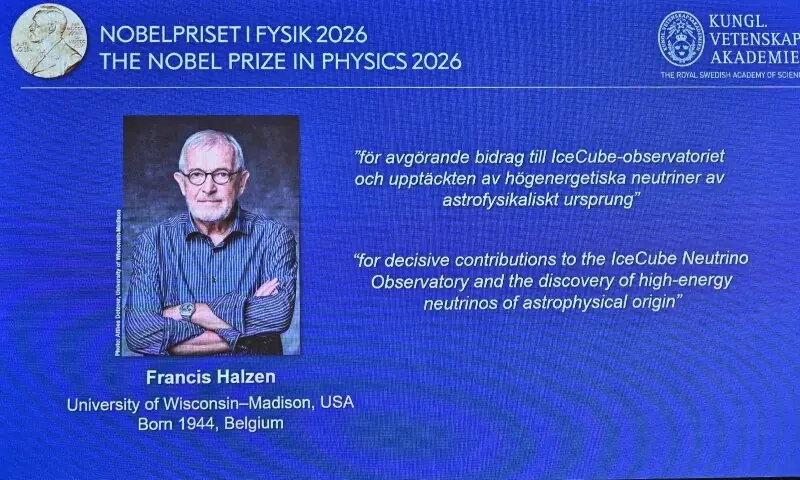
On Tuesday, the Nobel Prize in Physics was awarded to Francis Halzen, a Belgian physicist affiliated with the University of Wisconsin–Madison, for his pioneering work on detecting high-energy neutrinos from space using the IceCube Neutrino Observatory at the South Pole. The observatory uses one cubic kilometer of Antarctic ice as its detection medium to spot flashes of light caused by rare collisions between neutrinos and atomic nuclei. This discovery allows researchers to study extremely energetic processes in distant parts of the universe. Halzen first proposed his vision for detecting these particles in 1988, and the IceCube Observatory was completed in 2011. The prize, worth 12 million Swedish kronor (approximately $1.2 million), recognizes Halzen's "decisive contributions to the IceCube Neutrino Observatory" and his discovery of neutrinos with astrophysical origins.