Nobel prize awarded to researchers who learned how to light up the brain

Read the original at The Globe and Mail ↗
The Globe and Mail · collected 2026-10-05 · by Ivan Semeniuk

Quick Summary

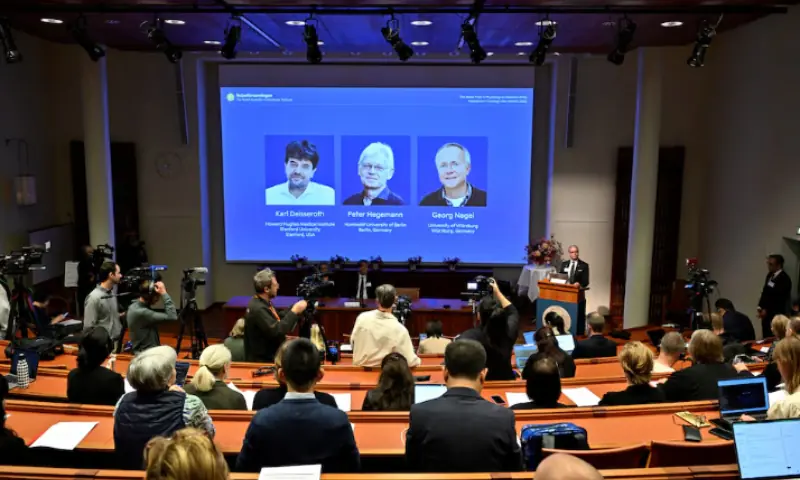
Three scientists—Karl Deisseroth from Stanford University, and Peter Hegemann and Georg Nagel from Germany—have been awarded this year's Nobel Prize in Physiology or Medicine for their work developing optogenetics, a technique that uses light to control brain cells. Their research originated with the study of algae proteins sensitive to light, leading to methods where channelrhodopsin genes are inserted into mammalian neurons to manipulate neural activity through light pulses. The prize is shared equally among them and amounts to approximately $1.74 million Canadian dollars.
Written locally by qwen2.5:14b on 2026-10-05, using this article's own text rather than the other coverage of the same event (that is the story summary below).

AI analysis runs on qwen2.5:14b, locally

Story summary

On October 5, 2026, the Nobel Prize in Physiology or Medicine was awarded to Karl Deisseroth (Stanford University), Peter Hegemann (Humboldt University of Berlin), and Georg Nagel (University of Würzburg) for their pioneering work in optogenetics. The trio’s research focused on light-gated ion channels, a technique that allows scientists to control individual nerve cells using light, significantly advancing the field of neuroscience. This groundbreaking method is now used globally to study brain functions and has potential clinical applications, such as restoring sight in visually impaired individuals. Each scientist will receive 12 million Swedish kronor (approximately $1.2 million) for their contributions. The prize announcement kicked off Nobel Prize week in Stockholm, with subsequent awards scheduled throughout the week until October 12.

Written for “Nobel Prize Brain Research” on 2026-10-05, grounded in this article and the 10 other(s) covering the same event.

Signals How these are calculated →

Claims extracted
16
claim-shaped sentences
Uncertain
12%
2 of 16 hedged
Leaning
not political
takes no side on a contested political question
Correction & hedging signals
51.0
corrections and hedging in what we collected; not a measure of accuracy
Outlets on this story
11
Science
Narrative spread
1
articles carrying this framing
Analyzed 2026-10-05 · how these are computed

Story

📰 Nobel Prize Brain Research
Science · 11 article(s) covering the same event. See how they differ ↓

How this is being covered How these are calculated →

Article leaning vs. publisher reliability
Source leaning vs. consistency

Compared with similar articles

This article reads unscored and hedges 12% of its claims. Each row says how that neighbour differs.
Dawn · 0.89 cosine similarity
⚖️ leaning not scored 🔴 8% hedged 2 of 26 📰 publisher trust 77
“Both articles describe the exact same awarding of the Nobel Prize in Physiology or Medicine on October 5, 2026 to Karl Deisseroth, Peter Hegemann and Georg Nagel for their work in optogenetics.”
Dawn · 0.88 cosine similarity
⚖️ leaning not scored 🔴 8% hedged 2 of 26 📰 publisher trust 77
“Both articles report on the identical Nobel Prize award announcement for the same three scientists in the field of optogenetics on the same day.”
The Guardian
⚖️ leaning not scored 🔴 0% hedged 0 of 6 📰 publisher trust 68
“Both articles report on the exact same Nobel Prize in Physiology or Medicine award announcement for 2026, naming the identical three scientists and their work on optogenetics.”
BBC News
⚖️ leaning not scored 🔴 0% hedged 0 of 4 📰 publisher trust 78
“Both articles describe the exact same awarding of the Nobel Prize in Physiology or Medicine to Karl Deisseroth, Peter Hegemann, and Georg Nagel on October 5, 2026.”
NPR
⚖️ leaning not scored 🔴 0% hedged 0 of 11 📰 publisher trust 60
“Both articles describe the exact same event: the awarding of the Nobel Prize in Physiology or Medicine to Karl Deisseroth, Peter Hegemann, and Georg Nagel for their research into optogenetics on October 5, 2026.”
ABC News (AU)
⚖️ leaning not scored 🔴 0% hedged 0 of 3 📰 publisher trust 61
“Both articles describe the awarding of the Nobel Prize in Physiology or Medicine to the same three scientists on October 5, 2026.”
New York Post
⚖️ leaning not scored 🔴 0% hedged 0 of 17 📰 publisher trust 64
“Both articles report on the identical Nobel Prize in Physiology or Medicine award to the same three scientists for their work in optogenetics and brain research, on the same date.”
The Independent
⚖️ leaning not scored 🔴 0% hedged 0 of 11 📰 publisher trust 59
“Both articles report on the exact same Nobel Prize in Physiology or Medicine award to the same three scientists for their work on optogenetics, occurring on the same date.”

Publisher

The Globe and Mail · 584 article(s) · 23 correction(s) detected
Running correction rate · 23 correction(s)
2026-10-04
Morning Update: Pilot attacked fellow pilot in Israel-bound flight
2026-10-02
Morning Update: A pipeline in the national interest
2026-10-01
Morning Update: Pilot attacked co-pilot in Israel-bound flight
2026-09-28
Morning Update: Security experts call for Havana Syndrome probe
2026-09-25
Morning Update: Trump rolls out the red carpet for Xi
2026-09-24
Morning Update: Kenneth Law sentencing hearing begins
2026-09-22
Morning Update: Still seeking answers after synagogue shooting
2026-09-19
Morning Update: Selling a new alliance
2026-09-15
Morning Update: We need more than money
2026-09-14
Morning Update: Broadening our economic horizons
2026-09-11
Morning Update: Gander remembers, 25 years later
2026-09-10
Morning Update: A long wait for trade talks
2026-09-09
Morning Update: Adversity ahead
2026-09-08
Morning Update: Say hello to Canadian countertariffs
2026-09-07
Morning Update: Tumbler Ridge survivors file new lawsuits
2026-09-06
Morning Update: Made-in-Canada trains
2026-08-31
Ontario plan to stop mandatory inquests for inmate deaths a mistake, advocates say
2026-08-31
Morning Update: Mapping new points of resistance
2026-08-28
Morning Update: Lake Ontario forever
2026-08-27
Morning Update: Rethinking resources as a trade weapon
2026-08-26
Morning Update: Ottawa bites back
2026-08-25
Morning Update: A new trade deal remains in the cards
2026-08-24
Morning Update: ‘You are at war when you get attacked’

Who wrote this

Ivan Semeniuk
9 article(s) here · 1 carrying a prediction
🔮 Karl Deisseroth of Stanford University, Peter Hegemann of Humboldt University of Berlin and Georg Nagel of the University of Würzburg will share equally in the prize, worth approximately $1.74 million Canadian dollars.
🔮 Their arrival marks the start of a busy handoff period during which the population of the station will temporarily be at 11 – four of which will depart some time next week.
🔮 Once he arrives at the station, he is set to become the fourth Canadian astronaut to undertake a long-duration mission on the orbiting laboratory, which is expected to last about six months.
🔮 Canada’s next space traveller is fast approaching his scheduled departure – but the weather may have other ideas.
🔮 If someone threw a party for every type of mammal on Earth, a large portion of the guest list would be taken up by bats.
🔮 That one used to be so huge it would overhang along the edge,” says Larry Audlaluk, an elder who was a child when the Canadian government relocated his family in 1953 from northern Quebec to the hamlet, which is located 1,160 kilometres north of the Arctic Circle.
🔮 For some, this week’s news is another sign that, instead of competing with AI, their skills may be better put toward managing its risks.
🔮 Canadians are feeling the effects of climate change to a greater degree and facing more serious consequences than federal scientists projected less than a decade ago.
🔮 Just two weeks after a solar eclipse plunged parts of Europe into an eerie daytime darkness, Canadian skywatchers will have the chance to experience the reverse effect.
Also by Ivan Semeniuk
Nothing else under this byline is closely related to this article, so these are simply their most recent.
All 9 articles by Ivan Semeniuk →

Topics

Germany Sweden the Karolinska Institute the Nobel Assembly the United States

Subjects

Hegemann PERSON · 3× Deisseroth PERSON · 2× Germany GPE · 1× Karl Deisseroth PERSON · 1× Peter Hegemann PERSON · 1× Stanford University ORG · 1× Sweden GPE · 1× the Karolinska Institute ORG · 1× the Nobel Assembly ORG · 1× the United States GPE · 1×

Narrative

On Monday, the Nobel Assembly at the Karolinska Institute in Sweden announced this year’s prize has been has awarded to three scientists, one in the United States and two in Germany, for work leading to the development of the field known as optogenetics.
framing: assertive · carried by 1 article(s) · first seen 2026-10-05
🔮 Karl Deisseroth of Stanford University, Peter Hegemann of Humboldt University of Berlin and Georg Nagel of the University of Würzburg will share equally in the prize, worth approximately $1.74 million Canadian dollars.
2026-10-05 · The Globe and Mail
Nobel prize awarded to researchers who learned how to light up the brain · assertive framing

Claims (16 extracted, 2 hedged)

A discovery that began with algae and turned into a powerful method for investigating the brain is the subject of this year’s Nobel Prize in Physiology or Medicine. asserted
that → begin → Physiology
On Monday, the Nobel Assembly at the Karolinska Institute in Sweden announced this year’s prize has been has awarded to three scientists, one in the United States and two in Germany, for work leading to the development of the field known as optogenetics. asserted
prize → announce → optogenetics
Karl Deisseroth of Stanford University, Peter Hegemann of Humboldt University of Berlin and Georg Nagel of the University of Würzburg will share equally in the prize, worth approximately $1.74 million Canadian dollars. asserted
Deisseroth → share → prize
The story of this year’s medical Nobel begins with Dr. Hegemann, a biophysicist who in the 1980s became fascinated with the ability of pond algae to sense and respond to sunlight. asserted
who → begin → sunlight
Algae rise or sink depending on the amount of light, and in doing so can regulate photosynthesis. asserted
Algae → rise → photosynthesis
The phenomenon led to the discovery of a class of proteins called channelrhodopsins, which the algae use to turn light into electrical signals. asserted
algae → lead → signals
Dr. Hegemann found the underlying gene associated with the protein in algae, which Dr. Nagel was then able to reproduce in frog eggs to study the protein’s function. asserted
Nagel → find → function
In 2005, Dr. Deisseroth and a colleague in the U.S. showed how a channelrhodopsin gene could be inserted into the DNA of a mammal neuron. uncertain
gene → show → neuron
This created a brain cell that could be turned on or off with a pulse of light. uncertain
that → create → light
With that innovation, optogenetics was born. asserted
optogenetics → bear → innovation
Researchers have now used the technique to understand how the brain is wired, opening a new window into a range of complex neural functions including perception, memory and emotion. asserted
brain → use → perception
The breakthrough technique has since been widely celebrated. asserted
technique → celebrate → ?
Monday’s announcement kicks off a week of Nobel prize reveals, with the recipient or recipients of the physics prize to be named on Tuesday, chemistry on Wednesday, literature on Thursday and the Nobel Peace Prize on Friday. asserted
announcement → kick → Friday
The prizes were first awarded in 1901, with categories stipulated in the will of Swedish businessman and inventor, Alfred Nobel. asserted
categories → award → businessman
A sixth prize for economics, added in 1969, is set to be announced on Oct. 12. asserted
prize → add → Oct.
All the prizes are bestowed annually at a special ceremony held in Stockholm on Dec. 10, the anniversary of Alfred Nobel’s death in 1896. asserted
prizes → bestow → 1896

💬Give feedback
🕘History 🎫Support