That is 0 articles you have read today.
The Aporia is free and carries no advertising, so readers are the only
thing paying for it. If you are getting this much out of it, a small
donation is what keeps it independent.
Daily limit reached
You have read 0 articles today.
That is more than the 15 a day The Aporia gives away,
and well past what it can carry on nothing. Your allowance resets at
midnight.
There is no advertising here and nothing about you is sold, so readers
are the only thing paying for it. If the site is worth this much of
your day, it is worth a few dollars.
Everything else stays open: the
maps, the
directory and
search do
not count against this, and neither does re-opening something you have
already read today.
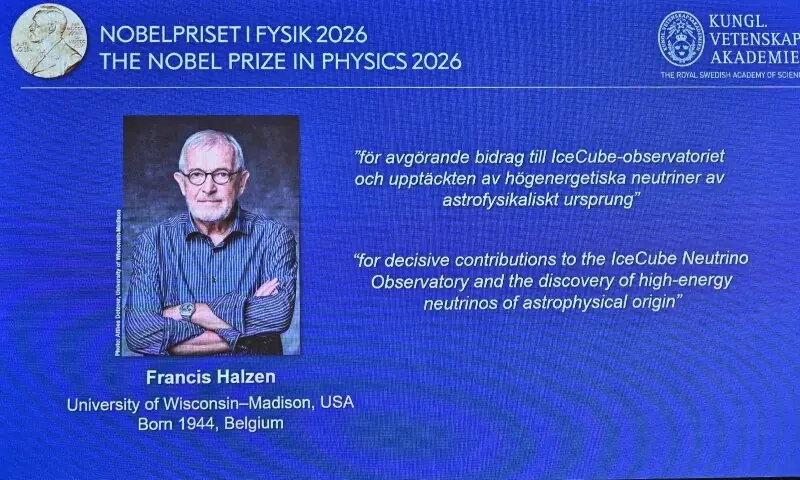
Francis Halzen won the Nobel Prize in physics for his work on high-energy neutrinos from space, specifically through his contributions to the IceCube Neutrino Observatory at the South Pole. Mark Pearce of the Nobel Committee praised Halzen's leadership and scientific vision that led to a new kind of astronomy. Born in Belgium and now 82 years old, Halzen expressed surprise upon receiving the award. The prize includes a monetary amount of 12 million Swedish kronor (approximately $1.2 million).
Written locally by qwen2.5:14b on 2026-10-06,
using this article's own text rather than the other coverage of the
same event (that is the story summary below).
Story summary
On Tuesday, the Nobel Prize in Physics was awarded to Francis Halzen, a Belgian physicist affiliated with the University of Wisconsin–Madison, for his pioneering work on detecting high-energy neutrinos from space using the IceCube Neutrino Observatory at the South Pole. The observatory uses one cubic kilometer of Antarctic ice as its detection medium to spot flashes of light caused by rare collisions between neutrinos and atomic nuclei. This discovery allows researchers to study extremely energetic processes in distant parts of the universe. Halzen first proposed his vision for detecting these particles in 1988, and the IceCube Observatory was completed in 2011. The prize, worth 12 million Swedish kronor (approximately $1.2 million), recognizes Halzen's "decisive contributions to the IceCube Neutrino Observatory" and his discovery of neutrinos with astrophysical origins.
Written for “Neutrino Research Nobel Prize” on 2026-10-06,
grounded in this article and the 8 other(s) covering the same event.
Francis Halzen wins Nobel Prize in physics for work on high-energy neutrinos from space
STOCKHOLM —
asserted
Halzen → win → space
Francis Halzen won the Nobel Prize in physics on Tuesday for his contributions to the IceCube Neutrino Observatory and his discovery of high-energy neutrinos of astrophysical origin.
asserted
Halzen → win → origin
"Francis Halzen has led an international team of researchers and engineers who have provided us with a fantastic instrument.
asserted
who → lead → instrument
His tenacity and scientific vision has paved the way for a new kind of astronomy," Mark Pearce, chair of the Nobel Committee for Physics, said in a news release.
asserted
Pearce → pave → release
Halzen spoke to the committee by phone from Italy on Tuesday.
asserted
Halzen → speak → Tuesday
"It was a great surprise and I obviously didn't expect it," he said.
asserted
he → expect → it
Halzen said it was predicted before that he would win the Nobel Prize but the announcement still made him feel "strange."
Born in Belgium, the 82-year-old scientist is affiliated with the University of Wisconsin–Madison in the U.S. Efforts by The Associated Press to reach him were not immediately successful.
asserted
Efforts → say → him
The IceCube Neutrino Observatory is a research facility located at the South Pole in Antarctica, according to its website, and the University of Wisconsin–Madison is its lead institution.
uncertain
University → locate → Wisconsin
Yet they are everywhere: they spew from stars like the sun and trillions zip through our bodies every second.
asserted
trillions → spew → bodies
Scientists can't glimpse the mysterious ghost particles zooming around on their own.
asserted
Scientists → glimpse → own
Instead, they measure what happens when the tiny particles collide with other bits of matter, producing flashes of light or charged particles.
asserted
particles → measure → light
Halzen studied a rare gang of neutrinos that scientists consider messengers from the cosmos, offering clues to how the universe evolved.
asserted
universe → study → clues
His research into capturing neutrinos at the South Pole dates back to the 1980s.
asserted
research → capture → 1980s
The Royal Swedish Academy of Sciences announced the award in Stockholm.
asserted
Academy → announce → Stockholm
Last year, three scientists won the Nobel Prize in physics for research on the strange behavior of subatomic particles called quantum tunneling that enabled the ultra-sensitive measurements achieved by MRI machines and laid the groundwork for better cellphones and faster computers.
asserted
that → win → cellphones
The announcements of this year's prizes began Monday with the Nobel Prize in medicine being awarded to three scientists whose work led to a tool that uses light to help unravel how the brain works.
asserted
brain → begin → light
This week's awards continue Wednesday with the chemistry prize and literature on Thursday.
asserted
awards → continue → Thursday
After Friday's peace prize is awarded, the Nobel Memorial Prize in Economic Sciences will be announced on Monday.
asserted
Prize → award → Monday
 The Aporia