Story summary
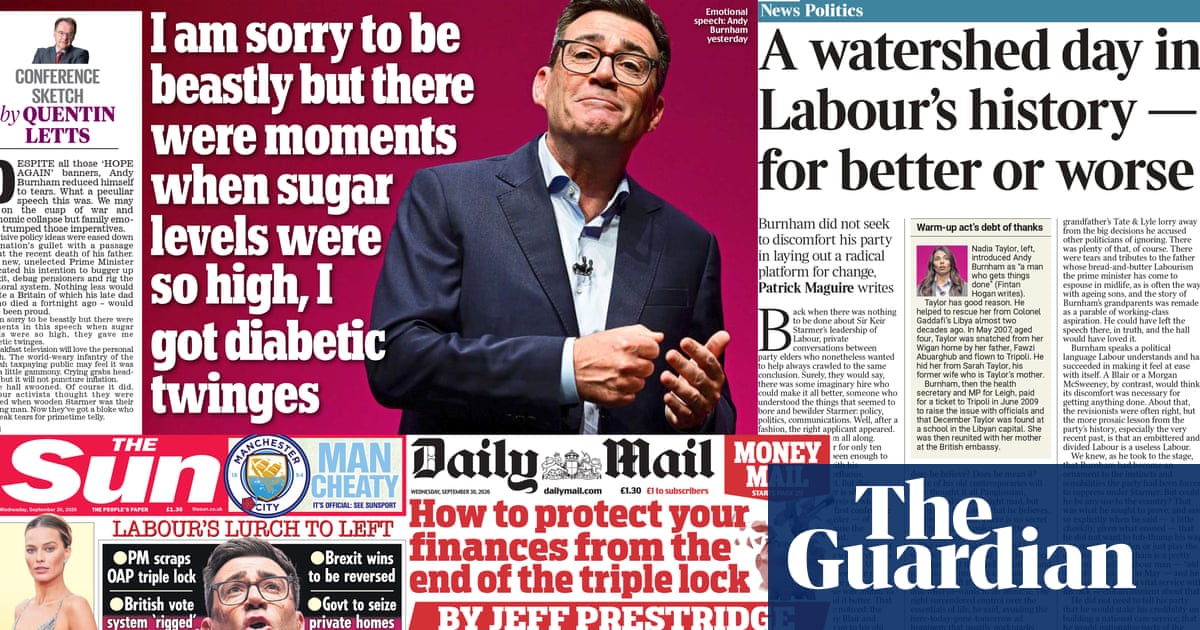
Andy Burnham, newly elected leader of the Labour Party, delivered his first speech as leader at the party's conference in Liverpool on Wednesday. The speech was emotional and covered bold policies such as reforming social care and electoral systems, drawing mixed reactions from attendees and media outlets.
Burnham choked up while discussing his father who recently passed away, a moment that resonated deeply with the audience. He admitted to wanting to move faster on cost-of-living measures but stressed fiscal honesty about what Britain can afford. The speech was seen by some as one of the most memorable in recent years, with former BBC political editor Andrew Marr comparing it favorably to Tony Blair's speeches.
Critics like Mail Online’s Quentin Letts were less impressed, describing the emotional tone and policy promises as overly sentimental and sugar-coated. Meanwhile, supporters praised Burnham for his relatability and commitment to addressing working-class concerns, potentially appealing to voters who had drifted away from Labour under Keir Starmer.
The speech also touched on plans for electoral reform, aiming to introduce proportional representation in Westminster elections, a significant change since 1918. This move is seen as part of Burnham's strategy to transform the UK’s political system fundamentally, though some within the party are wary about such dramatic changes given current fiscal constraints and public opinion.
Written for “Andy Burnham Labour Speeches” on 2026-10-05,
grounded in this article and the 24 other(s) covering the same event.
- See more Daily Mail on Google - save us as a Preferred Source
If you hanker for the decade of flares, shag carpeting and the Bay City Rollers, Andy Burnham’s conference speech was pitched directly to you.
asserted
speech → see → you
For the Prime Minister’s address to the Labour faithful in Liverpool was a gushing love letter to the suffocating socialism of the 1970s.
asserted
address → gush → 1970s
His remarks, the most chilling from any Labour prime minister of my lifetime, outlined a wild lurch to the Left that went far beyond anything even Jeremy Corbyn attempted during his time as Labour leader.
asserted
Corbyn → outline → leader
The delegates lapped it up, one ovation after another.
asserted
delegates → lap → another
The Prime Minister’s address to the Labour faithful in Liverpool was a gushing love letter to the suffocating socialism of the 1970s
Burnham promised ‘good growth in every postcode, hope in every heart’ – and the paternalistic prod of the state in every conceivable crevice of the marketplace.
asserted
Burnham → promise → marketplace
Angela Rayner would front ‘the biggest council-house building programme since the post-war era’, he said.
asserted
he → front → era
But these homes would be unlike the council housing of today, and the past 40 years: there would no longer be a right to buy.
asserted
homes → buy → today
Instead, the state would exert ‘democratic control over our housing stock’.
asserted
state → exert → stock
This announcement came halfway through a speech which had begun with Burnham emoting about his grandparents buying their home and the opportunities this had created for his family.
asserted
this → come → family
He didn’t stop there, either.
asserted
He → stop → ?
councils would be given new powers to seize private property where it was deemed to be unused, or which landlords were failing to keep well-maintained.
asserted
landlords → give → property
The Prime Minister kept reminding us of how important housing was, which was why he refused to see it ‘as a market’ and insisted on treating it ‘as an essential that everyone needs’.
asserted
everyone → remind → that
But it is precisely because housing is an essential that it requires the involvement of the market.
asserted
it → require → market
Contrary to Burnham’s resentment-flecked world view, the market is not an external imposition on honest, hard-working folks.
asserted
market → fleck → folks
The market is those folks, their preferences, and the pricing signals sent by their economic activity.
asserted
market → send → activity
Homeowners and would-be homeowners understand better than any bureaucrat what they want in a home and what they are willing to pay for.
asserted
they → understand → what
Burnham wishes to sever the connection between consumer and price, a fool’s errand – and a costly one.
asserted
Burnham → wish → consumer
The most deafening cheer came when he told the hall of his intention to repeal Margaret Thatcher’s prohibition on public ownership of water companies.
asserted
he → come → companies
He seemed to believe this would make the utility more affordable.
asserted
utility → seem → ?
Inefficient state companies do not drive down prices; they limit the consumer’s options, which is what makes it possible to raise prices.
asserted
it → drive → prices
Anyone satisfied with the results of placing healthcare into the hands of a bureaucratic behemoth will relish the possibilities of creating a second one for social care.
asserted
Anyone → satisfy → care
1970s Britain was blighted by power cuts, three-day weeks, ceaseless strikes and indifferent state industries.
asserted
Britain → blight → cuts
Rubbish piled up on the streets of London during strikes by binmen in 1979
That was another major theme of the speech, and like much of what the Prime Minister had to say, it was an analysis of market forces from someone whose entire career has been shielded from any contact with them.
asserted
career → pile → them
Burnham spelt out his ‘theory of growth’, which involved ‘control’ of the essentials… followed by the devolution of powers from Westminster to lower-level politicians and officials.
asserted
which → spell → politicians
It’s the sort of theory that ought to be kept far away from practice.
asserted
that → ’ → practice
In reality, it will mean third-rate national politicians seizing control of sections of the economy and handing them over to fourth-rate regional politicians to regulate them into ruin.
asserted
politicians → mean → ruin
What Burnham forgot in his nostalgia trip back to an era he never experienced outside of childhood is that, by the time Mrs Thatcher came along, the British public was well and truly sick of nationalised industries.
asserted
public → forget → industries
They were inefficient, unresponsive, one-size-fits-all, and simply allergic to innovation.
asserted
size → fit → innovation
When the state held a monopoly on a service or utility, it not only locked out private enterprise, but it also denied consumers the most powerful tool of all in the marketplace: choice.
Where there is choice, there is competition – and no mechanism can raise quality and lower prices like competition.
asserted
mechanism → hold → competition
State control, even where it is not monopolised, deprives the consumer of the power he enjoys in a free market.
asserted
he → monopolise → market
The next generation, to whom Burnham directed his remarks, knows nothing of the days when Britain was served by nationalised industries.
asserted
Britain → direct → industries
If you wanted a phone line, you had to be prepared to wait six months.
asserted
you → want → months
And forget about choosing a model to suit you: there was one model in whatever colour they gave you.
asserted
they → forget → you
Younger voters might well be taken in by the Prime Minister’s tempting talk of lower prices and affordability, but this is wholly at odds with the British experience of socialism.
uncertain
this → take → socialism
They will come to learn what their grandparents did once the peace time idealism of the Attlee government gave way to the realities of collectivism.
asserted
idealism → come → collectivism
When state intervention fails it prompts more, not less, intervention.
asserted
it → fail → intervention
Burnham cannot fathom this basic rule because, more than a socialist, he is a sentimentalist, and he came of age at a time and in a place where Thatcherism was spoken of as an almost metaphysical evil.
asserted
Thatcherism → fathom → evil
The handbag-wielding market warrior was a cruel and wicked woman who tore society to shreds for the sheer hell of it.
asserted
who → wield → it
In fact, the MP for Finchley was responding to the abject failure of post-war socialism.
asserted
MP → respond → socialism
She did not secure three election victories in a row because she brainwashed the voters, but because the voters – in particular working-class Labour ones – were fed up with the endless misery of 1970s Britain, with power cuts, three-day weeks, ceaseless strikes, and indifferent state industries.
asserted
voters → secure → cuts
…and 11 more, not listed.
 The Aporia