Critics and commentators across British media are debating Andy Burnham's recent Labour party conference speech, with opinions ranging widely. Andrew Marr and Piers Morgan praised Burnham's oratory skills, comparing him favorably to Tony Blair. Meanwhile, right-leaning outlets like the Daily Mail criticized his proposals as overly left-wing and divisive, focusing on issues such as a new Brexit deal, social care reforms, and ending the pension triple lock.
Written locally by qwen2.5:14b on 2026-09-30,
using this article's own text rather than the other coverage of the
same event (that is the story summary below).
Story summary
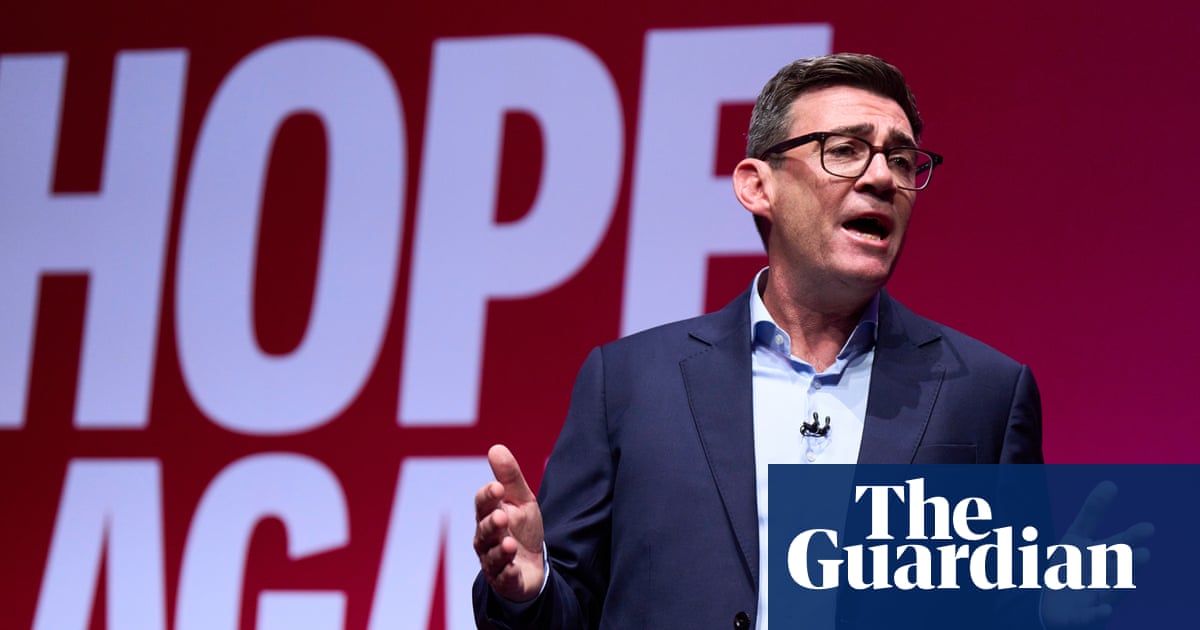
Andy Burnham, newly elected leader of the Labour Party, delivered his first speech as leader at the party's conference in Liverpool on Wednesday. The speech was emotional and covered bold policies such as reforming social care and electoral systems, drawing mixed reactions from attendees and media outlets.
Burnham choked up while discussing his father who recently passed away, a moment that resonated deeply with the audience. He admitted to wanting to move faster on cost-of-living measures but stressed fiscal honesty about what Britain can afford. The speech was seen by some as one of the most memorable in recent years, with former BBC political editor Andrew Marr comparing it favorably to Tony Blair's speeches.
Critics like Mail Online’s Quentin Letts were less impressed, describing the emotional tone and policy promises as overly sentimental and sugar-coated. Meanwhile, supporters praised Burnham for his relatability and commitment to addressing working-class concerns, potentially appealing to voters who had drifted away from Labour under Keir Starmer.
The speech also touched on plans for electoral reform, aiming to introduce proportional representation in Westminster elections, a significant change since 1918. This move is seen as part of Burnham's strategy to transform the UK’s political system fundamentally, though some within the party are wary about such dramatic changes given current fiscal constraints and public opinion.
Written for “Andy Burnham Labour Speeches” on 2026-10-05,
grounded in this article and the 24 other(s) covering the same event.
When assessing British political speeches, even many critics of the New Labour years measure success against Tony Blair, a leader whose podium appearances are regarded as the peak of oratory.
asserted
appearances → assess → oratory
On that measure, Andrew Marr, the former BBC political editor and now the New Statesman’s chief political commentator, reached for the ultimate accolade.
asserted
Marr → reach → accolade
“Rather to my surprise, I have to report Andy Burnham is at least as good a platform speaker” as Blair, he said.
asserted
he → have → Blair
Piers Morgan, the former News of the World editor, concluded that Burnham’s speech to the Labour party conference on Tuesday was “one of the best, and most powerfully delivered, by a British politician in a very long time”.
asserted
speech → conclude → time
Burnham’s onstage performance was also praised by Tim Shipman, the right-of-centre Spectator magazine’s political editor.
asserted
performance → praise → centre
He concluded it was sub-Blair but “as good as anything we’ve seen since”.
asserted
we → conclude → anything
Shipman wrote: “I’ve been attending party conferences since 2001 and in that time I’ve heard about 70 leaders’ speeches from all the parties.
asserted
I → write → parties
This was one of the most important and defining – I expect it will remain among the half-dozen most memorable.”
asserted
it → expect → dozen
Patrick Maguire, the Times’s chronicler of Labour’s inner workings, agreed.
asserted
Maguire → agree → workings
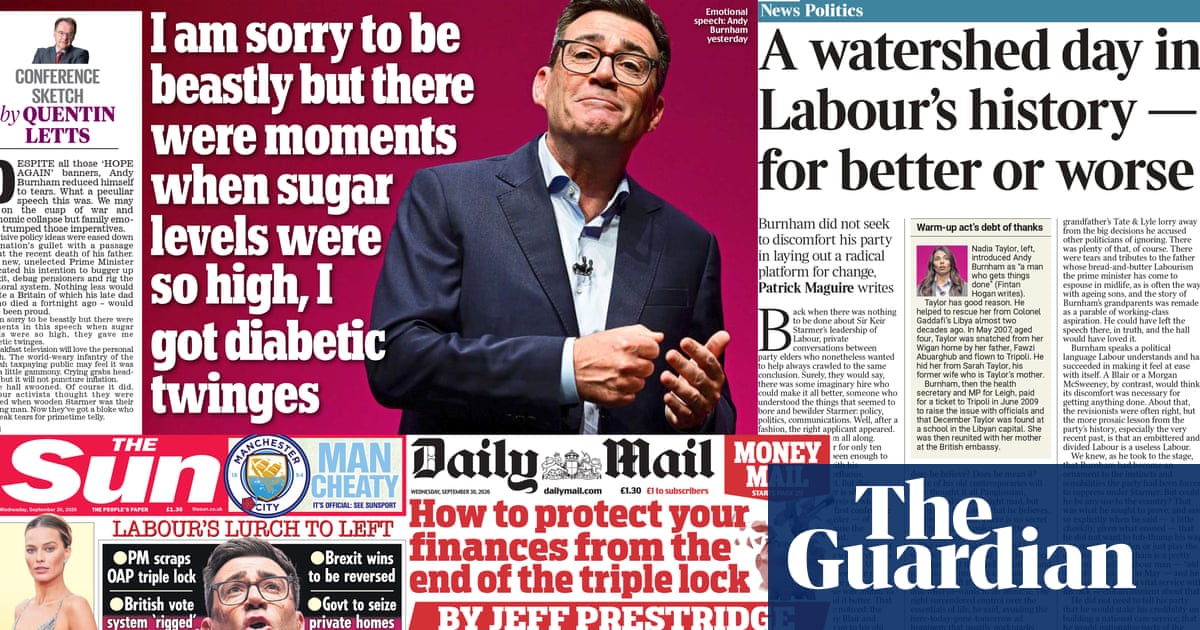
“The Labour party will talk about this speech for years and it will be remembered, as so few speeches are, as a formative, watershed moment in the history of this young century, for better or worse,” he said.
asserted
he → talk → century
Quentin Letts, the Mail’s sketch writer, said the speech was so saccharine in its plea for unity that “I got diabetic twinges”.
asserted
I → say → twinges
While there was both fulsome and grudging praise for Burnham’s delivery – the Daily Mail’s highly critical editorial on the speech said the “PM’s performance was slick, oozing everyman charm” – its radical nature placed it squarely in the crosshairs of the right-leaning media.
asserted
nature → be → media
A new Brexit deal, the prospect of a proportional voting system and his social care and housing plans were all targeted.
asserted
deal → target → system
The Mail’s front page described the “triple shock” of Burnham’s pension changes, care plans and Brexit rethink.
asserted
page → describe → changes
It regarded the speech as the “most leftwing speech by a PM since [the] 1970s”.
asserted
It → regard → 1970s
The Telegraph said it was a “road back to a failed past”.
asserted
it → say → past
The Sun, which has a difficult relationship with Burnham amid claims that he will not give any interviews or opinion pieces to the once dominant red top, did not hold back.
uncertain
he → have → top
It labelled the speech the “locky horror show”, a reference to Burnham’s pledge to end the pensions triple lock that guarantees big increases in the state pension.
asserted
that → label → pension
“The British vote system ‘rigged’,” it said.
asserted
it → say → ?
“Government to seize private homes,” it claimed, a reference to Burnham’s plan to remove homes from bad landlords.
asserted
it → seize → landlords
He described the address as “the most divisive speech I’ve heard from any prime minister”.
asserted
I → describe → minister
He even described the prime minister’s emotional reference to his late father as “a blatant pitch for sympathy from voters who might otherwise have been shocked by what we can all now see as Burnham’s truly socialist revolution”.
uncertain
we → describe → revolution
The Sun’s editorial column lamented Burnham’s lack of action on cutting the “ballooning welfare bill”.
asserted
column → lament → bill
Attacks on Burnham’s lack of attention to the welfare bill –a theme for both the Conservatives and Reform UK – was reflected across the rightwing media.
asserted
Attacks → reflect → media
“Who pays for PM’s New Jerusalem,” asked the Mail’s editorial column, suggesting the speech would have pleased Labour supporters in the hall but concerned the general voter.
asserted
speech → pay → voter
It also took the chance to put the boot into Burnham’s predecessor, Keir Starmer.
asserted
It → take → predecessor
“There’s no question he is an oratorical improvement on his incorrigibly wooden predecessor, a strong candidate for worst public speaker in political history,” it jibed.
asserted
it → ’ → history
“[Burnham] knew his audience, enthralling them with his northern working-class boy made good life story.
asserted
Burnham → know → story
The truth is that Middle England is about to be deluged with new tax rises, but ‘Honest Andy’ is too craven to admit it.”
The Daily Express’s front-page headline decried the speech as a “crying shame for our nation”.
asserted
headline → deluge → nation
Despite praising the delivery, the Spectator’s Shipman cited “room for improvement” in the speech’s content, citing potential flaws in his plan for a national care service and the limited early savings from ditching the pensions triple lock.
asserted
Shipman → praise → lock
He argued Burnham had “no plan for growth” – the issue that has plagued prime ministers of both main parties.
asserted
that → argue → parties
Shipman concluded that the speech amounted to “the most partisan leftwing set of priorities we have seen since the days of Harold Wilson”.
asserted
we → conclude → Wilson
What united coverage was a conclusion that unlike Starmer, Burnham had produced a clear statement of intent about who he was and what he wanted to achieve – for better or worse.
asserted
he → unite → what
The Times’s Maguire concluded: “There will be a hell of a row before we know whether it’s an epoch-defining Thatcherism of the left or Truss with charisma.
asserted
it → conclude → charisma
But for the first time in recent history, the leader of the Labour party wants that argument and is making his own.”
asserted
leader → want → own
The Times’s editorial column, however, reflected the political right’s early verdict on Burnham’s address – an appeal based in Labour’s comfort zone.
asserted
column → reflect → zone
“Mr Burnham’s speech was in some ways a curious throwback,” it stated.
asserted
it → state → ways
“Labour is becoming more middle class by the year, in composition and support, yet he imagines it as a vehicle dedicated to the working class of his memory.
asserted
he → become → memory
What exactly are wealth creators supposed to make of this charming man?”
asserted
creators → suppose → man
 The Aporia