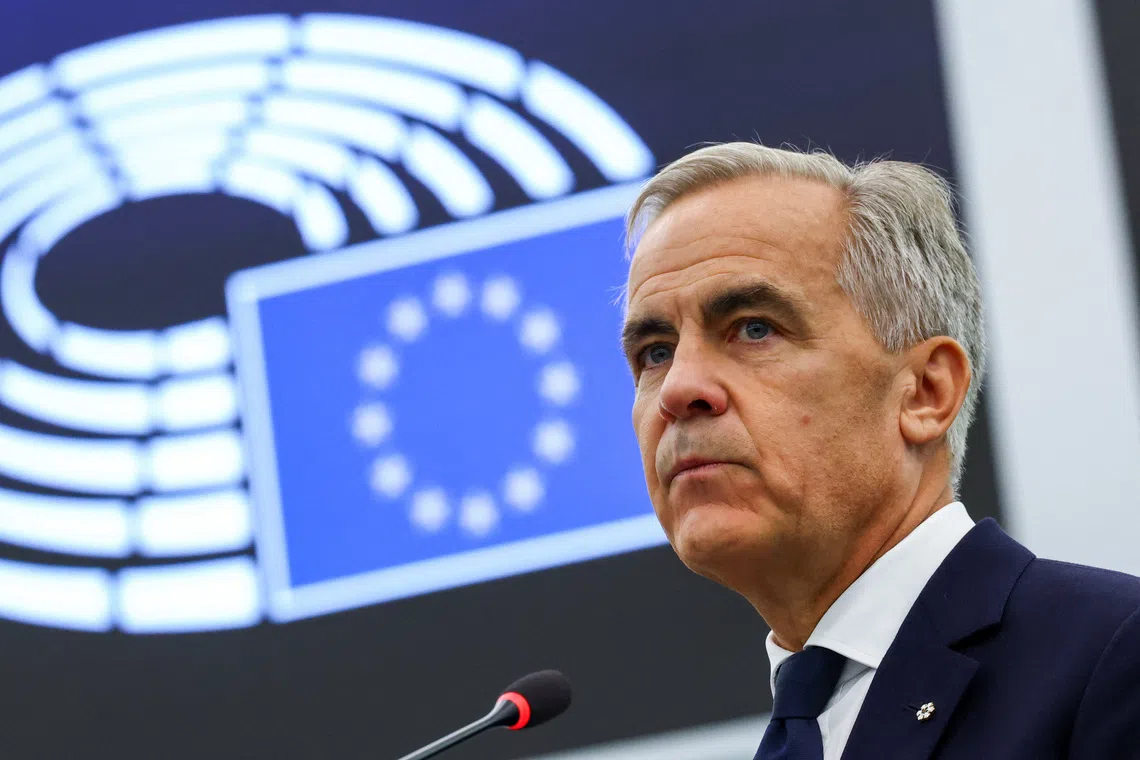
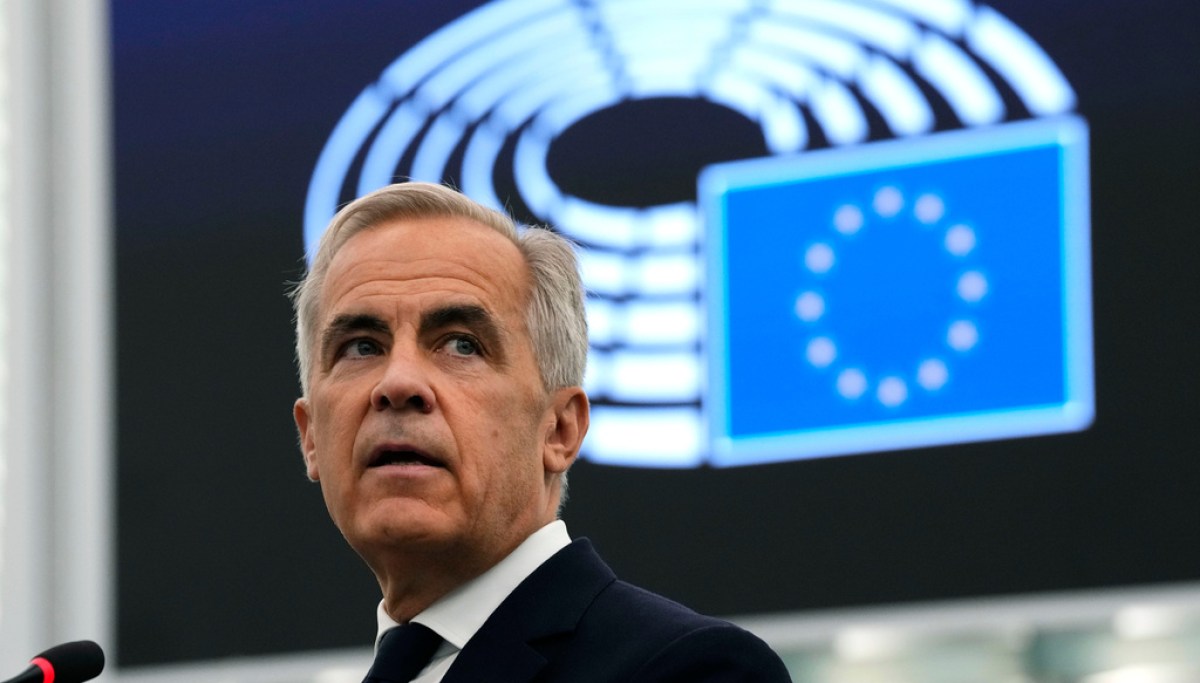
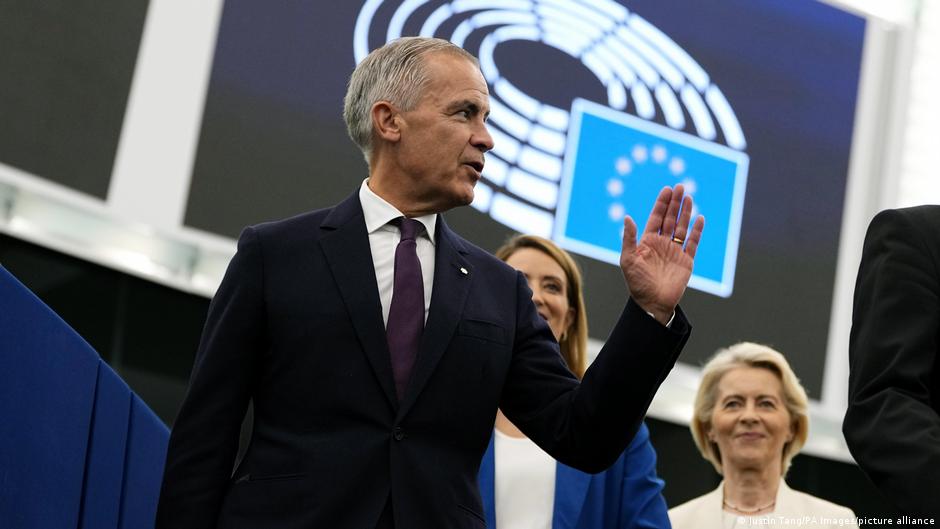
Canadian Prime Minister Mark Carney on Thursday welcomed the prospect of Canada becoming an “associate member” of the E.U., just hours after U.S. President Donald Trump dismissed the proposal as “laughable.”
asserted
Trump → welcome → proposal
Addressing the European Parliament as a guest of honor in Strasbourg, France, Carney insisted “Europe and Canada are stronger together” and said “Canada and the European Union can anchor our ground to hold our values while forming a protective canopy under which our citizens can thrive.”
Carney’s pivot toward Europe comes as he seeks to establish stronger international ties and curtail Canada’s reliance on the American market amid an all-out trade war.
asserted
he → address → war
Canada’s retaliatory tariffs came into effect last week, matching the economic pressure imposed by the U.S. after negotiations collapsed last month.
asserted
negotiations → come → U.S.
Trump’s repeated threats against Canadian sovereignty and calls to make it the “51st state” have added to the months-long tension.
asserted
it → repeat → tension
While Carney did not directly mention Trump or his Administration while addressing European lawmakers, he appeared to make nods to the current volatility of Canada-U.S. relations and condemned economic coercions.
asserted
he → mention → coercions
Speaking about the "current geopolitical rupture," he said a "new dimension was needed.”
asserted
dimension → speak → rupture
“Economic integration is now being weaponized, tariffs being used to exert pressure,” he said.
asserted
he → weaponize → pressure
“Financial mechanisms have been used for coercion.
asserted
mechanisms → use → coercion
Supply chains constitute weak points to be exploited.”
asserted
chains → constitute → points
Championing the burgeoning E.U. alliance, Carney focused on what he said were shared values between Canada and the bloc, insisting: "We are not fair-weather allies.
asserted
We → champion → Canada
We believe that our prosperity grows when it is shared.
asserted
it → believe → ?
“I'm not proposing a third bloc in order to become a 'great power' rival, only with better manners,” Carney continued.
asserted
Carney → propose → manners
“We do not seek power to dominate others.
asserted
We → seek → others
On the contrary, we are pursuing resilience so no one can control our open markets, impair our sovereignty, threaten our territorial integrity, or undermine our freedoms, our democracies, our rule of law.”
asserted
one → pursue → law
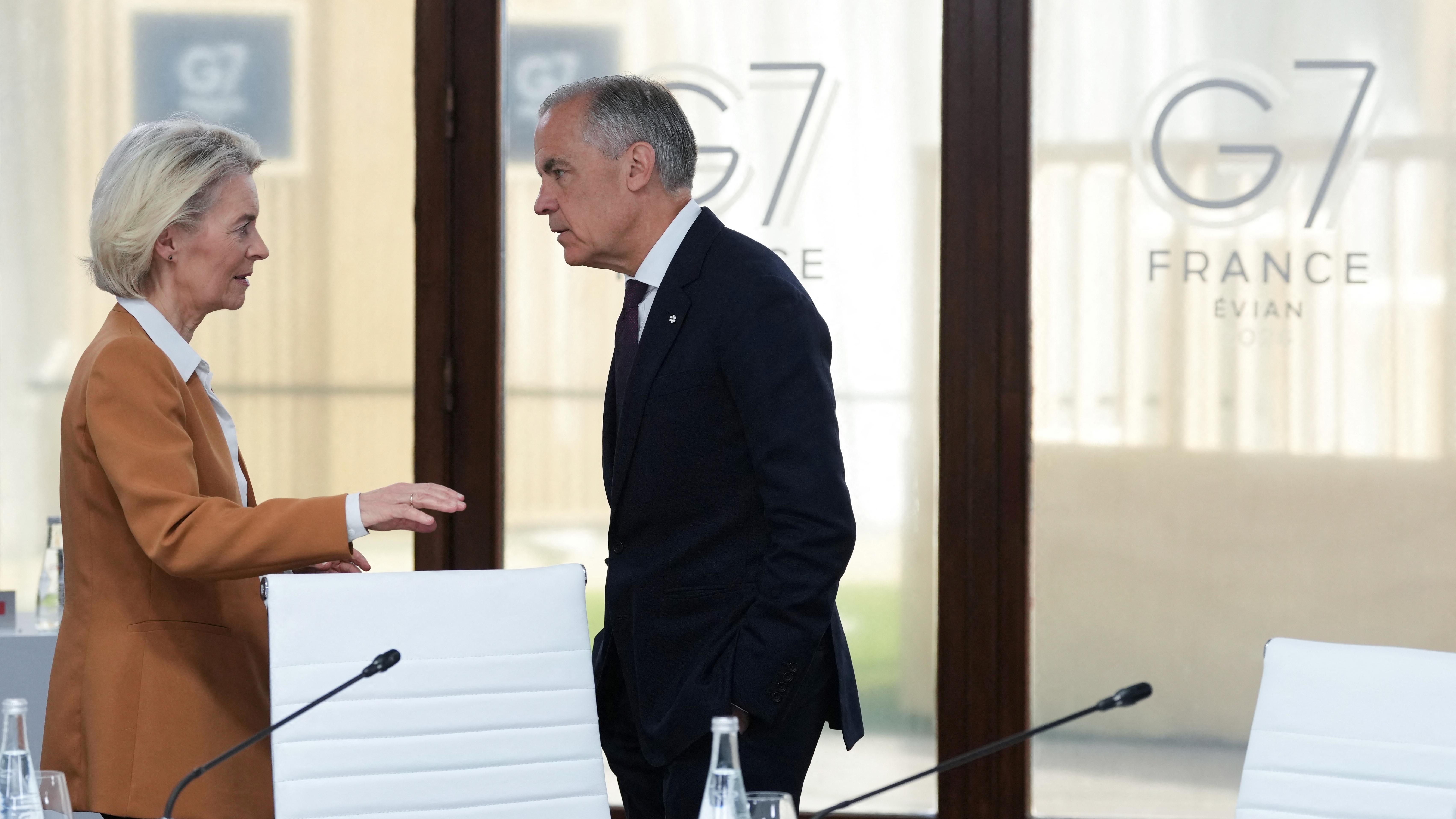
Carney, who began his speech in French—one of Canada’s official languages—before continuing in English, with splatterings of German, welcomed how European Commission president Ursula von der Leyen had on Wednesday opened the door for Canada becoming an “associate member” of the 27-member bloc.
asserted
Canada → begin → bloc
When speaking about forging closer ties with the E.U., Carney referenced seeking strategic autonomy through “deep co-operation in the full range of strategic capabilities, including critical minerals, defense industrial capacity, AI and compute, energy security, space and payments.”
asserted
Carney → speak → minerals
He insisted Canada and Europe must not be dependent on “individual nations or individual companies” as this “creates vulnerabilities, particularly when supposedly global companies prove national in the breach.”
asserted
companies → insist → breach
He also hinted at a potential freedom of movement between the E.U. and Canada that would allow “youth to work, study, and live where they want, on either side of the Atlantic.”
asserted
they → hint → Atlantic
Carney’s passionate advocacy for the deepening of ties with the E.U.—a move he says Canadians have shown they’re in support of—came after Trump lambasted the idea of a new European dawn for Canada.
asserted
Trump → say → Canada
Speaking to reporters Wednesday, Trump called the proposal “laughable” and threatened economic punishments if the E.U. moves forward with von der Leyen’s plan.
asserted
E.U. → speak → plan
"If they do that, if I think it's at all a hostile act, I will put very serious tariffs or stop trading with Europe on many things," Trump said en route to an event in North Carolina.
asserted
Trump → do → Carolina
If it's a bad intention, we'll put very heavy tariffs on Europe.”
asserted
we → put → Europe
In response to Trump’s remarks, a European Commission spokesperson told TIME: “As president von der Leyen made clear [on Wednesday], the proposed strengthening of our partnership with Canada is not against anyone else, but for our common strength.”
asserted
strengthening → tell → strength
Carney welcomes new alliances on visit to Europe
Carney's speech to the European Parliament came on the final day of his stay in Europe, where he sought to cement and deepen Canada’s international relationships.
asserted
he → welcome → relationships
The E.U. is Canada’s second-largest global trading partner for goods and services, with bilateral trade worth approximately C$178.6 billion in 2025.
asserted
E.U. → trade → 2025
The Canadian leader also traveled to Liverpool, England, to meet British Prime Minister Andy Burnham.
asserted
leader → travel → Burnham
The pair attended a football game and watched Everton—the team they both support—secure a victory against the Wolverhampton Wanderers.
asserted
they → attend → Wanderers
"The leaders began by underscoring the close co-operation between the U.K. and Canada and emphasized the importance of building similar close ties with European partners, particularly on trade and defence,” a Downing Street spokeswoman told TIME.
asserted
spokeswoman → begin → TIME
Ahead of the meeting, Burnham called Carney a “great progressive leader” with whom the U.K. shares “so many values, but also with whom we have a shared opportunity on defense co-operation, on trade” and AI.
asserted
we → call → trade
Canada applies to join U.K.-led military coalition
Following Burnham and Carney's meeting, it was announced that Canada has applied to join the British-led Joint Expeditionary Force military coalition.
The force, formally launched in 2014, consists of 10 North Atlantic NATO member states that deliver rapid response and security operations.
asserted
that → apply → operations
“Prime Minister Carney announced that Canada has formally applied to join the Joint Expeditionary Force and welcomed the U.K.’s support for Canada’s participation in this important initiative,” Carney’s office said in a statement.
asserted
office → announce → statement
Canada, already a NATO member, is seeking to diversify its defense dependency from the U.S. with new partnerships across the Atlantic.
asserted
Canada → seek → Atlantic
In February, Canada became the first non-European country to participate in the "Security action for Europe” (SAFE) instrument, which provides up to €150 billion in low-interest loans to help member states purchase military and defense equipment.
asserted
states → become → equipment
What happens next as Canada seeks "associate" membership with the E.U.?
asserted
Canada → happen → E.U.
Following von der Leyen’s proposal, a European Commission spokesperson told TIME that the executive cabinet will work “in close coordination with [its] member states and the European Parliament” to “create a new form of partnership that has not existed until now–building the closest imaginable form of association with a partner outside Europe.”
asserted
that → follow → Europe
The proposed alliance is set to include deeper economic ties, a technology alliance, greater integration of defense industrial bases, and efforts to make the Arctic a flagship joint project.
asserted
Arctic → propose → bases
It could also expand cooperation on energy, critical minerals and batteries, as well as AI, quantum technology, cybersecurity, and economic security.
uncertain
It → expand → energy
The proposal has been welcomed by many European lawmakers across the bloc.
asserted
proposal → welcome → bloc
Member of the European Parliament (MEP) for Spain Javier Moreno Sánchez, who also serves as chair of the parliament’s delegation for relations with Canada, told TIME the decision to bring Canada in as an “associate member” was “politically and symbolically significant,” but warned it “must now be followed by concrete actions.”
asserted
it → serve → actions
Irish MEP Barry Andrews told TIME that the announcement is a clear “win-win for both sides,” adding that “in an ever more insecure world, truly democratic countries must come together and stand up to Trump, [Chinese President] Xi Jinping, and [Russian President Vladimir] Putin.”
asserted
countries → tell → Trump
…and 9 more, not listed.
 The Aporia
.jpg?branch=production&width=5426&quality=75&auto=webp&crop=16:9)