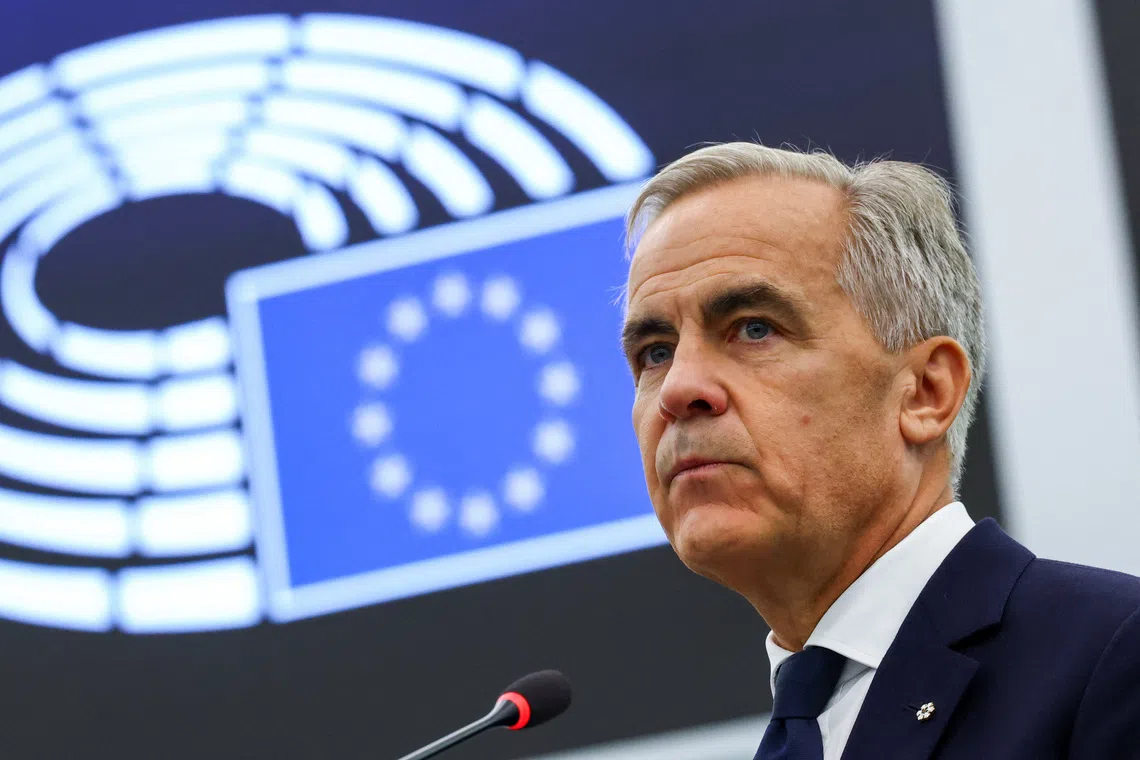
Mark Carney, Canadian Prime Minister (and former Governor of the Bank of England), addressed the European Parliament in Strasbourg, France, aiming to allay U.S. concerns over his proposal for an EU-Canada partnership following a speech by Ursula von der Leyen, President of the European Commission. In his remarks, Carney emphasized that the new relationship would not be aimed at challenging the U.S., but rather enhancing Canada’s sovereignty and making it a better partner to America. His comments came amid tensions with the U.S., particularly under President Trump's administration, with Carney indirectly criticizing the current American stance on trade without naming Trump directly.
Written locally by qwen2.5:14b on 2026-09-17,
using this article's own text rather than the other coverage of the
same event (that is the story summary below).
Story summary
Prime Minister Mark Carney addressed the European Parliament in Strasbourg, France, outlining his vision for a closer relationship between Canada and the EU. Carney emphasized maintaining sovereignty while deepening economic ties, including trade in critical minerals, AI, defense, and digital services. The proposed alliance aims to counterbalance growing tensions with the U.S., particularly under President Donald Trump's administration. Reports suggest that the EU is considering designating Canada as an "associate member," a non-existent title aimed at enhancing cooperation without compromising Canadian autonomy. Carney’s speech was well-received in Europe, which sees the move as beneficial for mutual resilience against global challenges.
Written for “Carney Seeks Closer EU Ties” on 2026-09-17,
grounded in this article and the 11 other(s) covering the same event.
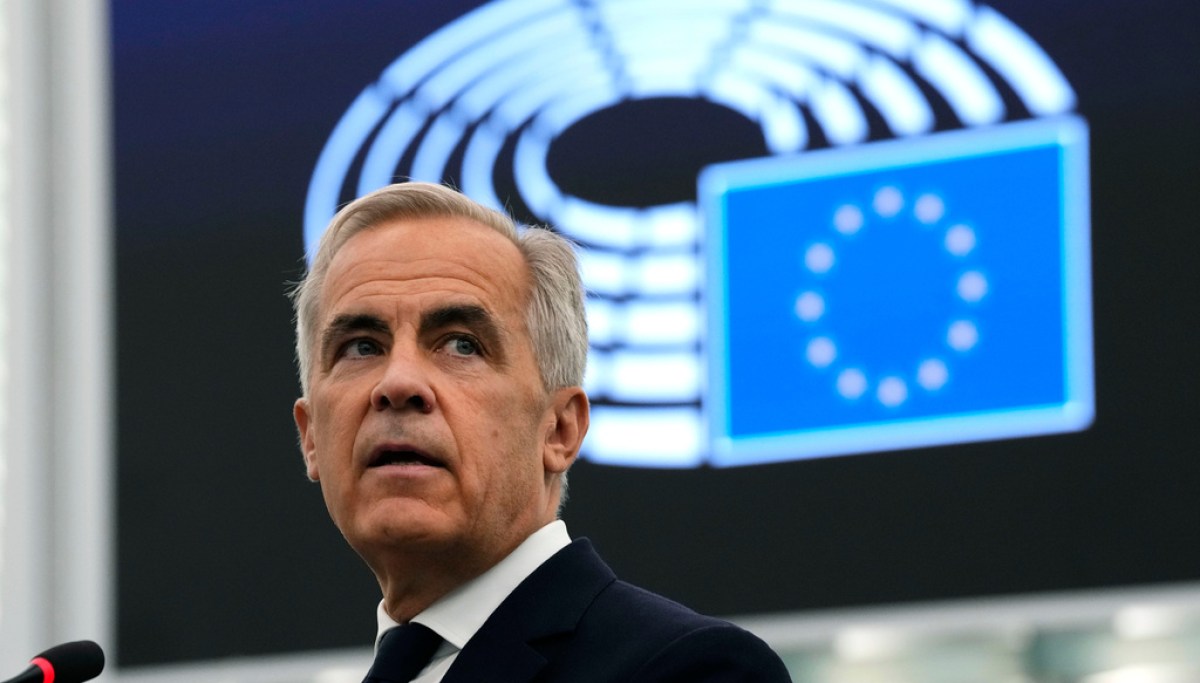
Canadian Prime Minister Mark Carney tried to soothe U.S. fears over his overtures toward the European Union, pledging that a planned new partnership wouldn’t be detrimental to the United States.
asserted
partnership → try → States
Carney outlined his vision for the planned first-of-its-kind alliance with the EU in a speech to the European Parliament in Strasbourg, France, on Thursday, a day after European Commission President Ursula von der Leyen introduced the concept in her own speech.
asserted
Leyen → outline → speech
The obvious subtext to the push is a mutual desire to counter U.S. influence, after the pair’s respective relationships with the U.S. have soured under President Donald Trump.
asserted
relationships → counter → Trump
Carney focused on tempering U.S. resistance to the move, arguing that it would ultimately benefit the U.S. as well.
asserted
it → focus → U.S.
Carney said he was, “not proposing a third bloc in order to become a great-power rival — only with better manners.”
asserted
he → say → manners
“We do not seek power to dominate others.
asserted
We → seek → others
On the contrary, we are pursuing resilience so that no one can control our open markets, impair our sovereignty, threaten our territorial integrity, or undermine our freedoms, our democracies, our rule of law,” he added.
asserted
he → pursue → law
The new partnership would instead make Canada “a better partner for the U.S.”
asserted
Canada → make → U.S.
Despite this, Carney made numerous veiled swipes at Trump, though never mentioning him by name.
asserted
Carney → make → name
“We are looking for partnerships that are complementary, that reinforce our sovereignty,” he said.
asserted
he → look → sovereignty
“And that’s what is on offer here.
asserted
what → ’ → offer
Nobody is going to tell us what language we speak, no one is going to dictate our culture, or with whom we can strike agreements internationally.”
asserted
we → go → agreements
Carney previously said that the red line that led to a breakdown in trade negotiations with the U.S., which are currently at a standstill, was the U.S. violating Canada’s French language provisions.
asserted
U.S. → say → provisions
The underlying tension with the U.S. was illustrated when Carney first took the podium, when an unidentified person in the crowd began a “U.S.A.” chant, drawing a laugh from Carney and boos from the rest of the crowd.
asserted
person → underlie → crowd
Carney’s attempts to soothe U.S. fears came after Trump made his first comments on the planned “associate membership,” in which he expressed his disapproval.
asserted
he → soothe → disapproval
“I think it’s laughable, the whole thing with Canada.
asserted
it → think → Canada
Canada has been a terrible trade partner,” Trump said, when asked about the planned alliance.
asserted
Trump → say → alliance
“If they do that, if I think at all it’s a hostile act, I will put very serious tariffs, or stop trading with Europe, on many things,” he continued.
asserted
he → do → things
“So, if Europe does that, with a bad intention — if they do it with a good intention, that’s fine.”
asserted
that → do → intention
Von der Leyen’s speech announcing her intention to welcome Canada as the first associate member of the EU reportedly took most of the bloc by surprise, leaving officials scrambling to figure out what the deal would actually entail.
uncertain
deal → announce → what
This confusion was reflected in remarks by EU Ambassador to the U.S. Jovita Neliupsiene, who spoke to reporters on Wednesday and stressed that the actual details were still up in the air.
asserted
details → reflect → air
“To see Canada as a potential associated member is still to be discussed, that’s what the commission president said,” she said.
asserted
she → see → what
“It’s open doors and open ideas” with Canada.
asserted
It → ’ → Canada
Timothy Nerozzi contributed to this report.
asserted
Nerozzi → contribute → report
 The Aporia



.jpg?branch=production&width=5426&quality=75&auto=webp&crop=16:9)