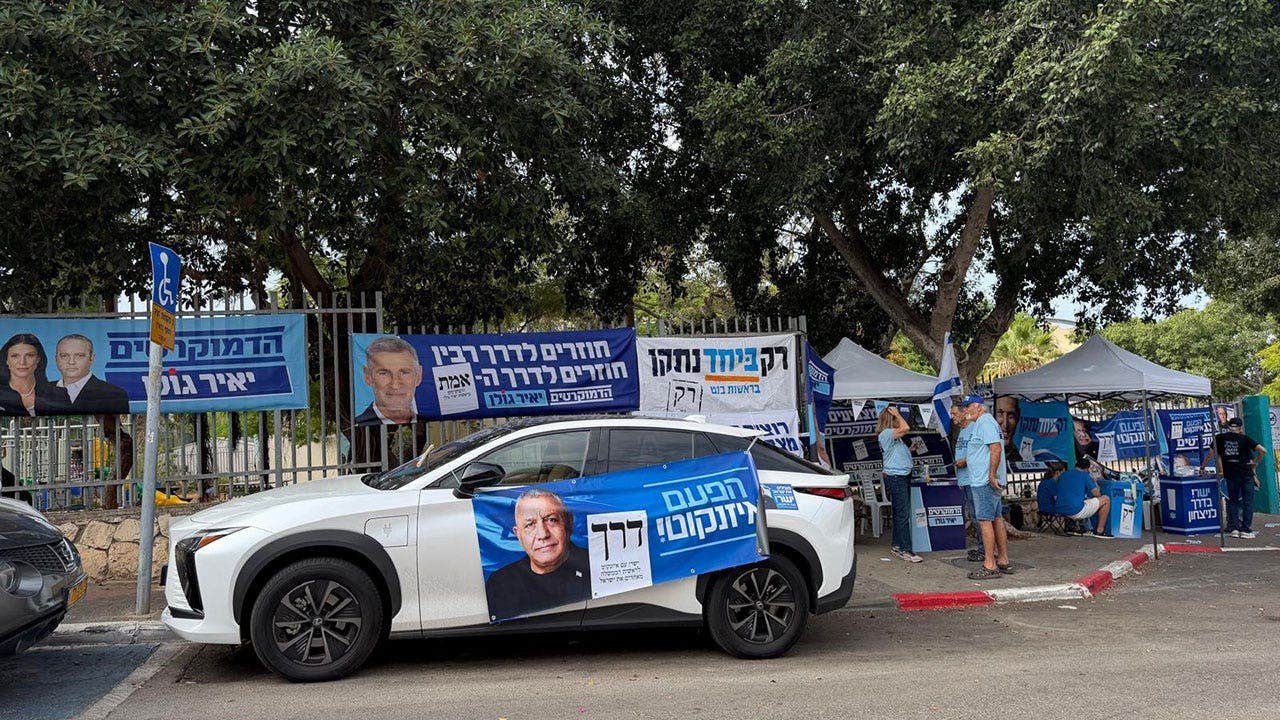
News Analysis | What has driven the high Arab turnout in Israel’s elections?

Read the original at The Hindu ↗
Cite

Parthasarathy, S. (2026, October 28). News Analysis | What has driven the high Arab turnout in Israel’s elections? The Hindu. https://www.thehindu.com/news/international/news-analysis-what-has-driven-the-high-arab-turnout-in-israels-elections/article71637664.ece

Dated from the outlet's own feed. Check the original for its byline.

The Hindu · collected 2026-10-28 · by Sambavi Parthasarathy

Quick Summary

Israel’s recent October 27 legislative elections saw a voter turnout of 77.7%, the highest since 1999, largely driven by high participation from Arab citizens estimated at nearly 80%. This surge contrasts with historical trends where only about 40% of eligible Arab adults typically voted in previous elections. The key motivator for this increased turnout among Arabs was fear of a continued right-wing government led by Benjamin Netanyahu, who framed the election as a matter of national survival to rally his base.
Written locally by qwen2.5:14b on 2026-10-28, using this article's own text rather than the other coverage of the same event (that is the story summary below).

AI analysis runs on qwen2.5:14b, locally

Story summary

Summary unavailable.

Written for “Israeli Election Campaign And Outcomes” on 2026-10-28, grounded in this article and the 90 other(s) covering the same event.
Why this leaning score
The model judged this article politically coded and scored it -0.45, but all 2 of its quote(s) are attributed speech - words the article quotes from someone, not the article's own narration, so the score is not published.
Written under an earlier scoring contract, which gave a paragraph rather than checkable quotes. Re-analysing this article replaces it.
Leaning score withheld for article 112604: attributed speech only · logged 2026-10-28

Story

📰 Israeli Election Campaign And Outcomes
Politics · 91 article(s) covering the same event. Compare every outlet's account →

Compared with similar articles

This article reads unscored and hedges 4% of its claims. Each row says how that neighbour differs.
BBC News
⚖️ leaning not scored 🔴 24% hedged 8 of 34 📰 publisher trust 69
“Both articles discuss the same Israeli election held on October 27, 2026, with high voter turnout being a key factor in both reports.”
Fox News
⚖️ leaning not scored 🔴 28% hedged 8 of 29 📰 publisher trust 70
“Both articles describe the high voter turnout in the October 27, 2026, Israeli national election.”
New York Post
⚖️ Leans left 🔴 13% hedged 2 of 15 📰 publisher trust 66
“The articles discuss different aspects of the Israeli election but do not describe the same specific incident or outcome.”
Al Jazeera
⚖️ Leans strongly left 🔴 13% hedged 6 of 46 📰 publisher trust 60
“The articles discuss related topics but describe different aspects of the Israeli election, not the same specific incident.”
South China Morning Post
⚖️ leaning not scored 🔴 20% hedged 1 of 5 📰 publisher trust 64
“Article A describes the voting process on election day, while Article B analyzes the high voter turnout after the election results.”
Daily Mail
⚖️ Leans right 🔴 7% hedged 3 of 43 📰 publisher trust 68
“Article A covers the overall context and significance of the election, while Article B focuses specifically on the high Arab turnout in the October 27 elections, discussing a particular aspect rather than the event as a whole.”
Al Jazeera
⚖️ Leans left 🔴 14% hedged 5 of 35 📰 publisher trust 60
“Both articles describe the high voter turnout among Palestinian citizens of Israel during the same parliamentary election on October 27, 2026.”
Al Jazeera
⚖️ leaning not scored 🔴 0% hedged 0 of 4 📰 publisher trust 60
“While both articles discuss the Israeli election, Article A focuses on voter sentiment and ballot counting in Tel Aviv, while Article B analyzes the high turnout among Arab citizens. They describe different aspects of the same larger event but do not clearly report on the exact same specific incident.”
Daily Mail
⚖️ leaning not scored 🔴 9% hedged 4 of 44 📰 publisher trust 68
“While both articles discuss the Israeli election of October 27, 2026, and mention high voter turnout, Article B focuses specifically on Arab voter turnout analysis rather than the overall event described in Article A.”
Al Jazeera
⚖️ Leans left 🔴 23% hedged 9 of 39 📰 publisher trust 60
“Article A provides background on the upcoming election, while Article B discusses the high voter turnout in the actual election that occurred later.”
How this article was measured signals, leaning charts, publisher record, byline, topics and claims

Signals How these are calculated →

Claims extracted
23
sentences that state something as happening or true
Uncertain
4%
1 of 23 hedged ("reportedly", "may", "according to")
Leaning
withheld
no quote in the article backed the model's score
Publisher signals
78/100
The Hindu's corrections and hedging, across everything collected from it. Not a measure of accuracy.
Outlets on this story
91
Politics
Same framing elsewhere
1
articles that frame the event the way this one does
Analyzed 2026-10-28 · how these are computed

How this is being covered How these are calculated →

Article leaning vs. publisher reliability
Source leaning vs. consistency

Publisher

The Hindu · 650 article(s) · 2 correction(s) detected
Running correction rate · 2 correction(s)

Who wrote this

Sambavi Parthasarathy
7 article(s) here · 1 carrying a prediction
🔮 This implies that the voter turnout among Arab citizens in Israel would be the highest in at least a decade.
🔮 With Israel set to go the polls on Tuesday (October 27, 2026), Mr. Eisenkot’s year-old centrist party, Yashar (Hebrew for Straight), is projected to win 20 of 120 seats in parliament, putting it ahead of Mr. Netanyahu’s Likud.
2026-10-24 · assertive framing · Gadi Eisenkot | Netanyahu’s challenger
🔮 However, the tender process is required only in 13 settlements and is not required in others, so the actual number of housing units being constructed could be much higher.
🔮 In May, the Trump administration imposed secondary sanctions on foreign firms dealing with the Cuban state and its military conglomerate, GAESA.
2026-10-07 · assertive framing · The status of the U.S. blockade on Cuba
🔮 Recent polls by media outlets have suggested that neither Prime Minister Benjamin Netanyahu’s coalition nor the Zionist opposition bloc will be able to secure the 61 seats required for a parliamentary majority in the 120-member Knesset, and projected that the Arab parties could win up to 12 seats.
2026-09-28 · assertive framing · Why Israel banned Arab parties ahead of polls
🔮 This construction on Palestinian land is illegal under international law and would isolate Palestinian communities between the northern and southern West Bank.
🔮 According to the poll published by Maariv, Yashar was projected to win 25 seats while Likud trailed with 19.
Also by Sambavi Parthasarathy
Nothing else under this byline is closely related to this article, so these are simply their most recent.
All 7 articles by Sambavi Parthasarathy →

Topics

Arab Arabs Israel Israeli Knesset

Subjects

Arab NORP · 18× Knesset ORG · 6× Arabs NORP · 4× Israel GPE · 4× Israeli NORP · 3× Netanyahu PERSON · 3× Jewish NORP · 2× Rudnitzky PERSON · 2× the Israel Democracy Institute ORG · 2× the Central Elections Committee ORG · 1×

Narrative

We know that approximately 10% of Arab citizens boycott Knesset elections for ideological reasons, but the majority are reluctant to take part in this political game because of the conduct of their parties,” said Arik Rudnitzky, from the Israel Democracy Institute in Jerusalem.
framing: assertive · carried by 1 article(s) · first seen 2026-10-28
🔮 This implies that the voter turnout among Arab citizens in Israel would be the highest in at least a decade.

Claims (23 extracted, 1 hedged)

Israel’s October 27 legislative elections recorded a massive voter turnout of 77.7%, the highest since 1999. asserted
elections → record → 1999
The country’s Arab citizens, who turned up in massive numbers to vote, remained one of the main factors, contributing to the surge. asserted
who → turn → surge
While the official figures for voter turnout among Israeli Arabs are yet to be released by the Central Elections Committee, exit polls recorded by Channel 12 estimate Arab voter turnout to be nearly 80%. asserted
turnout → release → Channel
This implies that the voter turnout among Arab citizens in Israel would be the highest in at least a decade. asserted
turnout → imply → decade
Also Read | Israel elections: Understanding how Knesset polls work vs India’s system While Arabs account for about 21% of Israel’s population, the parties representing them have never held more than 15 seats in the 120-member Knesset. asserted
parties → read → Knesset
Their turnout in the elections has also been relatively low, with about 40% of eligible Arab adults abstaining from voting in most Knesset elections over the past two decades. asserted
% → abstain → decades
“In the previous elections, I think the low voter turnout was a result of disappointment mainly from Arab parties themselves. asserted
turnout → think → parties
We know that approximately 10% of Arab citizens boycott Knesset elections for ideological reasons, but the majority are reluctant to take part in this political game because of the conduct of their parties,” said Arik Rudnitzky, from the Israel Democracy Institute in Jerusalem. asserted
Rudnitzky → know → Jerusalem
This trend was defied in the latest election. asserted
trend → defy → election
“I believe the number one motivator specifically in these elections is fear. asserted
motivator → believe → elections
Fear of another term of the Netanyahu government or a right-wing government because Arab citizens have had enough in the past four years,” Mr. Rudnitzky told The Hindu. asserted
Rudnitzky → have → Hindu
This surge was used by Israeli Prime Minister Benjamin Netanyahu and his coalition to mobilise right-wing voters. asserted
surge → use → voters
Mr. Netanyahu, on his X, called on his supporters to vote for Likud and described the situation as a “matter of life and death”. asserted
Netanyahu → call → life
His posts tried to mobilise voters by calling the situation “a war at home.” asserted
posts → try → home
This attempt was criticised by Arab parties for being racist and for inciting hatred. asserted
attempt → criticise → hatred
A survey by the Israel Democracy Institute published in September revealed that a party’s position regarding foreign affairs and security, followed by the economy and high cost of living, were the two most influential factors determining the support of Jewish Israelis. asserted
position → publish → Israelis
In contrast, more than half of the surveyed Arabs felt that the party’s position regarding crime in Arab society was one of the most important factors determining their vote. asserted
position → survey → vote
A large voter turnout among Israeli Arabs is expected to benefit the Arab parties, thereby improving the chances of Arab representation in the Knesset committees and better policies or support for them. asserted
turnout → expect → them
This is evident in the exit polls and latest numbers which have put Arab parties leading in at least 17 seats in the Knesset However, it is also true that not all Arab citizens support Arab parties. asserted
citizens → put → parties
“In general, approximately 15% of the Arab or Arab citizens support non-Arab parties, Jewish parties. asserted
% → support → parties
Most of them support centrist parties. asserted
Most → support → parties
Also the Democrats headed by Yair Golan enjoy relative significant support in the Arab sector,” said Mr. Rudnitzky. asserted
Rudnitzky → head → sector
Latest numbers also show that neither the Netanyahu-bloc nor the Opposition coalition is set to secure a clear majority, meaning that Arab parties could hold the key as to who forms the government this time. uncertain
who → show → government

💬Give feedback
🕘History 🎫Support