Photo via The Sydney Morning Herald

The Israeli elections have produced a deadlock. What happens now?

Read the original at The Sydney Morning Herald ↗
Cite

Knott, M. (2026, October 28). The Israeli elections have produced a deadlock. What happens now? The Sydney Morning Herald. https://www.smh.com.au/world/middle-east/where-to-from-here-after-israel-s-election-20261028-p619ic.html?ref=rss&utm_medium=rss&utm_source=rss_feed

Dated from the outlet's own feed. Check the original for its byline.

The Sydney Morning Herald · collected 2026-10-28 · by Matthew Knott

Quick Summary

Israeli elections have resulted in a deadlock, with Benjamin Netanyahu's bloc securing 54 seats and the opposition bloc led by Gadi Eisenkot winning 47 seats. To form a government, a party leader needs at least 61 seats or could potentially govern as a minority. President Isaac Herzog will consult party leaders to determine who can form a coalition. Possible outcomes include Netanyahu forming a majority with support from the opposition or a minority government reliant on Arab parties. If no one can command a majority, another election may be called.
Written by AI on 2026-10-31, from this article's own text only (the story summary below draws on all the coverage).

AI analysis

Story summary

On October 27, 2026, Israel held its parliamentary elections after three years of conflict. With 99.5% of votes counted, Benjamin Netanyahu's right-wing bloc secured the most seats but fell short of an outright majority in the 120-seat Knesset, winning 53 seats compared to 48 for the main opposition led by Gadi Eisenkot. Arab parties won a record 19 seats, up from 10 previously, making them key players in forming a coalition government. Despite these changes, neither side secured enough support to form a majority without the other's cooperation, leading to potential political deadlock.

Written for “Israeli Election Results Unclear” on 2026-10-31, grounded in this article and the 222 other(s) covering the same event.

Story

📰 Israeli Election Results Unclear
Politics · 223 article(s) covering the same event. Compare every outlet's account →

Compared with similar articles

This article reads unscored and hedges 12% of its claims. Each row says how that neighbour differs.
National Post
Hedges 5 of 29 claims Outlet record 60/100
BBC News
⚖️ Centre Hedges 0 of 4 claims Outlet record 68/100
NPR
Hedges 12 of 62 claims Outlet record 60/100
Toronto Star
Hedges 11 of 35 claims Outlet record 64/100
Times of India
Hedges 16 of 43 claims Outlet record 59/100
South China Morning Post
Hedges 2 of 4 claims Outlet record 64/100
The Straits Times
⚖️ Leans left Hedges 2 of 25 claims Outlet record 66/100
ABC News (AU)
Hedges 3 of 19 claims Outlet record 68/100
South China Morning Post
Hedges 1 of 3 claims Outlet record 64/100
Daily Mail
⚖️ Leans right Hedges 5 of 46 claims Outlet record 68/100
How this article was measured signals, leaning charts, publisher record, byline, topics and claims

Signals How these are calculated →

Claims extracted
42
sentences that state something as happening or true
Uncertain
12%
5 of 42 hedged ("reportedly", "may", "according to")
Leaning
withheld
no quote in the article backed the model's score
Publisher signals
61/100
The Sydney Morning Herald's corrections and hedging, across everything collected from it. Not a measure of accuracy.
Outlets on this story
223
Politics
Same framing elsewhere
1
articles that frame the event the way this one does
Analyzed 2026-10-31 · how these are computed

How this is being covered How these are calculated →

Article leaning vs. publisher reliability
Source leaning vs. consistency

Publisher

The Sydney Morning Herald · 5658 article(s) · 15 correction(s) detected
Running correction rate · 15 correction(s)

Who wrote this

Matthew Knott
31 article(s) here · 1 carrying a prediction
🔮 “He’s a huge fighter, he will never bend down.”
2026-10-30 · assertive framing · ‘We need Bibi’: How Netanyahu defied the polls
🔮 The Joint List parties have not traditionally sought to join Israeli governing coalitions on the grounds that it would be wrong to provide legitimacy to the Israeli government until the occupation of the Palestinian territories in the West Bank and Gaza ends.
🔮 Israeli President Isaac Herzog will consult all the party leaders to inquire who they could support as prime minister.
🔮 To their dismay, the problem has only worsened in the years since.
🔮 “God willing, we will stay here until the government will take this settlement and put it into Gaza,” says Chaim, a member of the controversial Nachala settler organisation led by Daniella Weiss, known as the godmother of the Israeli settler movement.
🔮 The message was as subtle as a slap in the face: vote for me or armageddon will follow.
🔮 But Rahamim would regularly cross into Gaza to buy jewellery, eat hummus and catch up with Palestinian friends, including some who attended his wedding.
🔮 As blazing sunlight streams through the glass windows of Ehud Barak’s office, the former Israeli prime minister paints a dark portrait of what could unfold as Prime Minister Benjamin Netanyahu prepares to vote next Tuesday.
🔮 He said the party would support providing military aid to Ukraine if it were backed by the United Nations Security Council, but critics have noted Russia would inevitably use its veto power to block any such move.
🔮 US President Donald Trump has made a stunning late intervention in Israel’s elections, endorsing Prime Minister Benjamin Netanyahu in a move the veteran leader hopes could allow him to remain in office.
Also by Matthew Knott
‘We need Bibi’: How Netanyahu defied the polls
2026-10-30 · The Sydney Morning Herald
Nothing else under this byline is closely related to this article, so these are simply their most recent.
All 31 articles by Matthew Knott →

Topics

Arab Israeli Israelis Jewish Knesset

Subjects

Netanyahu PERSON · 8× Arab NORP · 6× Israeli NORP · 5× Israel GPE · 3× Israelis NORP · 3× Eisenkot PERSON · 2× Jewish NORP · 2× Knesset ORG · 2× Zionist NORP · 2× Gadi Eisenkot PERSON · 1×

Narrative

He said he would “do everything in my power to build a Zionist, pro-IDF [Israeli Defence Forces] enlistment government”, while warning Netanyahu not to play with national security for political gain. United Arab List leader Mansour Abbas said: “If we join a government of change, we will be able to see substantial changes, not just empty talk.” How would another round of elections work?
framing: assertive · carried by 1 article(s) · first seen 2026-10-31
🔮 Israeli President Isaac Herzog will consult all the party leaders to inquire who they could support as prime minister.
2026-10-31 · The Sydney Morning Herald
The Israeli elections have produced a deadlock. What happens now? · assertive framing

Claims (42 extracted, 5 hedged)

The Israeli elections have, at least for now, produced a deadlock, with neither the pro nor anti-Benjamin Netanyahu blocs able to form a majority in their own right. asserted
blocs → produce → right
The latest results show Netanyahu’s bloc winning 54, the opposition bloc led by Gadi Eisenkot on 47 and the Arab parties on 19. asserted
bloc → show → 19
The key number is to reach at least a 61-seat parliamentary majority, although it is technically possible to govern in minority. asserted
it → reach → minority
What happens once the votes are counted? asserted
votes → happen → ?
Israeli President Isaac Herzog will consult all the party leaders to inquire who they could support as prime minister. uncertain
they → consult → minister
Based on these discussions, he will give one of the party leaders a chance to form a governing coalition. asserted
he → base → coalition
This is expected to be Netanyahu, given his Likud party has easily won the most seats in the Knesset, the Israeli parliament. asserted
party → expect → Knesset
In 2021 Naftali Bennett became prime minister despite winning only seven seats in the elections. asserted
Bennett → become → elections
The president’s chosen candidate will have 28 days, and an additional 14 days if they ask for it, to form a government. asserted
they → choose → government
If not, then someone else will be given a chance. asserted
someone → give → chance
Seats in the Knesset, are allocated by proportional representation to national party lists, with parties needing to pass a threshold of 3.25 per cent of the national vote to secure seats. asserted
parties → allocate → seats
About a dozen parties are widely thought to have a chance of crossing the threshold, so the final tally and seat allocation will take time. asserted
tally → think → time
- Netanyahu convinces at least one of the opposition parties to cross over and support his government, allowing him to reach a parliamentary majority. asserted
him → convince → majority
For example, he could ask Gadi Eisenkot’s Yashar party to serve in a national unity government alongside him. uncertain
he → ask → him
He could also look to find potential defectors from within the opposition parties to help him reach a majority. uncertain
He → look → majority
- Eisenkot tries to form a minority government reliant on the support of the Arab parties. asserted
Eisenkot → try → parties
Given his bloc has fallen far short of a majority, this would create an unwieldy government prone to collapse. asserted
this → give → collapse
The positions of the Joint List – a collection of far-left Arab parties including the remnants of the Communist Party – on the Israeli-Palestinian issue in particular sit well outside the mainstream of Jewish public opinion in Israel. asserted
positions → include → Israel
If no one can command a majority then Israelis will have to return to vote again. asserted
Israelis → command → majority
Netanyahu will remain in power as prime minister in the interim period. asserted
Netanyahu → remain → period
Herzog, however, has said he is not keen to put Israelis through another round of elections. asserted
he → say → elections
What are the key players saying? asserted
players → say → What
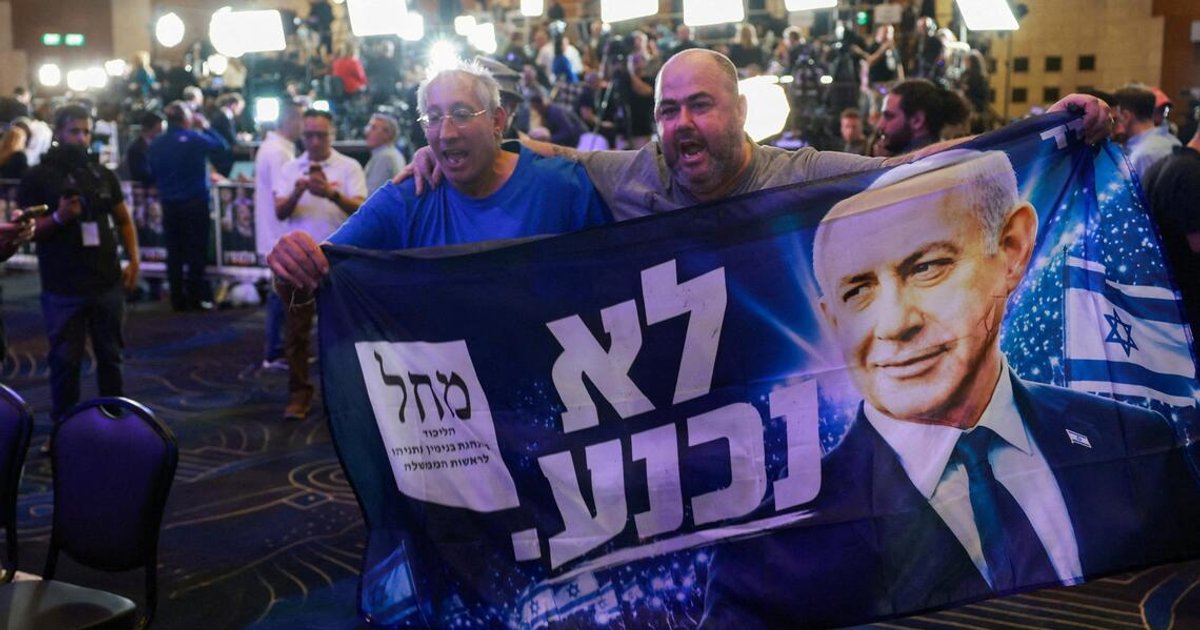
In his speech to supporters after polling booths closed, Netanyahu said: “The right-wing bloc has a clear, decisive majority among the Zionist public, among the Jewish public and all those who support the state.” asserted
who → close → state
For this reason, he said Israelis “need a right-wing, national, strong government. asserted
Israelis → say → government
That’s what has to be done.” asserted
what → ’ → ?
As yet, he has shown no sign of abandoning his ultra-Orthodox and far-right coalition members. asserted
he → show → members
Left-wing Democrats leader Yair Golan implored the opposition to form a government with the support of the Arab parties. asserted
Golan → implore → parties
“Anyone who tries to erase the voices of Arab citizens is surrendering to Netanyahu and giving up on Israel,” he said on social media. asserted
he → try → media
“We have a majority. asserted
We → have → majority
We have responsibility. asserted
We → have → responsibility
And we have an opportunity to form a government of change in partnership with Israel’s Arab citizens. asserted
we → have → citizens
A government that will serve all Israeli citizens asserted
that → serve → citizens
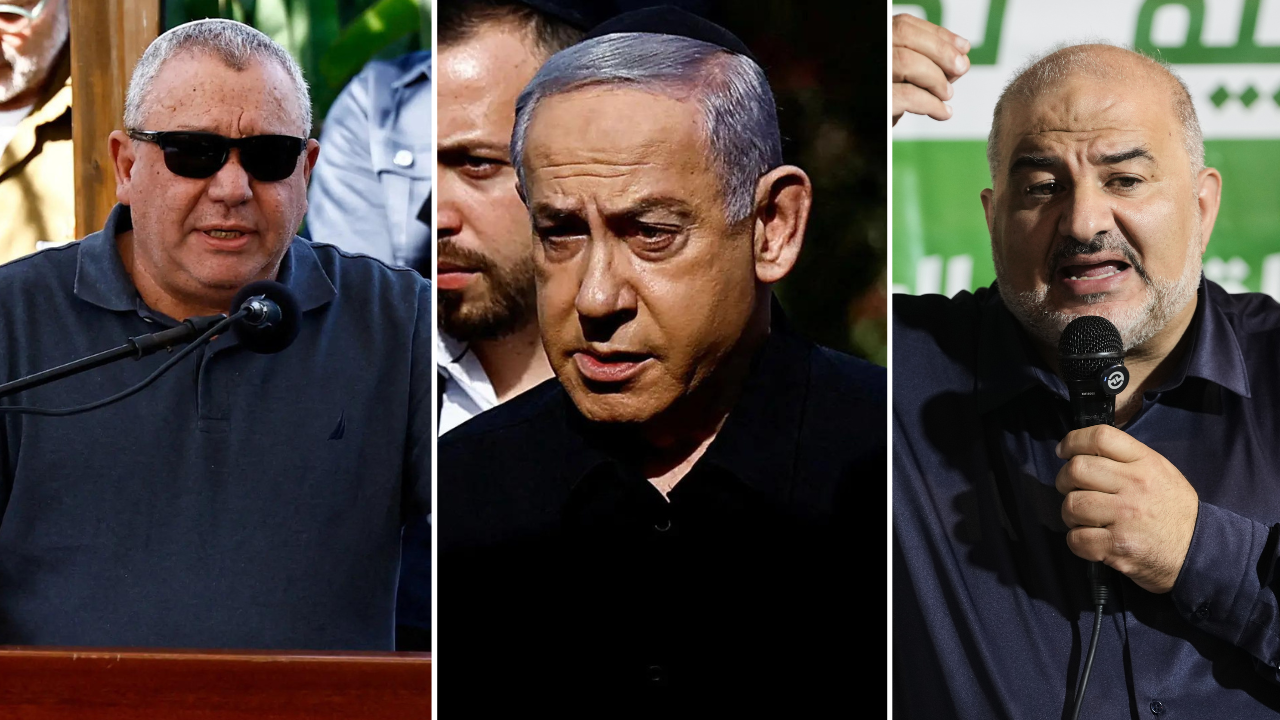
Eisenkot vowed to do “everything to fulfil the people’s will,” saying that calling another election would be “a mistake”. asserted
calling → vow → election
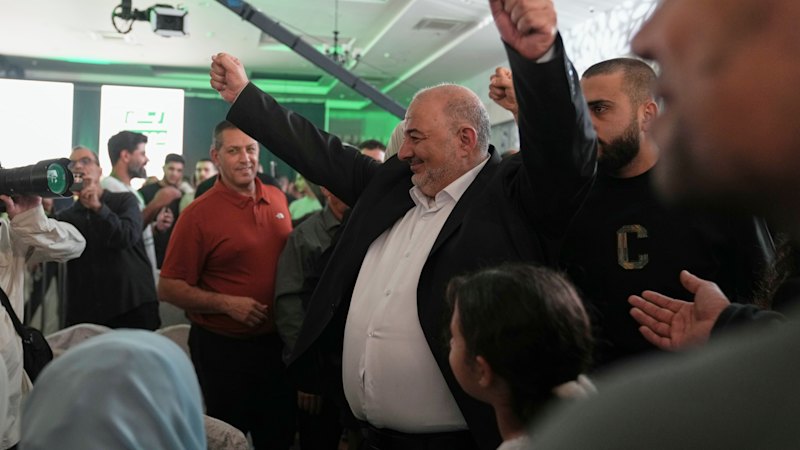
He said he would “do everything in my power to build a Zionist, pro-IDF [Israeli Defence Forces] enlistment government”, while warning Netanyahu not to play with national security for political gain. United Arab List leader Mansour Abbas said: “If we join a government of change, we will be able to see substantial changes, not just empty talk.” How would another round of elections work? asserted
round → say → elections
What happened in the 2019-2022 period could be a guide to Israel’s immediate future. uncertain
happened → happen → future
When Israelis voted in April 2019, Netanyahu’s Likud party and the Blue and White alliance led by former military chief Benny Gantz finished tied on 35 seats each. asserted
party → vote → seats
Neither could form a majority so Netanyahu remained as prime minister until Israelis voted again in September. uncertain
Israelis → form → September
Again, the results were virtually a tie, so Israelis headed to the polls again in March 2020. asserted
Israelis → head → March
This time Gantz agreed to a power-sharing arrangement, but he was never able to take up the prime ministership because the Knesset was dissolved before he had a chance. asserted
he → agree → chance
At the March 2021 elections, Likud was again easily the biggest party but opposition leaders Yair Lapid and Naftali Bennett cobbled together a governing majority with the support of the United Arab List. asserted
leaders → cobble → List
…and 2 more, not listed.

💬Give feedback
🕘History 🎫Support