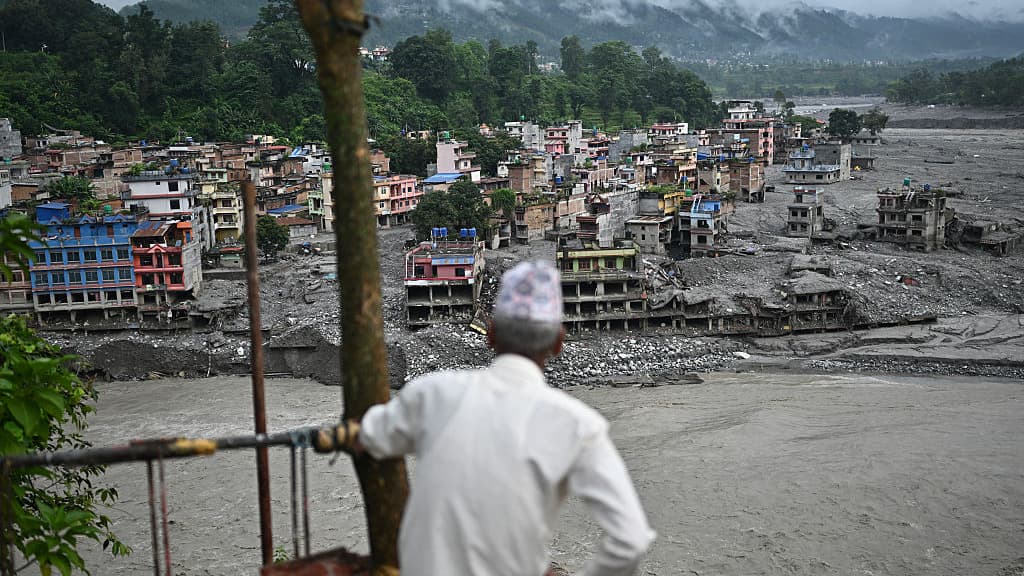
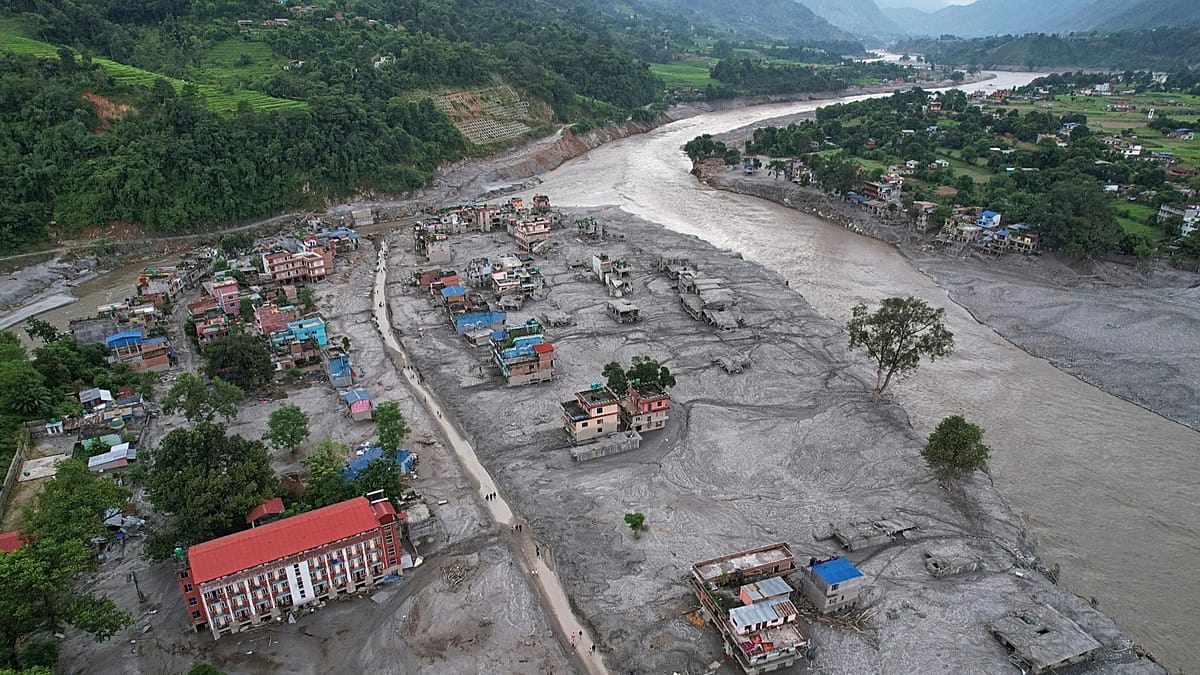
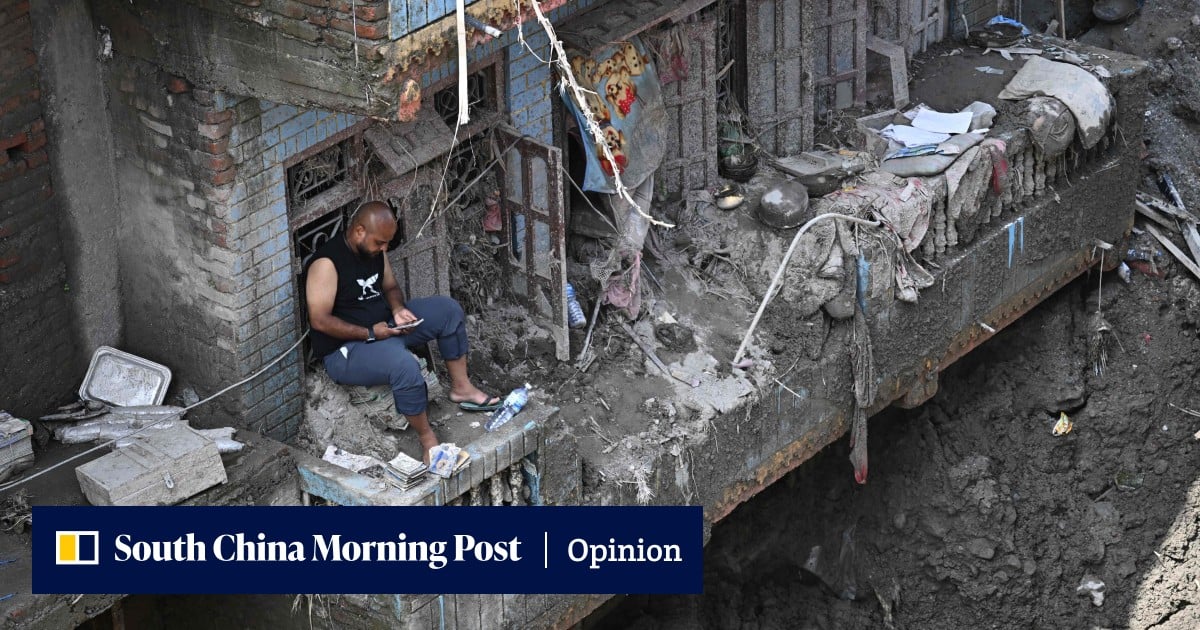
Nepal is demanding $20m in climate compensation for the recent devastating floods, as a senior minister called on the world’s most polluting countries to “wake up” and accept shared responsibility for a disaster that led to the death or disappearance of more than 6,000 people.
asserted
that → demand → people
Scientists believe the climate crisis had a role to play in the floods, which were triggered when a melting glacier partially collapsed and set off a deadly landslide and flash flooding through Chinese-controlled Tibet and Nepal in late August.
asserted
glacier → believe → August
So far, more than 1,300 are confirmed dead and more than 5,500 still missing, with hopes of their survival diminished after 12 days of rescue operations.
asserted
hopes → confirm → operations
Speaking to the Guardian, Nepal’s foreign minister, Shisir Khanal, was forthright in his call for climate justice and said it was imperative the world’s biggest economies stepped up to help Nepal recover and rebuild after the catastrophic floods.
asserted
Nepal → speak → floods
Nepal contributes less than 0.1% of global greenhouse gas emissions, while its neighbours India and China are among the world’s biggest emitters.
asserted
contributes → contribute → emitters
The mountains of the Himalayas – which span across India, China, Nepal and Bhutan – have been warming at a rate nearly 50% faster than the global average.
asserted
which → span → average
In 2023, the UN said Nepal’s mountains had lost close to a third of their ice in just over 30 years due to global heating.
asserted
mountains → say → heating
Khanal emphasised that the recent disaster was far more extreme than any flooding regularly seen during the monsoon season, and said the magnitude of damage was on par with the 2015 earthquake that left much of the country in ruins.
“This felt like a tsunami that was coming from the Himalayas,” he said.
asserted
he → emphasise → Himalayas
“We experienced waves as high as 60, 70 feet, which were mixed with debris, mud, stones, rocks, and came at the speed of almost 180km per hour.
asserted
which → experience → hour
Towns, villages and highways were completely wiped out and there are some areas still disconnected.”
asserted
Towns → wipe → ?
Khanal confirmed that Nepal’s ministry of finance and ministry of environment had written a joint letter to the UN’s fund for responding to loss and damage – which was set up in 2022 in line with the Paris climate agreement – to request $20m in climate-related damages.
asserted
which → confirm → damages
“We have contributed so little to climate change,” he said.
asserted
he → contribute → change
“It is imperative for those in the global community who benefit from larger, much more polluting economies, and whose historical contribution to greenhouse gases is much bigger than ours, to accept a shared responsibility.
asserted
contribution → benefit → responsibility
This affects all of humanity.”
asserted
This → affect → humanity
For Nepal, the disaster was particularly worrying because it was “one of the strongest warning signals that we’ve experienced of what’s to come”, he said.
asserted
he → experience → that
“The global community should not see this as one-off disaster; it should be viewed in the context of the changing climate in the Himalayas,” he said.
asserted
he → see → Himalayas
“We know it is going to be a recurring scenario that more and more communities, not just in Nepal but around the world, will have to face.”
asserted
communities → know → world
Khanal acknowledged that the compensation amount Nepal has requested from the UN was “obviously not nearly enough to cover the damage that we have sustained”.
asserted
we → acknowledge → that
According to some estimates, the total damage caused by the floods will be upwards of $5bn, though Khanal said it could be even higher.
uncertain
it → accord → floods
Upwards of 20,000 homes will probably have to be rebuilt, as well as the main highway.
asserted
homes → have → ?
Villages built in vulnerable areas along the river, some of which washed away entirely, may have to be relocated to higher, safer ground.
uncertain
some → build → ground
While Khanal initially singled out India and China as countries that should step in to help – while avoiding mention of the US, which is the world’s biggest polluter – he rowed back on those comments, saying: “It is not just about shifting the blame to one or the other country, it’s about us all working together.”
asserted
us → single → one
He emphasised that the compensation demand was also meant to act as a “wake-up call for the global community to establish a more robust mechanism to help vulnerable and small economies like Nepal”.
asserted
community → emphasise → Nepal
The UN has admitted the loss and damage fund is already facing a “significant financing gap”.
asserted
fund → admit → gap
The fund has already received requests totalling $2.8bn from about 119 countries, but so far only around $400m has been given by the international community.
asserted
m → receive → community
The US has given just $17m, after Donald Trump withdrew from the Paris agreement.
asserted
Trump → give → agreement
Khanal acknowledged there were “political challenges” in getting Nepal the climate compensation it was demanding.
asserted
it → acknowledge → compensation
“Yes there always will be people who may not agree to our perspective or deny there is climate change, but there are also people who deny that the Earth is round,” he said bluntly.
uncertain
he → agree → perspective
He emphasised the importance of funds being made available not just for immediate disaster response but also for preparedness and mitigation for climate-related risk.
asserted
funds → emphasise → risk
Khanal rebuffed allegations that China had failed to give an adequate warning or share data with Nepal about the impending floods.
asserted
China → rebuff → floods
He said he was in discussion with China about enhancing coordination and data sharing for the Himalayan region.
asserted
he → say → region
“With the benefit of hindsight, we can now see that this glacier was fragile and had been receding in the past six months,” he said.
asserted
he → see → months
“But before the floods hit, there was no knowledge on our part, or on the part of Chinese scientists, that this particular collapse was imminent.
asserted
collapse → hit → scientists
I do not believe any of us had any idea of the threat until it happened.”
asserted
it → believe → threat
 The Aporia