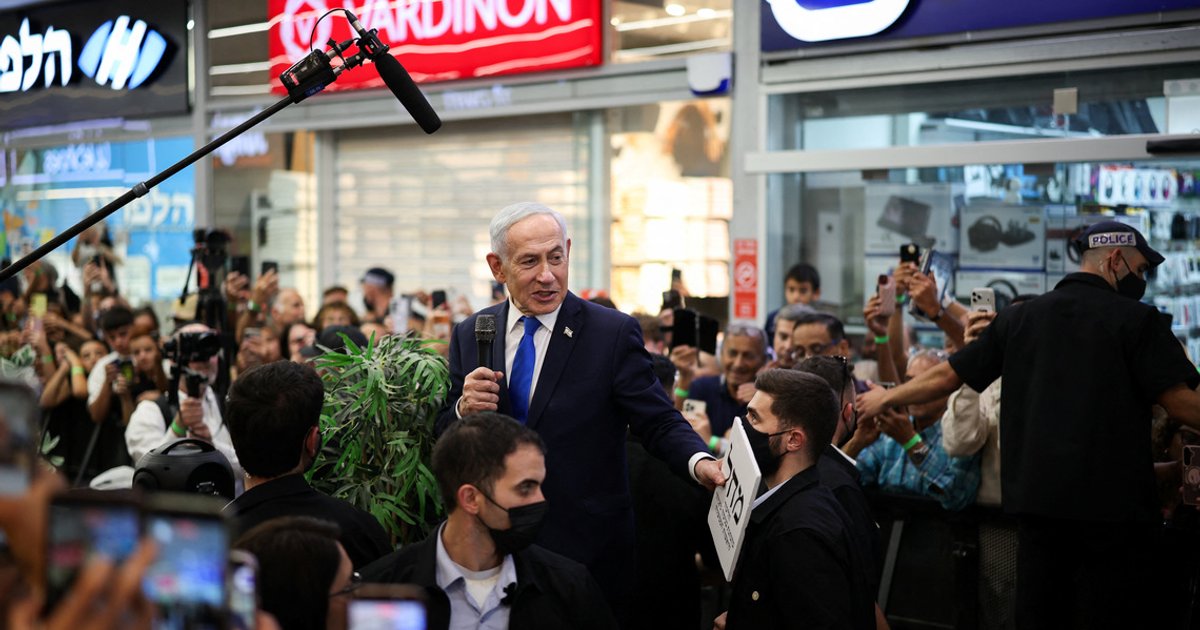
Israel’s elections 2026 explained in maps and charts

Read the original at Al Jazeera ↗
Cite

Haddad, M., & Duggal, H. (2026, October 20). Israel’s elections 2026 explained in maps and charts. Al Jazeera. https://www.aljazeera.com/news/2026/10/20/israels-elections-2026-explained-in-maps-and-charts?traffic_source=rss

Dated from the outlet's own feed. Check the original for its byline.

Al Jazeera · collected 2026-10-20 · by Mohammed Haddad, Hanna Duggal

Quick Summary

Israelis head to the polls on October 27 for the 26th Knesset elections in a highly competitive race between Benjamin Netanyahu's Likud-led coalition and the opposition bloc. With about 7.3 million eligible voters, no party is expected to secure an outright majority in the 120-seat parliament. The election comes amid significant regional tensions including recent conflicts involving Gaza, Lebanon, and Iran. Palestinians living under Israeli occupation do not have voting rights, creating a stark disparity between those who can participate politically and those who cannot.
Written locally by qwen2.5:14b on 2026-10-20, using this article's own text rather than the other coverage of the same event (that is the story summary below).

AI analysis runs on qwen2.5:14b, locally

Story summary

On October 27, 2026, Israelis will vote in the election for the 26th Knesset, amidst ongoing domestic and international challenges, including unresolved issues from the October 7, 2023 Hamas attack that killed around 1,200 people. Benjamin Netanyahu, currently on trial for corruption charges, is seeking another term as prime minister with his Likud party leading a far-right coalition. With about 7.3 million eligible voters, this election features a tight race between Netanyahu's coalition and the opposition bloc, neither likely to secure an outright majority in the 120-seat parliament. Polling stations will be open from 7am to 10pm, allowing those still queuing at closing time to vote. Any party surpassing the 3.25% electoral threshold will enter the Knesset for a four-year term, with no prime ministerial term limits in place.

Written for “Israel's Elections 2026” on 2026-10-20, grounded in this article and the 0 other(s) covering the same event.
Why this leaning score
The article's own words the score was based on. Each is quoted verbatim and was checked against the article text before being stored, so you can find it in the original.
Reading Leans left (beta estimate) Confidence high
Leaning: leans left for article 92607 (high confidence, 2 verified quotes) · logged 2026-10-20

Story

📰 Israel's Elections 2026
Politics · 1 article(s) covering the same event.

Compared with similar articles

This article reads leans left and hedges 4% of its claims. Each row says how that neighbour differs.
Al Jazeera
⚖️ leaning not scored 🔴 29% hedged 2 of 7 📰 publisher trust 60
“The articles discuss different aspects of Israeli politics and elections without focusing on the exact same incident.”
Al Jazeera
⚖️ Leans left 🔴 6% hedged 3 of 50 📰 publisher trust 60
“The articles discuss different aspects of the election context and do not describe the same specific incident or occurrence.”
Toronto Star
⚖️ Leans left 🔴 9% hedged 5 of 55 📰 publisher trust 63
“Article A focuses on a potential political partnership involving an Arab-led party, while Article B provides an overview of Israel's upcoming election and its key players.”
The Straits Times
⚖️ Leans left 🔴 7% hedged 2 of 30 📰 publisher trust 60
“Article A focuses on one individual's decision to vote for the first time due to concerns about a right-wing government, while Article B provides an overview of the election context and candidates.”
The Straits Times
⚖️ leaning not scored 🔴 14% hedged 1 of 7 📰 publisher trust 60
“Article A reports on Trump's endorsement of Netanyahu for the election while Article B provides an overview and analysis of the upcoming Israeli election.”
CBS News
⚖️ leaning not scored 🔴 7% hedged 1 of 15 📰 publisher trust 66
“Article A reports on Trump endorsing Netanyahu for reelection, while Article B provides an overview of Israel's upcoming elections and does not specifically discuss this endorsement.”
The Sydney Morning Herald
⚖️ Leans right further right than this 🔴 18% hedged 2 of 11 📰 publisher trust 61
“The articles discuss different aspects of Israel's election process; Article A focuses on Trump's endorsement of Netanyahu, while Article B provides a broader overview and analysis of the election.”
Daily Mail
⚖️ Leans strongly right further right than this 🔴 11% hedged 2 of 18 📰 publisher trust 64
“Article A describes Trump's endorsement of Netanyahu for re-election, while Article B provides an overview and analysis of Israel's upcoming parliamentary elections.”
Al Jazeera
⚖️ leaning not scored 🔴 11% hedged 5 of 44 📰 publisher trust 60
“The articles discuss different aspects of the upcoming Israeli election without focusing on the same specific incident or occurrence.”
The Straits Times
⚖️ Leans left 🔴 14% hedged 5 of 35 📰 publisher trust 60
“While both articles discuss the upcoming Israeli election and mention Netanyahu, they describe different aspects of the election process and do not focus on the same specific incident or time.”
How this article was measured signals, leaning charts, publisher record, byline, topics and claims

Signals How these are calculated →

Claims extracted
54
sentences that state something as happening or true
Uncertain
4%
2 of 54 hedged ("reportedly", "may", "according to")
Leaning
Leans left
of the writing, not the subject · beta estimate
Publisher signals
60/100
Al Jazeera's corrections and hedging, across everything collected from it. Not a measure of accuracy.
Outlets on this story
1
Politics
Same framing elsewhere
1
articles that frame the event the way this one does
Analyzed 2026-10-20 · how these are computed

How this is being covered How these are calculated →

Article leaning vs. publisher reliability
Source leaning vs. consistency

Publisher

Al Jazeera · 3477 article(s) · 2 correction(s) detected
Running correction rate · 2 correction(s)

Who wrote this

Mohammed Haddad
6 article(s) here · 1 carrying a prediction
🔮 Shas left the government in July 2025 but remained in the coalition and New Hope will merge into Likud for this election.
2026-10-20 · assertive framing · Israel’s elections 2026 explained in maps and charts
🔮 They were expected to make further withdrawals gradually, but instead, they have seized more territory.
🔮 On Tuesday, nearly 130 heads of state and government are expected to begin taking the podium at the annual United Nations General Assembly (UNGA) in New York as the high-level general debate opens.
🔮 This year’s El Nino began developing in June 2026 and is expected to peak by early 2027, with forecasters warning it could be one of the strongest ever recorded.
Also by Mohammed Haddad
Nothing else under this byline is closely related to this article, so these are simply their most recent.
All 6 articles by Mohammed Haddad →
Hanna Duggal
4 article(s) here · 1 carrying a prediction
🔮 Shas left the government in July 2025 but remained in the coalition and New Hope will merge into Likud for this election.
2026-10-20 · assertive framing · Israel’s elections 2026 explained in maps and charts
🔮 It is unclear how long repairs will take, although The Associated Press estimates three to five weeks, citing two regional officials.
🔮 Additionally, several private AI companies are valued in the billions of dollars, with some expected to go public in the coming months.
🔮 “Once the Middle East war kicked off, we suddenly saw more ship owners being willing to go into the Red Sea because there were far fewer options to get to the crew they needed to get to.
Also by Hanna Duggal
Nothing else under this byline is closely related to this article, so these are simply their most recent.

Topics

Israel Israeli Israelis Knesset Palestinians

Subjects

Israel GPE · 6× Israelis NORP · 5× Gaza GPE · 4× Israeli NORP · 4× Palestinians NORP · 4× West Bank GPE · 4× East Jerusalem GPE · 3× Knesset ORG · 3× Lebanon GPE · 2× Palestinian NORP · 2×

Narrative

Israelis are dealing with a series of domestic and international issues this election cycle, including: - October 7 security failures – Three years on, the government is yet to form a state commission of inquiry into the events of October 7, 2023, when a Hamas-headed attack led to the killing of some 1,200 people, with about 250 taken captive.
framing: assertive · carried by 1 article(s) · first seen 2026-10-20
🔮 Shas left the government in July 2025 but remained in the coalition and New Hope will merge into Likud for this election.
2026-10-20 · Al Jazeera
Israel’s elections 2026 explained in maps and charts · assertive framing

Claims (54 extracted, 2 hedged)

Israelis go to the polls on October 27 to elect the 26th Knesset, in the first general vote since the genocide against Palestinians in Gaza and the wars on Lebanon and Iran. asserted
Israelis → go → Lebanon
Benjamin Netanyahu, the longest-serving prime minister in Israel’s history, with 19 years in office, is seeking another term while standing trial on corruption charges. asserted
Netanyahu → serve → charges
His Likud party and the far-right coalition it leads are locked in a close race with a Jewish-led opposition bloc, with neither side appearing on track to win an outright majority in the 120-seat Knesset, Israel’s parliament. asserted
side → lead → Knesset
About 7.3 million people aged 18 and above are eligible to vote, according to Israel’s Central Elections Committee. uncertain
people → vote → Committee
Most polling stations open from 7am to 10pm, and anyone still queuing when they close is entitled to vote. asserted
they → open → pm
Any party clearing an electoral threshold of 3.25 percent enters parliament, which sits for a four-year term. asserted
which → clear → term
How voting works Israelis vote for a party, not a candidate. asserted
Israelis → work → party
A majority requires 61 of the 120 seats and no party has ever won that outright. asserted
party → require → that
Finishing first does not guarantee power. asserted
Finishing → finish → power
Parties then have 28 days, with a possible extension of up to 14 days, to assemble a coalition reaching 61. asserted
Parties → have → 61
If nobody manages it, the country votes again. asserted
country → manage → it
Seats are shared out in proportion to each party’s share of the national vote, so a party winning 30 percent of votes takes roughly 30 percent of seats. asserted
party → share → seats
The votes for parties failing to secure 3.25 percent are discarded, which explains why small parties routinely merge before every election. asserted
parties → fail → election
Who can and cannot vote? asserted
Who → vote → ?
About 7.3 million Israeli citizens are eligible to vote in this election, but they are not the only adults living under the government they choose. asserted
they → vote → government
Roughly three million adult Palestinians in Gaza, the occupied West Bank and occupied East Jerusalem have no vote in the government that controls their borders, movement and legal status. asserted
that → occupy → borders
Jewish Israelis and Palestinian citizens of Israel, who number about 1.2 million, asserted
who → number → million
So can adult settlers among the more than 750,000 Israelis living in the occupied West Bank and occupied East Jerusalem, who help elect the parliament that legislates over the land they live on. asserted
they → live → land
Most Palestinians in occupied East Jerusalem hold Israeli residency, not citizenship. asserted
Palestinians → hold → residency
They can vote for Jerusalem’s city council but not for the Knesset. asserted
They → vote → Knesset
The result is a sharp anomaly in the occupied West Bank, where a settler votes and a Palestinian family living nearby, under the same military authority, does not. asserted
family → vote → authority
Most Israeli citizens living abroad also cannot vote, because Israel has no general absentee ballot and requires voters to be physically in the country on election day. asserted
Israel → live → day
Diplomats and state emissaries are the exception, casting their ballots at Israeli missions on October 20. asserted
Diplomats → cast → October
Israelis are dealing with a series of domestic and international issues this election cycle, including: - October 7 security failures – Three years on, the government is yet to form a state commission of inquiry into the events of October 7, 2023, when a Hamas-headed attack led to the killing of some 1,200 people, with about 250 taken captive. asserted
250 → deal → people
Israel launched the genocidal war against Palestinians in the wake of the attack, killing at least 74,000 people and leaving most of the besieged territory in ruins. asserted
Israel → launch → ruins
- Ultra-Orthodox draft exemptions – Supporters of the exemptions say they protect full-time Torah study, but critics argue they place an unfair military burden on everyone else. - Judicial reform – Netanyahu’s push to curb the Supreme Court’s powers, which sparked mass protests before the war on Gaza, remains a deep fault line. asserted
which → say → Gaza
Critics see it as a threat to democracy, while supporters argue that the court has overstepped its authority. asserted
court → see → authority
- War and security – The public wants stability but remains wary of concessions in Gaza, the occupied West Bank and Lebanon. asserted
public → want → Gaza
Netanyahu promised “total victory”, but Hamas and Hezbollah remain operational. asserted
Hamas → promise → victory
- Cost of living – High prices and modest wages are being further squeezed by soaring defence spending. asserted
prices → squeeze → spending
Since 2023, Israel’s defence budget has doubled, increasing pressure on public finances. asserted
budget → double → finances
Israel’s outgoing government Netanyahu’s coalition held 60 of the Knesset’s 120 seats when parliament dissolved in July. asserted
parliament → hold → July
It comprised Likud with 32 seats, Shas with 11, Religious Zionism with seven, Itamar Ben-Gvir’s Otzma Yehudit with six, and New Hope with four. asserted
It → comprise → four
Shas left the government in July 2025 but remained in the coalition and New Hope will merge into Likud for this election. asserted
Hope → leave → election
The opposition held 59 seats: Yesh Atid with 24, Blue and White with eight, United Torah Judaism with seven, Yisrael Beiteinu with six, Hadash-Taal and Raam with five each and Labor with four. asserted
opposition → hold → four
Netanyahu is seeking re-election while facing a trial on corruption charges, which he denies. asserted
he → seek → which
His far-right coalition is up against a bloc comprising of four major Jewish-led opposition parties, whose leaders have signed a declaration promising not to attack each other ahead of the vote and to join forces in forming a government after the polls. asserted
leaders → comprise → polls
Former army chief Gadi Eisenkot is viewed as the opposition’s most likely candidate for prime minister, with his new Yashar party evenly matched with Likud in the opinion polls. asserted
party → view → polls
The opposition alliance includes the Together list, led by former Prime Ministers Naftali Bennett and Yair Lapid; Avigdor Liberman’s Yisrael Beiteinu and Yair Golan’s Democrats. asserted
alliance → include → Bennett
Other key players include far-right ministers Itamar Ben-Gvir and Bezalel Smotrich, the ultra-Orthodox parties, and the Arab-majority lists Ra’am and the Joint List. asserted
players → include → Gvir
…and 14 more, not listed.

💬Give feedback
🕘History 🎫Support