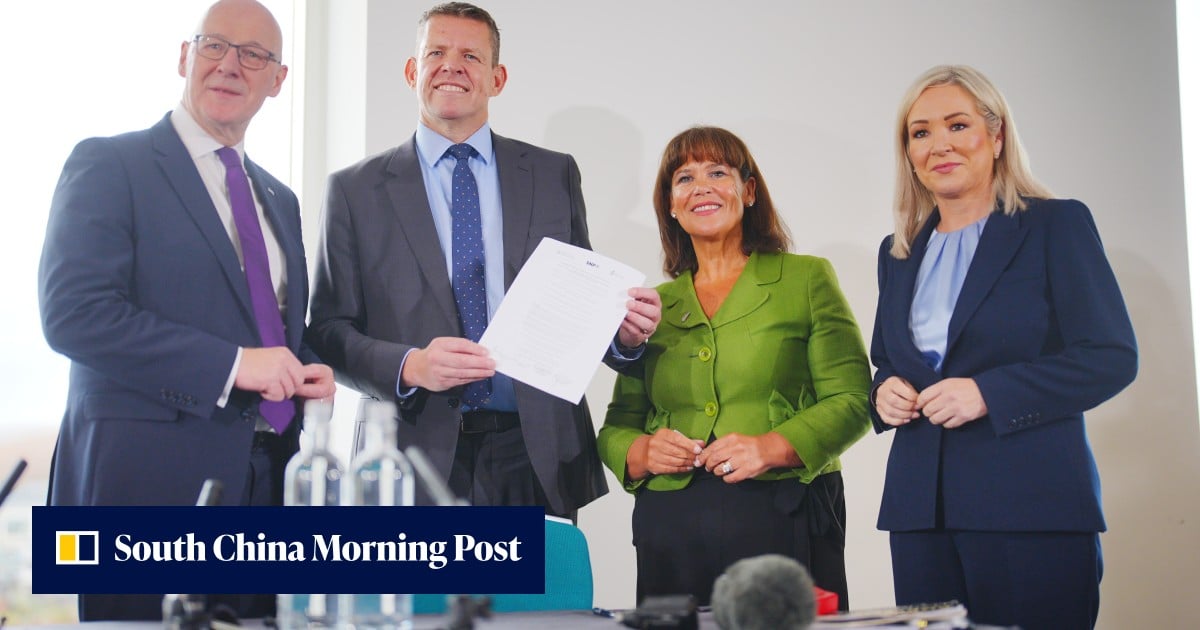
Welsh, Scottish, and Northern Irish nationalist leaders have signed an agreement declaring that "Westminster's time is coming to an end," advocating for their countries to leave the United Kingdom. During a joint press conference on Monday, Scotland’s John Swinney and Northern Ireland’s Michelle O'Neill called for referendums on independence, while Wales' Rhun ap Iorwerth declined to give a specific timeline for one in his country. The memorandum of understanding signed by Plaid Cymru, Sinn Féin, and the SNP asserts that no Westminster government can block democratic processes or undermine people's right to decide their future independently.
Written by the local model on 2026-09-14,
using this article's own text rather than the other coverage of the
same event (that is the story summary below).
- Published
The first ministers of Wales, Scotland and Northern Ireland have declared that "Westminster's time is coming to an end".
asserted
time → publish → end
The nationalist leaders from Plaid Cymru, Sinn Féin and the SNP - who want their countries to leave the United Kingdom - signed an agreement on Monday which said no Westminster government had the right to "block democracy".
But while Scotland's John Swinney and Northern Ireland's Michelle O'Neill called for referendums at a joint press conference, Wales' Rhun ap Iorwerth declined to give a timetable for one in his country.
asserted
Iorwerth → want → country
Labour and Reform accused Plaid of wanting to break up the UK.
asserted
Labour → accuse → UK
Swinney and ap Iorwerth's governments later backed a separate agreement agreed to work together on pressing UK government on "fairness" in funding and powers.
asserted
governments → back → funding
For the first time since devolution began, Wales, Scotland and Northern Ireland all have first ministers who want to leave the United Kingdom.
asserted
who → begin → Kingdom
All three met on Monday as representatives of their parties.
asserted
three → meet → parties
Sinn Féin president Mary Lou McDonald also attended.
asserted
McDonald → attend → ?
The memorandum of understanding said: "For people watching across these islands - for people watching around the world - there could be no clearer sign that Westminster's time is coming to an end.
"
uncertain
time → say → end
No Westminster government has the right to block democracy or undermine the principle that our people will decide their own future.
asserted
people → have → future
We recognise that our parties have different constitutional positions and that each nation will determine its own future in its own way and in its own time."
asserted
nation → recognise → time
Plaid has ruled out an independence referendum before the next Senedd election in 2030.
asserted
Plaid → rule → 2030
At the press conference, ap Iorwerth said there was a "growing recognition that Westminster is not working" and "power genuinely needs to be brought closer to people and communities".
asserted
power → say → people
He said the May Senedd election gave his government "a mandate for change to make Wales more confident, more prosperous and more in control of its future".
uncertain
Wales → say → future
"Wales should have the power, the resources, the fair treatment we need as a nation to build the future our people deserve," he said.
asserted
he → have → future
SNP leader Swinney said Monday was a "pivotal moment in the constitutional journey of the United Kingdom".
asserted
Monday → say → Kingdom
He said the elections in May for each nation created a situation with first ministers who believe "their countries should decide their own future".
uncertain
countries → say → future
"That principle of self-determination is an inalienable right," he said.
asserted
he → say → determination
He described Andy Burnham as the "last prime minister of the United Kingdom".
"Because the people of Scotland, if given the choice of independence in a referendum will take that choice."
asserted
people → describe → choice
Sinn Féin's McDonald described Monday's meeting as "historic", saying: "We have the right to referendum.
asserted
We → describe → right
We have the right to decide our future.
asserted
We → have → future
We will not accept or tolerate any prime minister telling us that right is off the table."
asserted
right → accept → table
Northern Ireland's First Minister O'Neill said all three nations were "distinctively different" and had their own priorities.
asserted
nations → say → priorities
But she said the "common cause here is that Westminster does not and will never serve our people well".
asserted
Westminster → say → people
O'Neill serves in a power sharing executive in Northern Ireland, where the Democratic Unionist Party's (DUP) deputy first minister Emma Little-Pengelly accused the Sinn Fein politician of attempting to "weaponise the role of first minister".
asserted
minister → serve → minister
In Northern Ireland, the first and deputy first minister have identical powers.
asserted
minister → have → powers
Asked by BBC Wales to clarify what the memorandum of understanding meant for Wales, and whether it meant asking Westminster not to block a Welsh independence referendum, ap Iorwerth said it was "up to the people of Wales to decide its own future".
asserted
it → ask → future
Pressed further, he said: "The timescale will be set by the people of Wales when they are persuaded.
asserted
they → press → Wales
My job is to persuade."
asserted
job → persuade → ?
The Welsh government does not have the power to hold such a referendum, but ap Iorwerth told the press conference he wanted to see that devolved.
asserted
that → have → conference
Later on Monday, Swinney and ap Iorwerth signed an agreement between the Welsh and Scottish governments.
asserted
Swinney → sign → governments
The agreement, which is not legally binding, said it would "press the case for greater fairness for Wales and Scotland in areas such as the operation of the UK funding arrangements and powers over our constitutional future".
asserted
it → say → future
It said the two governments would work together on a range of issues, including tackling child poverty and maximising the benefits of their relationships with the European Union.
asserted
governments → say → Union
At a second press conference, Swinney declined to offer support for reform of the Barnett Formula - the system that determines how Wales is funded.
asserted
Wales → decline → Formula
Welsh ministers have long called for the Barnett funding formula to be reformed, claiming it disadvantages Wales.
asserted
it → call → Wales
However, it is argued Scotland does well from the formula.
asserted
Scotland → argue → formula
Before he became prime minister, Burnham made the case for change, but on his recent visit to Wales he played down the prospect of reform.
asserted
he → become → reform
Swinney said: "Financial arrangements across the United Kingdom vary and by constituent part of the United Kingdom.
asserted
arrangements → say → Kingdom
We all have to put forward the issues and the interests and the perspectives in each of our countries."
asserted
We → have → countries
Ap Iorwerth said: "There are flexibilities that Scotland already have right now as a minimum to be handed to Wales, is something that is important to us."
asserted
that → say → us
During Prime Minister's Questions on Wednesday, Burnham appeared to indicate a second referendum could be held in Scotland if there was clear public support for a vote.
uncertain
referendum → appear → vote
…and 14 more, not listed.