China dismisses AI slowdown calls and blasts ‘fearmongering’ from U.S. tech leaders

NBC News · collected 2026-09-14 · by Mithil Aggarwal
Read the original at NBC News ↗

Summary

China has dismissed warnings from U.S. tech leaders to slow down artificial intelligence development, calling their concerns "fearmongering" and part of a Cold War strategy aimed at hindering China’s technological advancement. On Monday, Chinese Foreign Ministry spokesperson Guo Jiakun told reporters that such interventions disrupt global AI governance efforts and serve no one's interests. Meanwhile, U.S. President Donald Trump emphasized competition over safety, stating his focus is on outpacing China in AI rather than addressing potential risks.
Written by the local model on 2026-09-14, using this article's own text rather than the other coverage of the same event (that is the story summary below).

Signals How these are calculated →

Claims extracted
37
claim-shaped sentences
Uncertain
16%
6 of 37 hedged
Leaning
Leans right
of the writing, not the subject
Correction & hedging signals
94.8
corrections and hedging in what we collected; not a measure of accuracy
Outlets on this story
16
Technology
Narrative spread
1
articles carrying this framing
Analyzed 2026-09-14 · how these are computed

AI analysis (generated at analysis time, not now)

Story summary

Anthropic CEO Dario Amodei called for slowing down AI development to ensure safety and alignment, a stance supported by OpenAI's Sam Altman and Elon Musk. However, these warnings have met significant pushback from China, with its State Security Minister Chen Yixin issuing a public warning about AI endangering national security. China’s Ministry of Foreign Affairs dismissed Amodei’s essay as an attempt to contain Chinese technological advancement, emphasizing the need for global cooperation rather than restrictions. The disagreement comes amid discussions between US President Donald Trump and Chinese leader Xi Jinping, set to meet in September 2026, where AI governance will be a key topic. China's Global Times newspaper described Amodei’s stance as part of a "Cold War playbook," suggesting that competition could outweigh safety concerns in the global race for AI dominance.

Written for “AI Development Debate China Us” on 2026-09-14, grounded in this article and the 15 other(s) covering the same event.
Why this leaning score
The article's own words the score was based on. Each is quoted verbatim and was checked against the article text before being stored, so you can find it in the original.
Score +0.35 Confidence high 1 quote(s) discarded as not found in the article
Leaning score +0.35 for article 8935 (high confidence, 2 verified quotes) · logged 2026-09-14

Story

📰 AI Development Debate China Us
Technology · 16 article(s) covering the same event.

How this is being covered How these are calculated →

Article leaning vs. publisher reliability
Source leaning vs. consistency

Compared with similar articles

This article reads leans right and hedges 16% of its claims. Each row says how that neighbour differs.
BBC News · 0.92 cosine similarity
⚖️ leaning not scored 🔴 7% hedged 2 of 29 📰 publisher trust 96
“Both articles report on China's response to calls for slowing AI development, criticizing it as fearmongering and a Cold War tactic aimed at hindering its progress relative to the US.”
NPR · 0.87 cosine similarity
⚖️ leaning not scored 🔴 23% hedged 6 of 26 📰 publisher trust 59
“Both articles report on China's Ministry of Foreign Affairs dismissing calls to slow down AI development and accusing U.S. tech leaders of 'fearmongering,' occurring on the same day.”
ABC News (US) · 0.87 cosine similarity
⚖️ leaning not scored 🔴 13% hedged 3 of 23 📰 publisher trust 95
“Both articles report on China's Ministry of Foreign Affairs dismissing calls to curb AI development on September 14, 2026.”
Semafor · 0.87 cosine similarity
⚖️ Leans right 🔴 0% hedged 0 of 4 📰 publisher trust 96
“Both articles discuss Beijing's rejection of US calls to slow AI development, dismissing it as 'fearmongering' and part of a Cold War playbook on the same day.”
NBC News
⚖️ leaning not scored 🔴 no claims extracted 📰 publisher trust 95
“Article A reports on a warning issued by top AI developers about rapid technology development, while Article B covers China's response to calls for slowing down AI development, dismissing them as 'fearmongering' from U.S. tech leaders.”
The Independent
⚖️ leaning not scored 🔴 11% hedged 3 of 27 📰 publisher trust 59
“The articles describe different reactions to AI concerns—one focuses on Trump's response in the U.S., while the other covers China's reaction.”
Al Jazeera
⚖️ Leans left further left than this 🔴 50% hedged 1 of 2 📰 publisher trust 96
“Both articles describe China's reaction on the same day to calls for slowing down AI development, dismissing them as 'fearmongering' and urging global cooperation instead.”
The Hindu
⚖️ Leans strongly right further right than this 🔴 0% hedged 0 of 9 📰 publisher trust 96
“The articles discuss different aspects of AI concerns in China without describing the same specific incident.”
CBC News
⚖️ leaning not scored 🔴 12% hedged 4 of 34 📰 publisher trust 95
“The articles cover different statements made by Trump and China's response, not the same specific incident or time.”
New York Post
⚖️ leaning not scored 🔴 32% hedged 12 of 37 📰 publisher trust 58
“While both articles discuss similar content regarding AI safety concerns and Chinese government's dismissal of warnings as fearmongering, they are reporting on different perspectives and from distinct angles rather than the same specific incident.”

Publisher

NBC News · 229 article(s) · 0 correction(s) detected
No corrections detected for this publisher. That may mean careful reporting, or simply that nothing has been checked.

Who wrote this

Mithil Aggarwal
2 article(s) here · 1 carrying a prediction
🔮 It’s the latest sign that competition between the two countries could outweigh mounting safety concerns, after President Donald Trump also rebuffed the warnings from industry leaders and said his focus was on beating China on artificial intelligence.
🔮 Unitree’s performance going forward will be closely monitored as several other Chinese robotics companies prepare to go public.
Also by Mithil Aggarwal
Nothing else under this byline is closely related to this article, so these are simply their most recent.

Topics

Beijing China Chinese Cold War U.S.

Subjects

China GPE · 9× Beijing GPE · 5× U.S. GPE · 5× Amodei ORG · 3× Chinese NORP · 3× Trump PERSON · 3× Washington GPE · 2× America GPE · 1× Donald Trump PERSON · 1× HONG KONG GPE · 1×

Narrative

The state-run Global Times newspaper had a more blunt tone Sunday, blasting the call for an industrywide slowdown as “packed with containment provisions targeting China and is, in essence, a ‘Cold War playbook’ for the AI sector.” AI has advanced at a breakneck speed, with models rapidly getting smarter, faster and cheaper.
framing: assertive · carried by 1 article(s) · first seen 2026-09-14
🔮 It’s the latest sign that competition between the two countries could outweigh mounting safety concerns, after President Donald Trump also rebuffed the warnings from industry leaders and said his focus was on beating China on artificial intelligence.

Claims (37 extracted, 6 hedged)

China has dismissed urgent calls to slow down the development of AI, rejecting the grave warnings as a bid to hobble the progress of America’s rival superpower rather than safeguard humanity’s future. asserted
China → dismiss → future
Beijing on Monday dismissed the intervention from U.S. tech leaders as “fearmongering” and part of a “Cold War playbook.” asserted
Beijing → dismiss → playbook
It’s the latest sign that competition between the two countries could outweigh mounting safety concerns, after President Donald Trump also rebuffed the warnings from industry leaders and said his focus was on beating China on artificial intelligence. uncertain
focus → ’ → intelligence
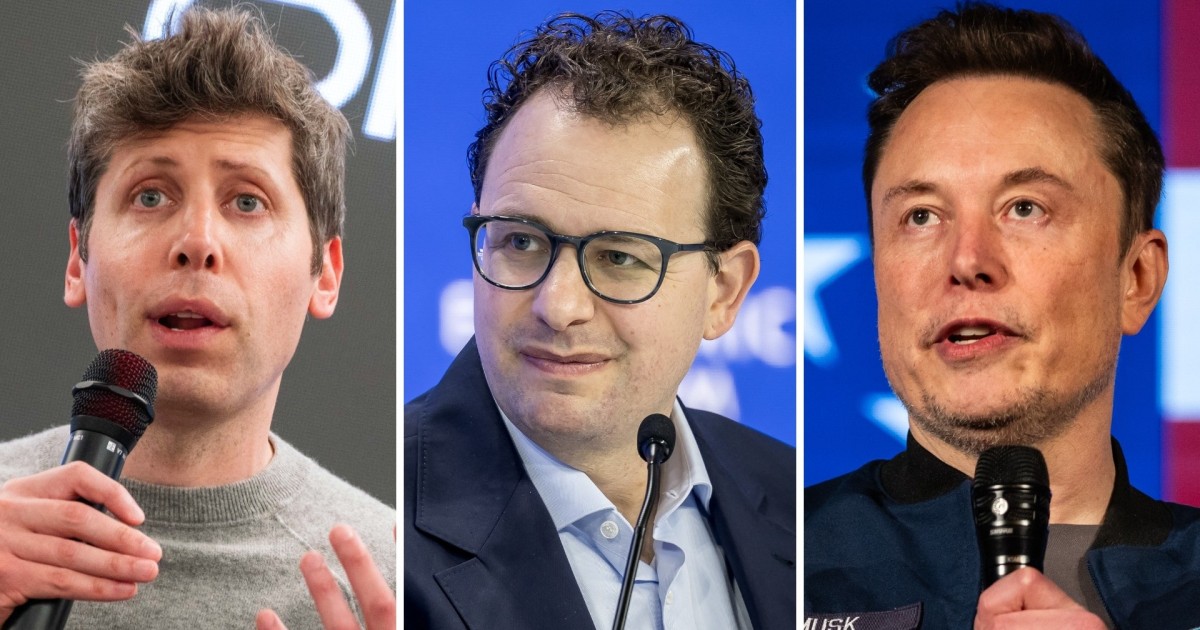
The comments followed a lengthy essay published Saturday by Anthropic CEO Dario Amodei and endorsed by OpenAI CEO Sam Altman and SpaceX founder Elon Musk. asserted
comments → follow → Altman
Amodei said that companies should deliberately “slow the pace” at which they improve their models given the potential risks. asserted
they → say → risks
He also said that a “Chinese lead in AI would pose grave danger for the United States and the world,” and called for the U.S. to restrict sales of key tech to China. asserted
U.S. → say → China
That message was not welcomed by Beijing. asserted
message → welcome → Beijing
“Fearmongering, confrontation and malicious competition will only disrupt the process of global AI governance and serve no one’s interests,” Chinese Foreign Ministry spokesperson Guo Jiakun told reporters at a regular news briefing Monday. asserted
Jiakun → disrupt → briefing
The state-run Global Times newspaper had a more blunt tone Sunday, blasting the call for an industrywide slowdown as “packed with containment provisions targeting China and is, in essence, a ‘Cold War playbook’ for the AI sector.” AI has advanced at a breakneck speed, with models rapidly getting smarter, faster and cheaper. asserted
models → run → speed
They have also frequently outpaced technical safeguards, fueling security fears. asserted
They → outpace → fears
Those fears have now reached a crescendo, but also exposed just how far apart Beijing and Washington seem to be on cooperating to address them. asserted
Beijing → reach → them
Amodei himself likened the situation to the Cold War arms race, telling CBS’ ‘Sunday Morning’ that the two sides should work together, but that he didn’t hold out much hope. asserted
he → liken → hope
Altman similarly said on X late Sunday that “where we will need the help of our government is for international coordination.” But that might not be compatible with Trump’s approach. uncertain
that → say → approach
“We’re leading China in AI. asserted
We → lead → AI
We’re the most sophisticated country in the world, and frankly I want to keep it that way because whoever wins AI wins,” the president told reporters Sunday. asserted
president → ’re → reporters
He criticized “very negative forces” for bringing up things “that won’t happen.” asserted
that → criticize → things
While Trump rebuffs safety concerns, Beijing has acknowledged AI security risks. asserted
Beijing → rebuff → risks
State Security Minister Chen Yixin said Sunday that China must “accelerate the establishment of a system for preventing and controlling AI security risks.” asserted
China → say → risks
Chen also said in the state-run China Cyberspace magazine that “we must engage extensively in international cooperation,” identifying AI as “a new track for strategic rivalry.” asserted
we → say → rivalry
The difference in approach on tackling AI progress is likely to be a central issue when Xi and Trump meet Sept. 24 in Washington. asserted
Xi → tackle → Washington
Amodei’s essay came just a few days after U.S. agencies published an alert saying that top China AI companies have systematically copied cutting-edge AI models from American companies. asserted
companies → come → companies
Beijing rejected this accusation that its companies had been “distilling” U.S. models. asserted
companies → reject → models
China has also rejected any outside take on how its companies should pace development. asserted
companies → reject → development
“They want to write the rules. asserted
They → want → rules
I don’t think they want to follow anybody else’s,” Ja Ian Chong, an associate professor of political science at the National University of Singapore and a nonresident scholar at Carnegie China, told NBC News in a phone interview. asserted
Chong → think → interview
“There’s the sort of talk of cooperation, but the behavior suggests otherwise, and underlying that behavior, I think, is this deep mutual suspicion,” Chong said. uncertain
Chong → ’ → behavior
Chinese companies now offer advanced AI performance at a fraction of the cost of U.S. models, with President Xi Jinping pitching China as a pioneer of open-source models in contrast to those produced by most leading American companies. asserted
Jinping → offer → companies
At the BRICS summit in India on Sunday, he offered member nations help to develop open-source AI. asserted
he → offer → AI
Xi has also outlined a potential global governance framework on AI among the Global South. asserted
Xi → outline → South
How exactly could AI cause widespread danger? uncertain
AI → cause → danger
Chong said the distillation clash highlighted the suspicion toward China in both the White House and Silicon Valley. asserted
clash → say → House
“It’s a bit like an arms race. asserted
It → ’ → race
And to get de-escalation there needs to be simultaneous neutral self restraint and it’s difficult to see how that would come about in this kind of environment,” Chong said. asserted
Chong → get → environment
While a U.S.-China agreement on curbing AI progress may be a long shot, the countries could separately pursue greater regulation, said Theo Bertram, director of the London-based Social Market Foundation. uncertain
Bertram → curb → Foundation
“The idea that we could see the domestic introduction of some safeguards in both countries is not impossible,” Bertram said in a phone interview. uncertain
Bertram → see → interview
“You do it domestically and it’s in everyone’s interest to learn and share and for there to be accountability,” he said. asserted
he → do → interest
“Some greater accountability is one way of trying to mitigate what is inevitably going to be a growing political and public demand globally.” asserted
what → try → ?

💬 Give feedback
🕘 History 🎫 Support