I grew up just across the Hudson River, with the famed skyline of America’s biggest city visible from my bedroom window.
asserted
skyline → grow → window
Being a Palestinian American living just outside of the world’s most famous city meant that I spent part of my summers as a tour guide for family visiting us from the Middle East, who, like so many people around the world, wanted to see the Big Apple that the movies and live broadcasts from Times Square on New Year’s Eve had made so famous.
asserted
movies → live → Eve
I took visitors to the Statue of Liberty, the Empire State Building, Central Park and the World Trade Center.
asserted
I → take → Liberty
We went to the observation deck of the World Trade Center known as “Top of the World”.
asserted
We → go → World
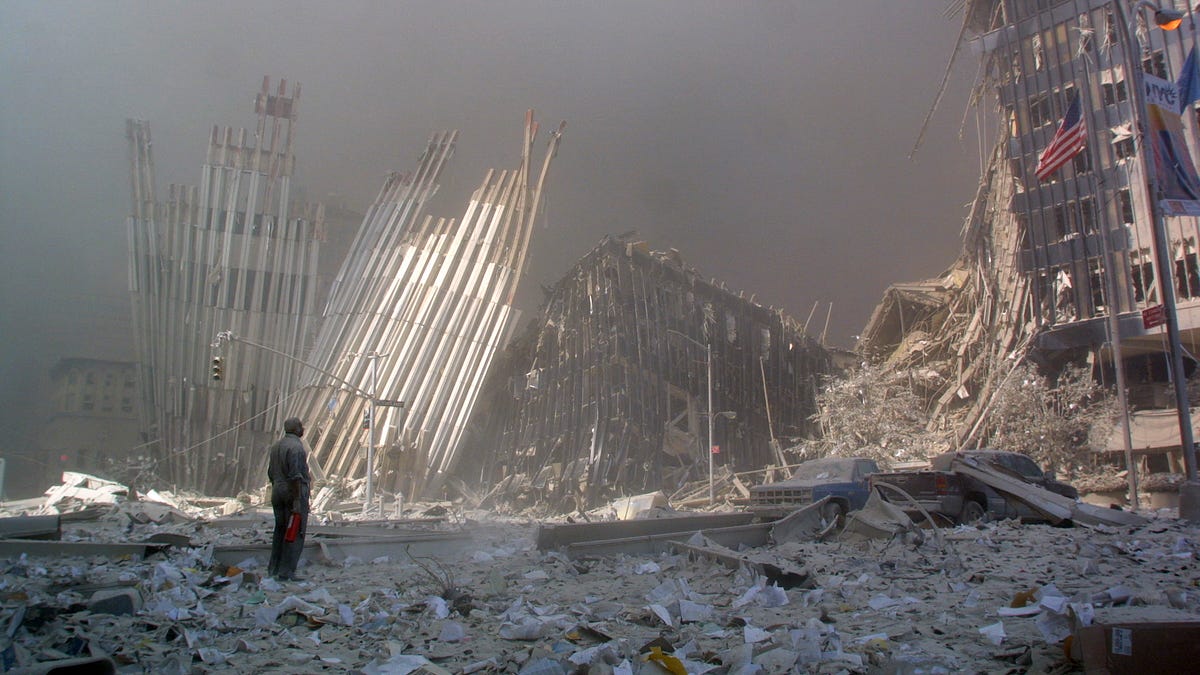
Little did I know that two weeks later that deck, where we had stood looking out at the amazing metropolis below, would come crashing down along with the entire World Trade Center, killing thousands and instantly changing the world as we had known it.
asserted
we → know → it
By the time of the September 11 attacks, I was back in my dormitory at university in New England and huddled around a 10-inch television screen with floormates watching ABC’s Peter Jennings cover the horrific news as it was unfolding that Tuesday morning.
asserted
it → huddle → news
Asked by The New York Times what the attack meant for relations between the United States and Israel, Netanyahu replied, “It’s very good.”
asserted
It → ask → States
Then he edited himself: “Well, not very good, but it will generate immediate sympathy,” adding that the attack would “strengthen the bond between our two peoples”.
asserted
attack → edit → peoples
This was his response while ground zero was still smouldering after an attack that had killed nearly 3,000 people.
asserted
that → smoulder → people
It immediately hit me that not only was the world about to change, but my life in the US as a Palestinian American was about to become far, far more complicated.
asserted
life → hit → American
The US was about to embark on military engagement in the Middle East, and Netanyahu was excited by the opportunity this presented Israel.
asserted
this → embark → Israel
To better understand the impact this moment had on US-Israel relations, it is crucial to consider the preceding context.
asserted
it → understand → context
I have argued elsewhere that the period between the end of the Cold War and 9/11 was a complicated one for US-Israel relations.
asserted
period → argue → relations
For most of the history of the US-Israel relationship, the Cold War was the defining paradigm in international relations.
asserted
War → define → relations
For Israel, this was an easy paradigm to navigate.
asserted
this → navigate → Israel
It billed itself to Americans as a like-minded, US-aligned democracy confronting Soviet-backed satellite states in the Arab world.
asserted
It → bill → world
But as the Cold War ended, the political landscape shifted.
asserted
landscape → end → ?
The Berlin Wall fell, democratisation swept Eastern Europe, and apartheid ended in South Africa, while Israel was brutally repressing the first Palestinian Intifada.
asserted
Israel → fall → Intifada
Suddenly, Israel did not fit so comfortably in this new world order.
asserted
Israel → fit → order
It was during this period that the US made its greatest investments in Israeli-Palestinian peacemaking, however flawed, and used some leverage to press the Israeli government on settlement building.
asserted
US → make → building
September 11 and the ensuing global “war on terror” changed all of this.
asserted
September → ensue → this
With the second Palestinian Intifada under way, the September 11 attacks on the US provided an opportunity to once again put Israel and the US on the same side of a new defining global divide.
asserted
attacks → provide → divide
Netanyahu and his allies understood this very well, just as he made clear to The New York Times 25 years ago this week.
asserted
he → understand → Times
A wounded America was primed for Islamophobic narratives, and pro-Israel voices were often happy to provide them, as they understood that an America obsessed with “counterterrorism” would have to stay close to Israel.
asserted
America → prim → Israel
There are numerous areas where we see the impact of this over time: enhanced US-Israel intelligence collaboration, growing US financial support for Israel and legislative initiatives supported by Israel’s backers in the US that used broadened anti-terror authorities to crack down on Palestinians, to name a few.
asserted
that → be → few
The narratives that helped support these outcomes
asserted
that → support → outcomes
Palestinians were also more easily turned into a “security problem” to American audiences.
asserted
Palestinians → turn → audiences
Instead of asking why Palestinians were resisting oppression, American audiences were pushed to see Israeli repression as self-defence similar to US behaviour.
asserted
audiences → ask → behaviour
Muslims were often cast as one of two types in American discourse: moderate or extremist, and those criticising Israel were routinely placed in the latter category, which led to stigma and a chilling effect.
asserted
which → cast → stigma
Israeli military practices could be cast as useful for America as well.
uncertain
practices → cast → America
Surveillance, counterinsurgency, targeted killings and other tactics Israel had used in the West Bank and Gaza, which had occasionally been criticised by Washington, were used by American forces in Iraq and Afghanistan and thus increasingly legitimised before American audiences.
asserted
which → target → audiences
Some of the greatest purveyors of the Islamophobic narratives that characterised much of the post-9/11 period in the United States included David Horowitz, who consistently sought to connect Palestinians with terrorism and called for profiling to make Palestinian identity itself a security concern; Daniel Pipes, who often characterised Muslim organisations as potentially or secretly militant, casting suspicion on Muslim advocacy; Steven Emerson, who sought to popularise infiltration narratives to try to turn mainstream Muslim organisations into security subjects; Brigitte Gabriel, who regularly framed Islamism as a civilisational threat, thus casting Israel as a front-line defender of the West; and David Yerushalmi, who sought to expand the threat narrative to Sharia law and Muslim political influence, thus casting Muslim political participation as potentially subversive.
asserted
who → characterise → participation
The general logic of these narratives was that terrorism was effectively synonymous with all things Palestinian/Arab/Muslim and thus Israel’s security model should be seen as legitimate, if not ideal, by Americans.
asserted
model → see → Americans
It is important 25 years later to reflect on the dangerous political opportunism that spewed hate into American discourse to cast Israel and Israeli policy in a favourable light.
asserted
that → reflect → light
A quarter-century later, the US is once again embroiled in a seemingly intractable quagmire, this time in Iran, a losing effort that has already cost Americans more than $100bn through higher petrol and diesel prices.
asserted
that → embroil → prices
Given all of this, Americans today should be quick to question Islamophobic narratives, the dangerous paths they lead down and the real motives of those who spread them.
asserted
who → give → them
The views expressed in this article are the author’s own and do not necessarily reflect Al Jazeera’s editorial stance.
asserted
views → express → stance
 The Aporia