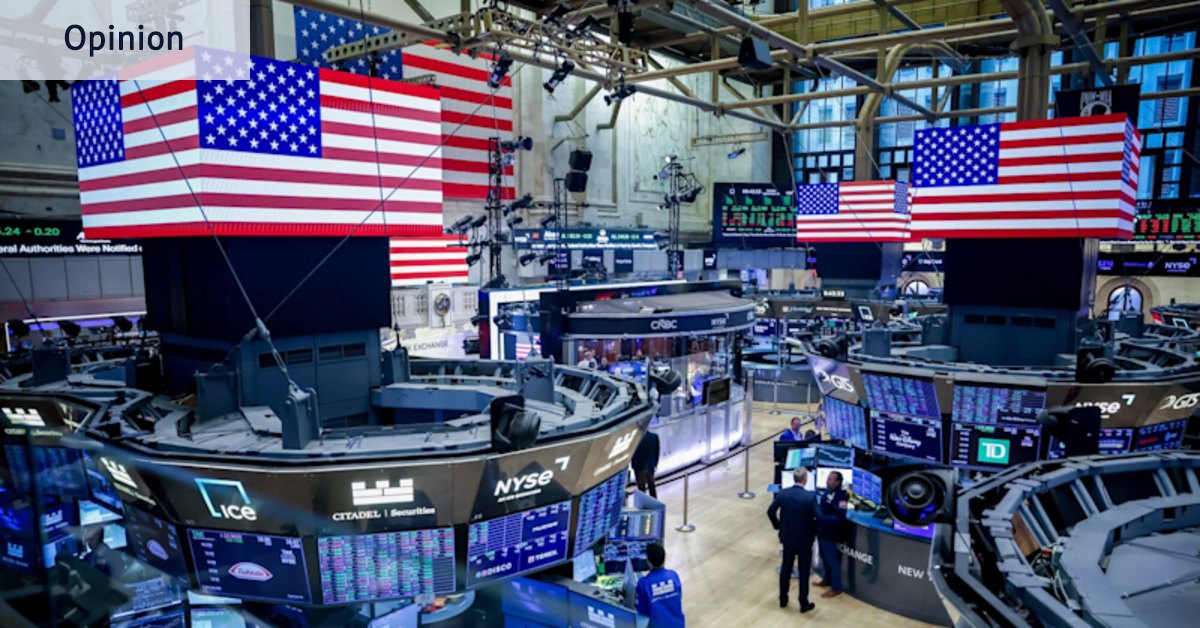
Shrugging off war, the bond rout and oil crunch: Why Wall Street keeps rallying

Read the original at The Sydney Morning Herald ↗
The Sydney Morning Herald · collected 2026-10-07 · by Stephen Bartholomeusz

Quick Summary

The US sharemarket reached another record high despite rising bond yields, which typically signal reduced stock appeal. This anomaly stems from investors heavily favoring tech stocks, particularly those linked to artificial intelligence. For instance, the S&P 500 has risen by over 14% this year, while more technology-focused indices like Nasdaq and NYFANG+ have seen even larger gains of around 18% and 25%, respectively. The performance is narrowly concentrated, with just four stocks—Nvidia, Apple, Micron, and AMD—accounting for nearly half of the S&P 500’s rise this year.
Written locally by qwen2.5:14b on 2026-10-07, using this article's own text rather than the other coverage of the same event (that is the story summary below).

AI analysis runs on qwen2.5:14b, locally

Story summary

As of recent reports, despite ongoing geopolitical tensions and financial uncertainties such as rising bond yields last seen in 2002, the US sharemarket hit another record high. This anomaly is attributed to investors heavily favoring stocks related to artificial intelligence (AI). The S&P 500 has risen by over 14% this year, while the tech-heavy Nasdaq index has surged more than 18%, and the NYFANG+ index reflecting major tech stocks' performance is up around 25%. Notably, the underperformance of the S&P 500 equal weight index, which assigns each stock equal weighting compared to market capitalization-based indices, highlights the narrow basis for current market gains. Four key companies—Nvidia, Apple, Micron, and AMD—contribute roughly half of the S&P 500’s rise this year, emphasizing the outsized impact of AI-related stocks on overall market performance.

Written for “Wall Street Continues to Rally” on 2026-10-07, grounded in this article and the 0 other(s) covering the same event.
Why this leaning score
This article does not take a side on a contested political question, so it has no leaning score. That is an answer rather than a gap: a match report or a rescue can be warmly or critically written without being left or right, and scoring it anyway is how approval of a subject gets recorded as a political position.
No political leaning scored for article 61675 · logged 2026-10-07

Signals How these are calculated →

Claims extracted
37
claim-shaped sentences
Uncertain
19%
7 of 37 hedged
Leaning
not political
takes no side on a contested political question
Correction & hedging signals
61.3
corrections and hedging in what we collected; not a measure of accuracy
Outlets on this story
1
Economy/Business
Narrative spread
1
articles carrying this framing
Analyzed 2026-10-07 · how these are computed

Story

📰 Wall Street Continues to Rally
Economy/Business · 1 article(s) covering the same event.

How this is being covered How these are calculated →

Article leaning vs. publisher reliability
Source leaning vs. consistency

Compared with similar articles

This article reads unscored and hedges 19% of its claims. Each row says how that neighbour differs.
Semafor
⚖️ Leans left 🔴 25% hedged 1 of 4 📰 publisher trust 95
“The articles describe different aspects of financial market conditions and trends, not a single identical incident.”
Semafor
⚖️ leaning not scored 🔴 33% hedged 1 of 3 📰 publisher trust 95
“The articles describe different market events on distinct dates, with Article A focusing on an AI-stock rally leading to a record close for Nasdaq specifically on Monday, while Article B covers the broader US sharemarket hitting another record a couple of days later.”

Publisher

The Sydney Morning Herald · 2615 article(s) · 4 correction(s) detected
Running correction rate · 4 correction(s)
2026-10-03
Tennessee’s prisons chief to resign after failed execution of Christa Pike
2026-09-28
Inside the prison left abandoned for years – now set to reopen as DV offenders weigh on system
2026-09-19
What will happen to your most cherished possessions when you die? You don’t want to know
2026-09-18
What will happen to your most cherished possessions when you die? You don’t want to know

Who wrote this

Stephen Bartholomeusz
10 article(s) here · 1 carrying a prediction
🔮 The equal weight index has risen 10.8 per cent this year and has actually fallen almost 3 per cent in the past month – the market might be at record levels, but its performance is very narrowly based. Indeed, only four stocks – Nvidia, Apple, Micron and AMD – account for roughly half the S&P 500’s rise this year.
🔮 Inflation rates are too high, growth rates are weak and there’s not the political will or ability to address the threat of a self-fuelling cycle of escalating debts and interest costs.
🔮 Will his gambit work?
2026-10-05 · assertive framing · Trump’s bluff is too late to save him
🔮 The “forced labour” tariffs are a transparent attempt to recreate the global tariff regime that the Court of International Trade ruled illegal last May; a judgment that the US Supreme Court confirmed in February.
🔮 While the leading frontier AI lab says it will have its second successive quarter of profitability, at an operating level, in the September quarter, last year it lost more than $US8 billion at an operating level – up from $US2.98 billion in 2024 – while reporting a net loss of $US42 billion.
🔮 With the US flirting with stagflation last year – low growth but relatively high levels of inflation – and unsettling discussions about how the Trump administration might respond to public finances that are spiralling out of control, gold’s “safe haven” status was another factor in the price surge.
🔮 The sudden spike in US bond yields over the past week to near 20-year highs raises a multi-trillion dollar question: Will those higher debt returns crash the sharemarket, and in the process derail the boom in artificial intelligence-related investment?
🔮 Last week, Berkshire Hathaway announced that Warren Buffett’s son, Howard, would replace him as chairman of the sprawling conglomerate.
🔮 That something would have dire consequences for much of the world, including the US - and Australia, the world’s biggest per-capita user of the fuel.
🔮 While Warsh might add growth and AI investment to the influences on US inflation, that begs the question of why other developed economies with less growth and less AI investment – from Australia and Japan to the European Union – are also wrestling with persistently high inflation and their central banks are also raising their policy rates.
2026-09-21 · assertive framing · Trump’s war is strangling the world
Also by Stephen Bartholomeusz
Trump’s bluff is too late to save him
2026-10-05 · The Sydney Morning Herald
Donald Trump’s war on the world faces a lethal blow
2026-10-01 · The Sydney Morning Herald
Nothing else under this byline is closely related to this article, so these are simply their most recent.
All 10 articles by Stephen Bartholomeusz →

Topics

Apple Micron Nasdaq Nvidia the S&P 500

Subjects

America GPE · 2× Micron ORG · 2× Nvidia ORG · 2× the S&P 500 ORG · 2× AMD ORG · 1× Apple ORG · 1× Federal Reserve Board ORG · 1× Jackson Hole GPE · 1× Kevin Warsh PERSON · 1× Nasdaq ORG · 1×

Narrative

The S&P 500 is up just over 14 per cent so far this year, but the more tech-laden Nasdaq index is up more than 18 per cent, and the NYFANG+ index, which reflects the performance of the biggest of the tech stocks, is up by about 25 per cent. The significance of the AI-related stocks to the wider sharemarket’s performance is underscored by the underperformance of the S&P 500 equal weight index, which assigns every stock the same weighting, against that of the primary S&P 500 index, which uses their market capitalisation.
framing: assertive · carried by 1 article(s) · first seen 2026-10-07
🔮 The equal weight index has risen 10.8 per cent this year and has actually fallen almost 3 per cent in the past month – the market might be at record levels, but its performance is very narrowly based. Indeed, only four stocks – Nvidia, Apple, Micron and AMD – account for roughly half the S&P 500’s rise this year.
2026-10-07 · The Sydney Morning Herald
Shrugging off war, the bond rout and oil crunch: Why Wall Street keeps rallying · assertive framing

Claims (37 extracted, 7 hedged)

The US sharemarket hit another record overnight, even as US bond yields reached levels last seen in 2002. asserted
yields → hit → 2002
Share prices and bond yields generally have an inverse correlation. asserted
prices → have → correlation
As yields go up, increasing the cost of credit and tightening financial conditions while producing near risk-free income streams, the appeal of riskier stocks and their dividends reduces. asserted
appeal → go → stocks
That isn’t happening in the US, or at least it is not being reflected in the overall sharemarket indices. asserted
it → happen → indices
Investors are still piling into the stocks powering the boom in artificial intelligence investment. asserted
Investors → pile → investment
The S&P 500 is up just over 14 per cent so far this year, but the more tech-laden Nasdaq index is up more than 18 per cent, and the NYFANG+ index, which reflects the performance of the biggest of the tech stocks, is up by about 25 per cent. The significance of the AI-related stocks to the wider sharemarket’s performance is underscored by the underperformance of the S&P 500 equal weight index, which assigns every stock the same weighting, against that of the primary S&P 500 index, which uses their market capitalisation. asserted
which → lade → capitalisation
The equal weight index has risen 10.8 per cent this year and has actually fallen almost 3 per cent in the past month – the market might be at record levels, but its performance is very narrowly based. Indeed, only four stocks – Nvidia, Apple, Micron and AMD – account for roughly half the S&P 500’s rise this year. uncertain
stocks → rise → rise
If you look at the market’s performance since mid-August, had it not been for the performance of two of those stocks – chipmakers Nvidia and Micron – the market would have actually fallen from that point. asserted
market → look → point
Last month, roughly three quarters of the stocks in the S&P 500 fell. asserted
quarters → fall → S&P
Mid-August is an important reference point because it was from about that point that US bond yields started their recent climb, a shift that accelerated after the Federal Reserve Board chairman Kevin Warsh dispelled doubts about his inflation-fighting credentials by giving a clearly “hawkish” speech at the annual Jackson Hole conference of economists and academics. asserted
chairman → start → economists
The narrow base for growth in the economy and the sharemarket makes both extremely vulnerable to any adverse development or shift in confidence in AI. asserted
both → make → AI
The Fed followed that up last month with its first interest rate increase in more than three years. Thus, while the index might suggest otherwise, most stocks in the S&P 500 are now going backwards, which is more in keeping with the normal relationship between bonds and shares. uncertain
which → follow → bonds
Bond yields are being driven by a number of influences. asserted
yields → drive → influences
A US inflation rate of 3.4 per cent is the most obvious, but a budget deficit of $US2 trillion ($2.9 trillion), or 6 per cent of GDP, and gross government debt of more than $US40 trillion not only raise concerns about the sustainability of America’s finances and how the Trump administration might seek to stabilise them, but are swelling the supply of bonds the market is being asked to absorb. uncertain
market → raise → bonds
The supply issue is being exacerbated by the increasing amounts of AI-related debt hitting debt markets and providing alternative investments to Treasury securities. asserted
issue → exacerbate → securities
The AI boom has significance beyond the sharemarket. asserted
boom → have → sharemarket
The vast amounts of investment being made are supporting the wider US economy, its solid 2.2 per cent growth rate and the stable jobs market. asserted
amounts → make → economy
The headline GDP numbers, however, contrast with what most Americans feel about the state of their economy, with consumer sentiment at record lows. asserted
Americans → contrast → lows
Consumer spending has, however held up, strongly. asserted
spending → hold → ?
That suggests that those wealthier households that are exposed to the AI boom, either directly or via the sharemarket, are feeling positive and are spending. uncertain
that → suggest → sharemarket
There are wealth effects on the broader economy that flow from sharemarket gains. asserted
that → be → gains
Like the sharemarket, it would appear that America’s economic growth is also narrowly based. asserted
growth → appear → sharemarket
Below the broad indices, only two of the 11 sectors in the sharemarket – IT and communications services – rose last month. asserted
sectors → rise → sharemarket
Higher interest rates, inflation, the surge in gasoline and diesel prices flowing from the conflict in the Middle East and the rise in input costs as a result of Donald Trump’s trade wars are having an effect on those companies not benefiting from AI. asserted
rates → flow → AI
An increasing volume of securitised corporate debt is now trading at material discounts to its face value – JPMorgan says there are about $US140 billion of loans trading at less than 80 per cent of their face value. asserted
JPMorgan → increase → value
Spreads and defaults in the leveraged loan and distressed debt markets have been surging. asserted
Spreads → surge → markets
While there might be a tale of two economies and two markets underlying the aggregated numbers, analysts remain bullish. uncertain
analysts → underlie → numbers
Expectations for the third-quarter profit reporting season starting next week is that it will produce an average 25 per cent increase in earnings over the same quarter last year. asserted
it → start → quarter
This year, a handful of the big tech stocks, notably Alphabet, Amazon and Meta, have accounted for most of the increase in the earnings expectations for the entire S&P 500, and their reported earnings – like those of most of the key players in AI -- lean heavily on their investments in, and contracts with, other AI companies. asserted
earnings → account → investments
The narrow base for growth in the economy and the sharemarket makes both extremely vulnerable to any adverse development or shift in confidence in AI. asserted
both → make → AI
For the moment, investors are clearly capitalising an extraordinarily lucrative future for the hyperscalers and frontier labs and AI infrastructure providers into their valuations. asserted
investors → capitalise → valuations
They don’t seem concerned about the impact of higher interest rates on companies increasingly reliant on debt to fund unprecedented levels of investment whose pay-off, if there is a payoff, is uncertain and may not be known for some years. uncertain
off → seem → years
There also appears to be some level of expectation (despite the evidence to date) that the war in the Middle East will end and oil, gasoline and diesel prices will subside. asserted
prices → appear → East
The bond market is volatile and signalling risk and concern. asserted
market → signal → risk
While it is conceivable that the sharemarket could keep rising off its narrow base in the face of a continuing surge in interest rates, there would be a point where the resilience of the AI sector and its investor base was tested. uncertain
resilience → keep → sector
It probably won’t come this month – the odds on another Fed rate hike in October have been receding – but the market is pricing in another one for December and more next year. asserted
market → come → December
Without a conclusive end to the war in the Middle East and a fall in oil, gasoline and diesel prices and with Trump continuing to slap new tariffs on America’s trading partners, the environment for AI, its backers and the broader sharemarket can only become more challenging and risky. asserted
environment → continue → AI

💬Give feedback
🕘History 🎫Support