Nobel Prize in Physics awarded to ‘ghost particle’ scientist

Read the original at Semafor ↗
Semafor · collected 2026-10-06 · by Brendan Ruberry

Quick Summary

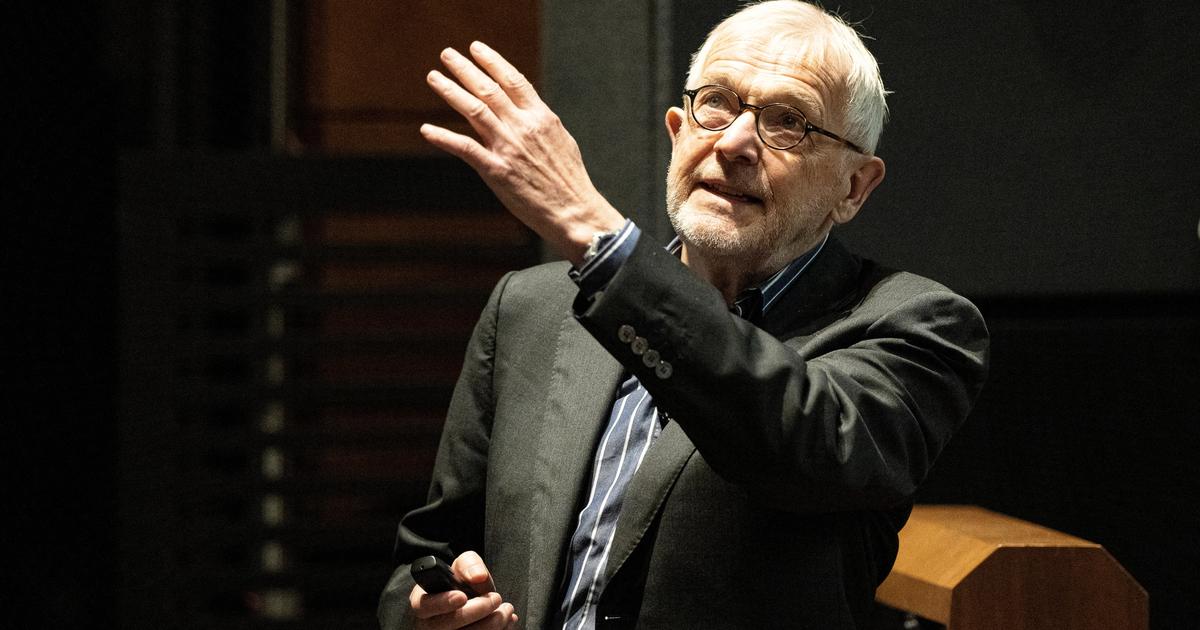
Francis Halzen, a Belgian-American scientist, received the 2026 Nobel Prize in Physics for his groundbreaking work on neutrinos, often referred to as "ghost particles," at the South Pole. He established an ice laboratory there that uses the unique clarity of Antarctic ice to detect these subatomic particles, which typically pass undetected through matter. Halzen emphasized that while his discovery was significant, it paves the way for future astronomical advancements with larger and more extensive telescopes.
Written locally by qwen2.5:14b on 2026-10-06, using this article's own text rather than the other coverage of the same event (that is the story summary below).

AI analysis runs on qwen2.5:14b, locally

Story summary

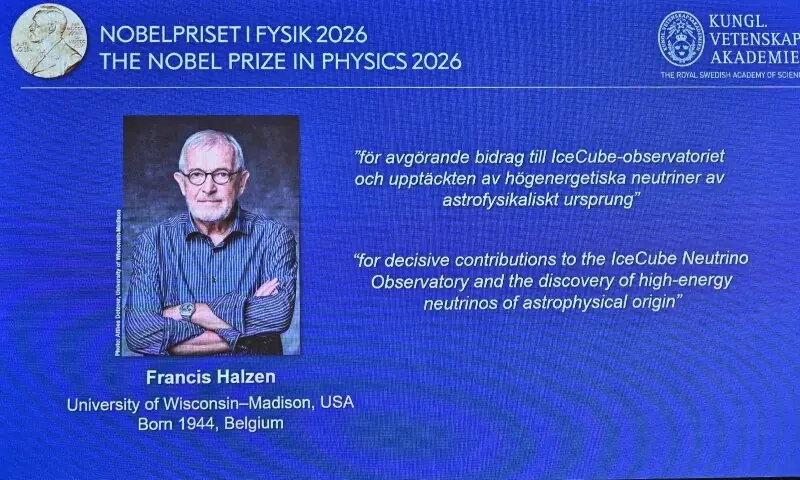
On Tuesday, Francis Halzen, a Belgian physicist and professor at the University of Wisconsin-Madison, was awarded the Nobel Prize in Physics for his groundbreaking work on the IceCube Neutrino Observatory located at the South Pole. The observatory uses a cubic kilometer of Antarctic ice to detect high-energy neutrinos from space, shedding light on distant cosmic phenomena. Halzen's contributions were recognized as "decisive" by the Royal Swedish Academy of Sciences, which noted his visionary approach and scientific leadership since first proposing the concept in 1988. The prize includes a sum of 12 million Swedish kronor (approximately $1.2 million).

Written for “Neutrino Research Nobel Prize” on 2026-10-07, grounded in this article and the 9 other(s) covering the same event.

Signals How these are calculated →

Claims extracted
4
claim-shaped sentences
Uncertain
25%
1 of 4 hedged
Leaning
not political
takes no side on a contested political question
Correction & hedging signals
94.9
corrections and hedging in what we collected; not a measure of accuracy
Outlets on this story
10
Science
Narrative spread
1
articles carrying this framing
Analyzed 2026-10-06 · how these are computed

Story

📰 Neutrino Research Nobel Prize
Science · 10 article(s) covering the same event. See how they differ ↓

How this is being covered How these are calculated →

Article leaning vs. publisher reliability
Source leaning vs. consistency

Compared with similar articles

This article reads unscored and hedges 25% of its claims. Each row says how that neighbour differs.
Dawn · 0.91 cosine similarity
⚖️ leaning not scored 🔴 5% hedged 1 of 19 📰 publisher trust 77
“Both articles report on the same Nobel Prize in Physics award for Francis Halzen's work with neutrinos at the South Pole on the same date.”
BBC News · 0.90 cosine similarity
⚖️ leaning not scored 🔴 0% hedged 0 of 5 📰 publisher trust 72
“Both articles report on the identical awarding of the Nobel Prize in Physics to Francis Halzen for his work with neutrinos and IceCube observatory.”
Dawn
⚖️ leaning not scored 🔴 26% hedged 6 of 23 📰 publisher trust 77
“Both articles report on the awarding of the 2026 Nobel Prize in Physics, mentioning the same recipient and his work with 'ghost particles'.”
Toronto Star
⚖️ leaning not scored 🔴 0% hedged 0 of 2 📰 publisher trust 63
“Both articles describe the announcement and awarding of the 2026 Nobel Prize in Physics on October 6, 2026, detailing the recipient's work with 'ghost particles' in Antarctica.”
CBC News
⚖️ leaning not scored 🔴 5% hedged 1 of 20 📰 publisher trust 60
“Both articles describe Francis Halzen being awarded the 2026 Nobel Prize in Physics for his work on neutrino particles using the IceCube Neutrino Observatory at the South Pole, occurring on October 6, 2026.”
NPR
⚖️ leaning not scored 🔴 6% hedged 1 of 18 📰 publisher trust 60
“Both articles describe Francis Halzen winning the Nobel Prize in physics on the same day for his work with high-energy neutrinos from space.”
The Globe and Mail
⚖️ leaning not scored 🔴 0% hedged 0 of 12 📰 publisher trust 51
“Both articles report on Francis Halzen winning the Nobel Prize in Physics for his work with neutrinos and IceCube Neutrino Observatory on the same date.”
New York Post
⚖️ leaning not scored 🔴 5% hedged 1 of 19 📰 publisher trust 64
“Both articles report on Francis Halzen winning the Nobel Prize in Physics for his work with high-energy neutrinos, specifically mentioning the IceCube Neutrino Observatory and his discovery of 'ghost particles' at the South Pole.”

Publisher

Semafor · 809 article(s) · 0 correction(s) detected
No corrections detected for this publisher. That may mean careful reporting, or simply that nothing has been checked.

Who wrote this

Brendan Ruberry
92 article(s) here · 1 carrying a prediction
🔮 Francis Halzen established a laboratory at the South Pole after discovering that the unusual clarity of its ice could be used to track subatomic particles called neutrinos, which otherwise pass undetected through the Earth and the human body: “We could catch them in ice, that was the goal,” Halzen said, adding that his discovery was comparatively minor compared with those the technique could eventually unlock.
🔮 France could be on the precipice of a financial crisis, as escalating student protests roiled an already shaky bond market.
2026-10-06 · assertive framing · French budget crisis worsens amid student protests
🔮 The strikes come amid wars in Europe and the Middle East in which commercial shipping is regularly targeted, raising fears that the supply of endangered tankers could become the next energy bottleneck: Traffic in the Strait of Hormuz has largely rebounded, but only at great risk to tankers, 20 of which have been struck in the last month, suggesting recovery could be unsustainable.
🔮 But a ruling party lawmaker cast the arrest in a positive light, telling DW it shows that Germany “will not tolerate the betrayal of secrets.”
2026-10-06 · assertive framing · Former German spy chief charged with treason
🔮 The route is expected to come into service next summer, albeit using slower trains that won’t cover the planned 316 miles.
🔮 Demand for compute is strong enough that hyperscalers remain undeterred by higher borrowing costs, a dilemma for the US Federal Reserve: The AI investment boom is adding to inflation even as interest rates begin to bite elsewhere, suggesting the Fed may have to “hurt the part of the economy that is more rate sensitive,” Barclays’ global chairman of research told The New York Times.
2026-10-05 · mixed framing · AI-stock rally powers Nasdaq to record close
🔮 Brazilian stocks surged Monday after Flávio Bolsonaro emerged as the presidential frontrunner following first-round voting, with investors betting the right-wing candidate would win with a large enough majority to push fiscal reform.
🔮 Reclaiming coastal areas seized during the Houthis’ lightning advance last month curtails the rebels’ ability to significantly disrupt energy flows, but the counteroffensive — a hoped-for “zero hour” — among some Saudi and Yemeni pundits, could widen the Iran war, further upending energy markets:
🔮 Despite being “peppered with remarks aimed at… maintaining market confidence,” Takaichi’s speech to parliament “does not necessarily mean that policy will actually be adjusted out of consideration for financial markets,” a Nomura economist wrote.
🔮 Saturday’s incident will complicate Tokyo’s cooperation goals, with one Japanese lawmaker saying the US is “failing completely” to train and discipline troops.
2026-10-04 · assertive framing · Japan summons US envoy after soldier accused of murder
Also by Brendan Ruberry
Nothing else under this byline is closely related to this article, so these are simply their most recent.

All 92 articles by Brendan Ruberry →

Topics

Belgian

Subjects

Belgian NORP · 1× Francis Halzen PERSON · 1× Halzen PERSON · 1×

Narrative

A Belgian-American scientist was awarded the 2026 Nobel Prize in Physics on Tuesday for his pioneering work studying “ghost particles” in the Antarctic.
framing: mixed · carried by 1 article(s) · first seen 2026-10-06
🔮 Francis Halzen established a laboratory at the South Pole after discovering that the unusual clarity of its ice could be used to track subatomic particles called neutrinos, which otherwise pass undetected through the Earth and the human body: “We could catch them in ice, that was the goal,” Halzen said, adding that his discovery was comparatively minor compared with those the technique could eventually unlock.

Claims (4 extracted, 1 hedged)

A Belgian-American scientist was awarded the 2026 Nobel Prize in Physics on Tuesday for his pioneering work studying “ghost particles” in the Antarctic. asserted
scientist → award → Antarctic
Francis Halzen established a laboratory at the South Pole after discovering that the unusual clarity of its ice could be used to track subatomic particles called neutrinos, which otherwise pass undetected through the Earth and the human body: “We could catch them in ice, that was the goal,” Halzen said, adding that his discovery was comparatively minor compared with those the technique could eventually unlock. uncertain
technique → establish → those
“This is a new way of looking at the universe, and it will take bigger telescopes, many more telescopes, to become real astronomy,” he said. asserted
he → look → telescopes
“And what this will bring is impossible to predict.” asserted
bring → bring → what
💬Give feedback
🕘History 🎫Support