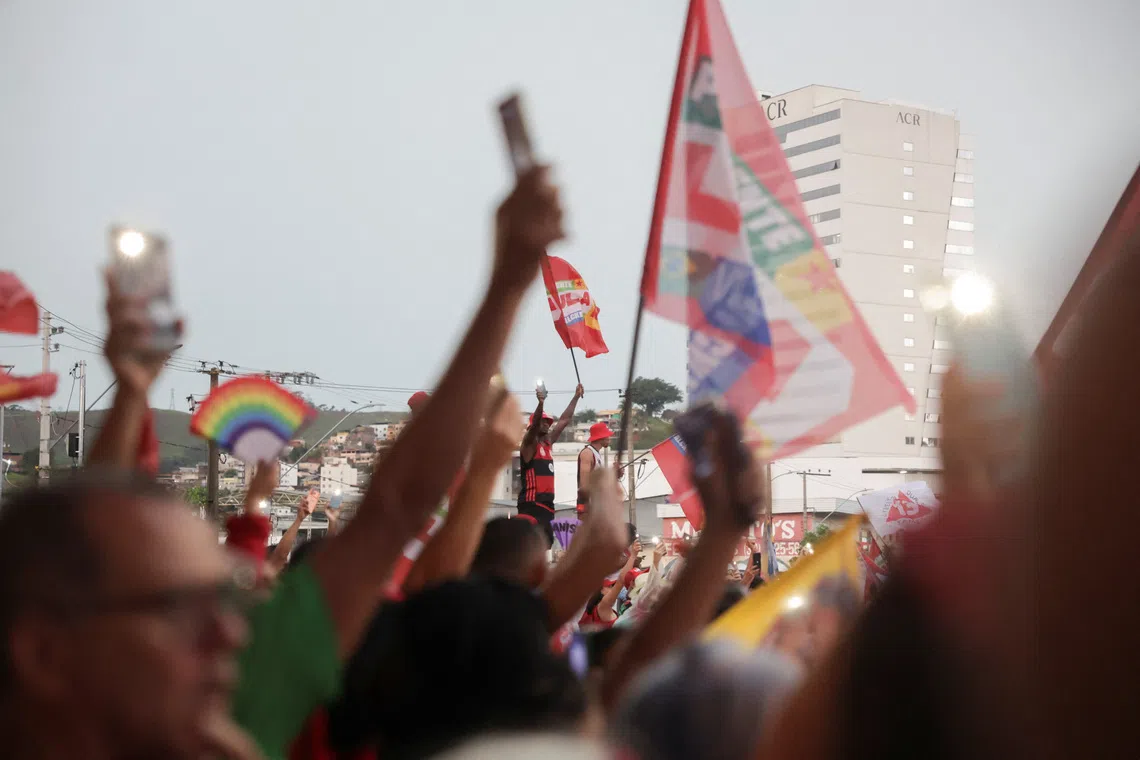
Brazil's recent congressional elections saw significant gains for the right-wing Liberal Party (PL), led by Senator Flavio Bolsonaro, with 28 seats in the Senate and 121 in the lower house. These results are projected to give the PL its strongest showing since the end of military rule in 1985, potentially allowing Flavio Bolsonaro's presidential campaign to gain momentum against leftist incumbent Luiz Inacio Lula da Silva ahead of the October 25 runoff election. The article highlights how an aligned Congress could aid Flavio Bolsonaro’s efforts to secure amnesty for his father, former President Jair Bolsonaro, who is facing legal consequences.
Written locally by qwen2.5:14b on 2026-10-05,
using this article's own text rather than the other coverage of the
same event (that is the story summary below).
Story summary
Brazil's right-wing Liberal Party, home to Senator Flavio Bolsonaro's presidential bid, emerged as the biggest winner in congressional elections on October 5. The party increased its representation in the Senate from 15 seats to 28, securing the strongest result for a single party since Brazil returned to democracy in 1985. In the lower house, projections showed the Liberal Party winning 121 seats, up from its current 98. Combined with other center-to-right parties and blocs, which were projected to win close to 250 seats in the lower house and more than 30 in the Senate, Bolsonaro's agenda is expected to have a significant majority in the upcoming Congress, potentially influencing federal spending and presidential appointments.
Written for “Brazil Right Wing Rise” on 2026-10-05,
grounded in this article and the 0 other(s) covering the same event.
Why this leaning score
The article's own words the score was based on. Each is quoted
verbatim and was checked against the article text before being
stored, so you can find it in the original.
-
Right-wing wave in Brazil's Congress boosts Bolsonaro camp ahead of presidential runoff
right frames the election results as a boost for Bolsonaro
-
Combined with other center-to-right parties and blocs, who were projected to win close to 250 seats in the lower house and more than 30 seats in the Senate, the Bolsonaro agenda looks set to enjoy a healthy working majority in the next Congress.
right describes Bolsonaro's political agenda as likely to dominate
-
An allied Congress - and particularly Senate - would help the younger Bolsonaro achieve his aim of granting amnesty to his father, who is serving a 27-year sentence for plotting a coup after losing the 2022 election.
right supports Bolsonaro's goal of amending laws
Leaning: leans strongly right for article 57593 (high confidence, 3 verified quotes) · logged 2026-10-05
Right-wing wave in Brazil's Congress boosts Bolsonaro camp ahead of presidential runoff
SAO PAULO/BRASILIA, Oct 5 -
asserted
wave → boost → runoff
Brazil's right-wing Liberal Party, home to Senator Flavio Bolsonaro's presidential bid, emerged as the biggest winner in congressional elections on Sunday, securing the largest single-party representation in both the Senate and the lower house.
asserted
Party → emerge → Senate
Senator Bolsonaro, the eldest son of former President Jair Bolsonaro, on Sunday won the most votes in the first round of the presidential race, advancing to a runoff against leftist President Luiz Inacio Lula da Silva on October 25.
asserted
Bolsonaro → win → October
During the campaign, the younger Bolsonaro stumped often for allied Senate candidates.
asserted
Bolsonaro → stump → candidates
His Liberal Party (PL) increased its representation in the Senate from 15 to 28 seats, the strongest result for a party since Brazil's return to democracy in 1985.
asserted
Party → increase → 1985
It also secured 121 seats in the lower house, projections for that chamber showed, up from 98 seats currently.
asserted
projections → secure → seats
Combined with other center-to-right parties and blocs, who were projected to win close to 250 seats in the lower house and more than 30 seats in the Senate, the Bolsonaro agenda looks set to enjoy a healthy working majority in the next Congress.
asserted
agenda → combine → Congress
An allied Congress - and particularly Senate - would help the younger Bolsonaro achieve his aim of granting amnesty to his father, who is serving a 27-year sentence for plotting a coup after losing the 2022 election.
asserted
who → help → election
The Senate's pro-Bolsonaro bloc may even be close to the threshold of 54 votes needed to impeach the Supreme Court justices who convicted the far-right former leader.
uncertain
who → need → leader
"I was very happy to see how many Brazilians went to the polls to make their voices heard and didn't stay on the sidelines because they want change," Bolsonaro said after the vote.
asserted
Bolsonaro → see → vote
Sunday's legislative races, held alongside the first round of the presidential election, renewed all 513 seats in the lower house of Congress and two-thirds of the 81-seat Senate.
asserted
races → hold → Senate
Congressional races in Brazil have drawn increasing voter attention in recent elections as lawmakers expand their influence in the capital Brasilia, particularly through greater control over federal spending and leverage over presidential appointments.
asserted
lawmakers → draw → appointments
Lula's Workers Party (PT) also increased its footprint in Congress.
asserted
Party → increase → Congress
The party maintained its Senate presence with nine seats, and a three-party bloc led by the PT was projected to win 88 seats in the lower house, up from 82 currently.
asserted
bloc → maintain → 82
Even as Lula fights for a come-from-behind victory in the second round of voting, analysts say the next Congress would make his fourth, non-consecutive term an uphill battle.
asserted
term → fight → voting
"Governance would pose a major challenge for President Lula," said Neuriberg Dias, head of legislative watchdog DIAP, adding that a right-wing bloc would work to stifle legislative progress and the functioning of government.
asserted
bloc → pose → government
Both political camps have illustrated the difficulties faced by presidents who do not have sufficient congressional backing.
asserted
who → illustrate → backing
In April, Lula became the first Brazilian president in more than a century to see a Supreme Court nominee voted down amid tensions with center-right Senate President Davi Alcolumbre.
asserted
nominee → become → Alcolumbre
Congress has also overturned dozens of Lula's vetoes since his return to office in January 2023, underscoring lawmakers' growing assertiveness.
asserted
Congress → overturn → assertiveness
Former President Bolsonaro faced similar obstacles, with Congress blocking some of his most prominent policy initiatives, including efforts to loosen gun-control rules and introduce a printed ballot verification system for elections.
asserted
Congress → face → elections
 The Aporia