Magenta solar panels made broccoli use sunlight 4.5 times more efficiently

Read the original at Times of India ↗
Times of India · collected 2026-10-05 · by TOI Science Desk

Quick Summary

Scientists at Mälardalen University in Sweden experimented with magenta solar panels over broccoli crops, finding that the plants grew 4.5 times more efficiently using sunlight compared to those under normal conditions. The semi-transparent panels allowed blue and red wavelengths crucial for plant growth while converting other light into electricity. Despite taking an additional 25 days to mature, the panel-grown broccoli reached similar sizes and yields as control crops. This approach suggests that agrivoltaic systems can produce both food and renewable energy on the same land efficiently.
Written locally by qwen2.5:14b on 2026-10-05, using this article's own text rather than the other coverage of the same event (that is the story summary below).

AI analysis runs on qwen2.5:14b, locally

Story summary

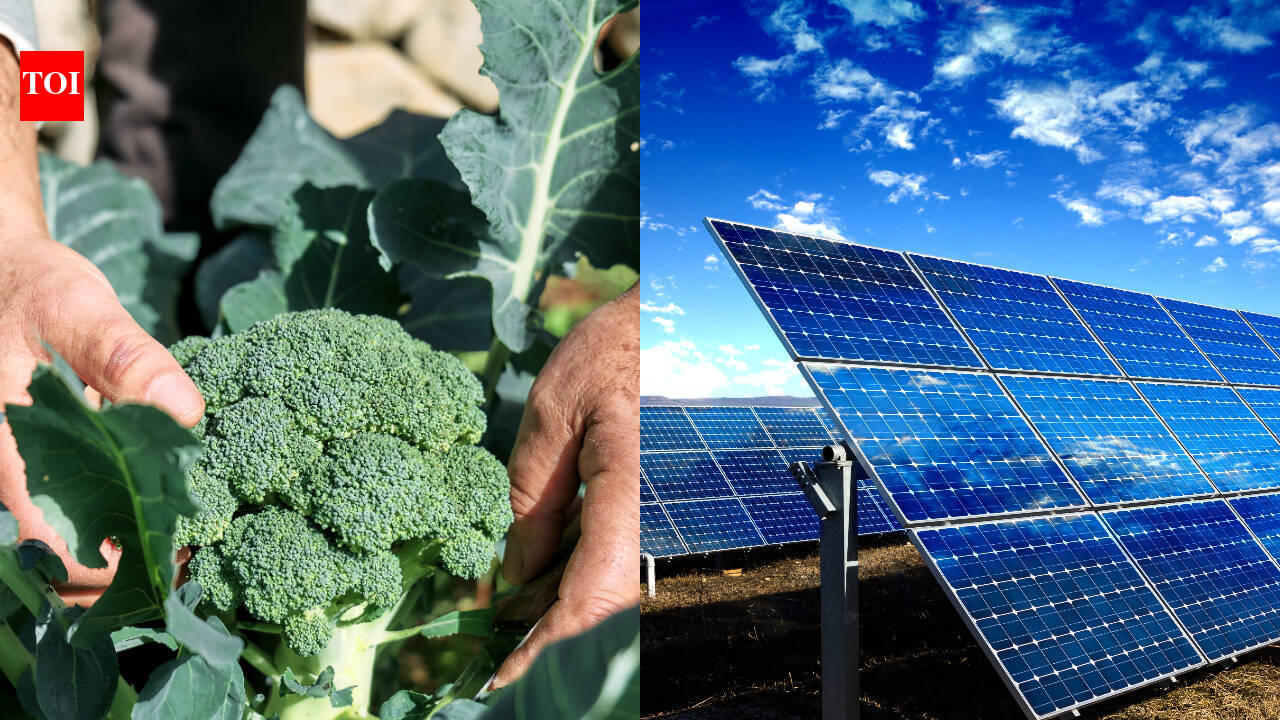
In a Swedish experiment led by researchers at Mälardalen University in Västerås, scientists installed semi-transparent magenta solar panels over broccoli fields to test how plants can use light more efficiently while generating electricity. For the 2024 growing season, they set up two experimental systems each covering an area of 20-by-20-metres. These panels allowed different levels of sunlight through, optimizing the wavelengths needed for plant growth and capturing excess sunlight to produce power.

The study found that under these conditions, broccoli could use sunlight 4.5 times more efficiently, suggesting a new approach to agrivoltaics where solar energy production coexists with agriculture without significantly hindering crop development. This innovative method addresses concerns about conventional panels blocking essential sunlight for crops, offering farmers an alternative way to integrate renewable energy into their farming practices.

Written for “Broccoli Shaped Solar Panels Efficiency” on 2026-10-05, grounded in this article and the 0 other(s) covering the same event.
Why this leaning score
This article does not take a side on a contested political question, so it has no leaning score. That is an answer rather than a gap: a match report or a rescue can be warmly or critically written without being left or right, and scoring it anyway is how approval of a subject gets recorded as a political position.
No political leaning scored for article 56680 · logged 2026-10-05

Signals How these are calculated →

Claims extracted
28
claim-shaped sentences
Uncertain
32%
9 of 28 hedged
Leaning
not political
takes no side on a contested political question
Correction & hedging signals
59.1
corrections and hedging in what we collected; not a measure of accuracy
Outlets on this story
1
Science
Narrative spread
1
articles carrying this framing
Analyzed 2026-10-05 · how these are computed

Story

📰 Broccoli Shaped Solar Panels Efficiency
Science · 1 article(s) covering the same event.

How this is being covered How these are calculated →

Article leaning vs. publisher reliability
Source leaning vs. consistency

Compared with similar articles

Nothing to compare against. No article is close enough to this one for the pipeline to have linked or judged the pair.

Publisher

Times of India · 1726 article(s) · 1 correction(s) detected
Running correction rate · 1 correction(s)
2026-10-04
Tennessee prison chief Frank Strada resigns after Christa Pike's botched execution

Who wrote this

TOI Science Desk
167 article(s) here · 1 carrying a prediction
🔮 The results suggest that the arrangement could make plants surprisingly efficient at using the light available to them, states an online report by The Debrief.
🔮 A fishing trip along the Rio Grande led a La Joya, Texas, seventh-grader to investigate whether discarded shellfish shells could help remove pollution from water.
🔮 About 3 million single-use face masks could be used to build the base of a one-kilometre, two-lane road, according to research by engineers at Australia's RMIT University that explored a way to turn discarded masks and construction waste into road-building material.
🔮 The seventh-grader from BASIS Independent Silicon Valley in San Jose designed an atmospheric water generator that pulls moisture from humid air, then tested whether sound could make it more effective.
🔮 Her goal was to explore whether an inexpensive device could support health surveillance in rural communities, where access to advanced diagnostic tools and disease-monitoring systems is often limited.
🔮 Seychelles also agreed to create a marine spatial plan to decide how its ocean would be protected and used.
🔮 This gives value to wool that might otherwise have few cost-effective uses.
🔮 The study, published in Agriculture, also found that the fabric could keep insects away while still allowing light, rain and air to reach the crops.
🔮 said returning rufous bettongs to Ngambaa Nature Reserve would help restore an important ecosystem engineer to the landscape while contributing to the long-term security of the species.
🔮 The project abstract describes the system as a scalable framework, but broader agricultural deployment would require further testing under different field conditions and at larger scales.
Wire or desk byline, not an individual reporter.
Also by TOI Science Desk
Nothing else under this byline is closely related to this article, so these are simply their most recent.
All 167 articles by TOI Science Desk →

Topics

Mälardalen University Sweden Swedish The Debrief Västerås

Subjects

Swedish NORP · 3× Sweden GPE · 2× Mälardalen University ORG · 1× The Debrief ORG · 1× Västerås GPE · 1×

Narrative

Giving broccoli a tailored spectrum For the 2024 growing season, researchers established two 20-by-20-metre experimental systems fitted with semi-transparent magenta solar panels. The panels varied in their transparency, allowing different amounts of sunlight to reach the plants.
framing: mixed · carried by 1 article(s) · first seen 2026-10-05
🔮 The results suggest that the arrangement could make plants surprisingly efficient at using the light available to them, states an online report by The Debrief.

Claims (28 extracted, 9 hedged)

What if the future of farming looked a little less green? asserted
future → look → farming
In a Swedish experiment, rows of broccoli grew beneath unusual magenta-coloured solar panels, turning a patch of farmland into a test site for a different kind of agriculture. asserted
rows → grow → agriculture
The idea was simple: let crops receive the wavelengths they need while using the rest of the sunlight to generate electricity. asserted
they → let → electricity
The results suggest that the arrangement could make plants surprisingly efficient at using the light available to them, states an online report by The Debrief. uncertain
report → suggest → Debrief
According to The Debrief report, the research was conducted by scientists at Mälardalen University in Västerås, Sweden, as part of a broader effort to understand how solar power and crop production can share the same space. uncertain
power → accord → space
It is stated that Agrivoltaic systems typically place solar panels above agricultural land, allowing farmers to produce electricity while continuing to grow crops underneath. asserted
farmers → state → crops
The panels can also offer protection from intense sunlight, heavy rain and hail. asserted
panels → offer → sunlight
The problem is that conventional panels are largely opaque, potentially blocking too much of the sunlight crops require, the report adds. asserted
report → block → sunlight
The Swedish team explored whether semi-transparent panels could solve that problem by filtering sunlight rather than simply blocking it. uncertain
panels → explore → it
Broccoli was chosen partly because it is widely grown and nutritionally important, and because it can adapt well to the local Swedish climate. asserted
it → choose → climate
Giving broccoli a tailored spectrum For the 2024 growing season, researchers established two 20-by-20-metre experimental systems fitted with semi-transparent magenta solar panels. The panels varied in their transparency, allowing different amounts of sunlight to reach the plants. asserted
amounts → give → plants
The systems were designed to increase the proportion of blue and red wavelengths reaching the broccoli, while using other portions of incoming sunlight for electricity generation, explains the online report. asserted
report → design → generation
A separate plot exposed to normal sunlight served as the control. asserted
plot → expose → control
Throughout the growing season, researchers monitored conditions including air temperature, humidity and soil moisture. asserted
researchers → monitor → temperature
They also assessed crop yield, nutrient composition and photosynthetic performance. asserted
They → assess → yield
The results were striking as broccoli grown beneath the magenta panels used sunlight 4.5 times more efficiently than plants growing under direct sunlight. asserted
broccoli → grow → sunlight
Despite receiving a modified light spectrum, the plants ultimately reached a similar size and produced comparable yields. asserted
plants → receive → yields
There was, however, a trade-off: the panel-grown broccoli needed about 25 additional days to reach maturity. asserted
broccoli → be → maturity
Electricity and food from the same field The findings point to one of the central attractions of agrivoltaics: the same piece of land could potentially produce both food and renewable energy, states The Debrief report. uncertain
report → point → food
Electricity generated by panels could be used to operate irrigation systems, agricultural machinery, refrigeration and storage equipment, or potentially be supplied to the wider power grid. uncertain
Electricity → generate → grid
At the same time, the panels could provide crops with a degree of protection from extreme weather and excessive sunlight. uncertain
panels → provide → weather
The technology tested in Sweden remains experimental, however. asserted
technology → test → Sweden
The magenta panels used in the study are not currently commercially available, and the researchers stressed that crop responses could vary according to climate, panel design and growing conditions. uncertain
responses → use → climate
The next generation of solar farming The team is now investigating which combinations of panel colour and transparency can produce the best balance between plant growth and electricity generation. asserted
combinations → investigate → growth
Experiments involving red and blue panels are also being conducted under controlled conditions, adds the report. asserted
report → involve → conditions
For now, smaller applications such as community gardens or greenhouse roofs may be more realistic than covering vast agricultural fields. uncertain
applications → cover → fields
The bigger idea is to rethink sunlight not as a single resource that belongs either to crops or solar panels, but as a spectrum that can potentially be divided between both. asserted
that → rethink → both
If future systems can get that balance right, farms may one day harvest two crops from the same sunlight: vegetables from the soil and electricity from above. uncertain
farms → get → above

💬Give feedback
🕘History 🎫Support