Antarctica’s 2 native flowering plants responded differently to 7 years of warming

Read the original at Times of India ↗
Times of India · collected 2026-10-05 · by TOI Science Desk

Quick Summary

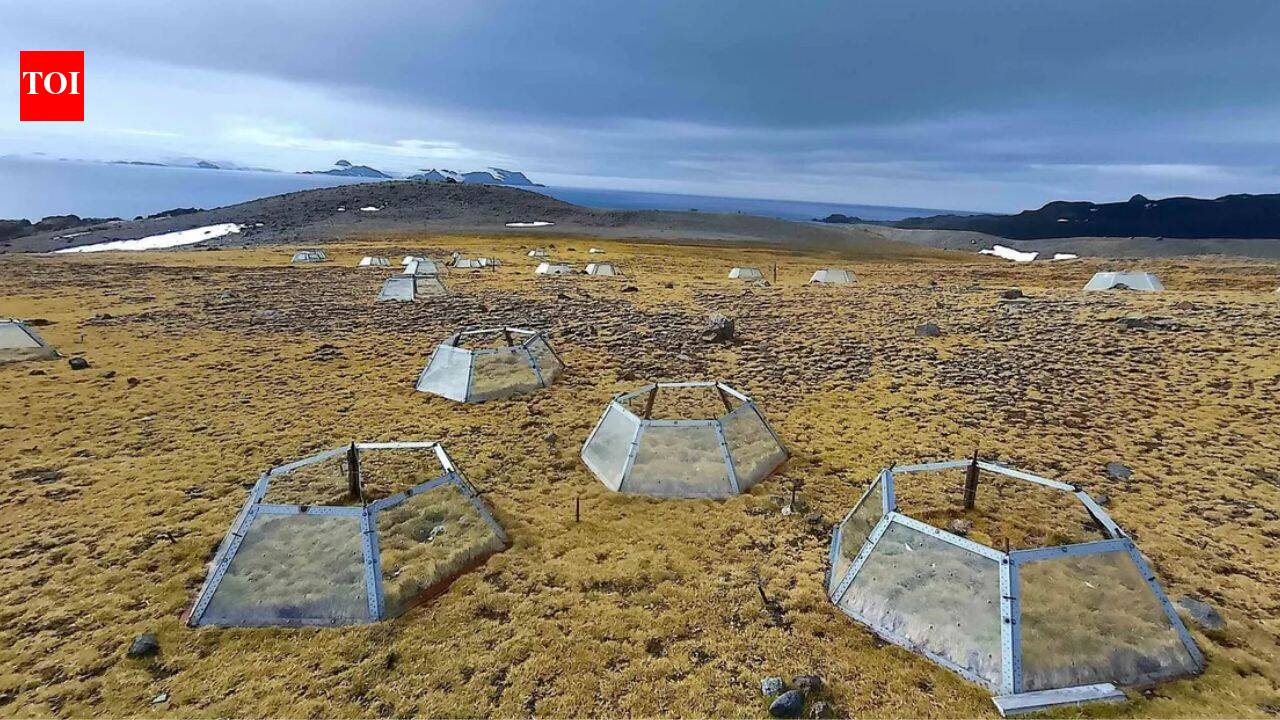
Researchers conducted a seven-year experiment on King George Island near the Antarctic Peninsula to study how Antarctica’s two native flowering plants—Antarctic hairgrass (Deschampsia antarctica) and Antarctic pearlwort (Colobanthus quitensis)—respond to long-term warming. They placed open-top chambers around some of the plants, creating warmer conditions inside while leaving others in natural settings for comparison. The study found that Antarctic hairgrass reduced its water transport capacity and photosynthetic rate under warming conditions, likely due to more frequent freeze-thaw cycles. In contrast, Antarctic pearlwort increased both its leaf hydraulic conductivity and photosynthetic rate, with enhanced cell wall elasticity and improved carbon dioxide diffusion.
Written locally by qwen2.5:14b on 2026-10-05, using this article's own text rather than the other coverage of the same event (that is the story summary below).

AI analysis runs on qwen2.5:14b, locally

Story summary

In a seven-year experiment conducted on King George Island, researchers studied how Antarctica’s two native flowering plants—Antarctic hairgrass (Deschampsia antarctica) and Antarctic pearlwort (Colobanthus quitensis)—responded to sustained warming. By placing open-top chambers around the plants, they created warmer conditions and observed that each species adapted differently over time. The study, published in Physiologia Plantarum, highlights contrasting physiological strategies used by these two plant species under long-term warming conditions, providing insights into how Antarctic flora might adapt to future climate changes.

Written for “Antarctica Plant Response To Warming” on 2026-10-05, grounded in this article and the 0 other(s) covering the same event.
Why this leaning score
This article does not take a side on a contested political question, so it has no leaning score. That is an answer rather than a gap: a match report or a rescue can be warmly or critically written without being left or right, and scoring it anyway is how approval of a subject gets recorded as a political position.
No political leaning scored for article 56801 · logged 2026-10-05

Signals How these are calculated →

Claims extracted
32
claim-shaped sentences
Uncertain
6%
2 of 32 hedged
Leaning
not political
takes no side on a contested political question
Correction & hedging signals
59.0
corrections and hedging in what we collected; not a measure of accuracy
Outlets on this story
1
Environment
Narrative spread
1
articles carrying this framing
Analyzed 2026-10-05 · how these are computed

Story

📰 Antarctica Plant Response To Warming
Environment · 1 article(s) covering the same event.

How this is being covered How these are calculated →

Article leaning vs. publisher reliability
Source leaning vs. consistency

Compared with similar articles

Nothing to compare against. No article is close enough to this one for the pipeline to have linked or judged the pair.

Publisher

Times of India · 1746 article(s) · 2 correction(s) detected
Running correction rate · 2 correction(s)
2026-10-05
NASA spacecraft gains 3.5 km/s speed from Earth’s gravity assist without major engine burn
2026-10-04
Tennessee prison chief Frank Strada resigns after Christa Pike's botched execution

Who wrote this

TOI Science Desk
174 article(s) here · 0 carrying a prediction
🔮 He wanted to know whether sound could change how much water the machine collected.
🔮 The Seattle District’s Navigation Section removes objects and debris that could damage vessels or create risks to public health, recreation or the environment in publicly maintained commercial boat harbours.
🔮 In Florida, researchers tested whether ash left over from burning everyday waste could safely sit beneath a working road.
🔮 It also found that some programmes had unintended consequences, including the removal of non-target species and effects that may inadvertently benefit target species, though these are not universal.
🔮 The work is expected to continue through 2027, according to the US Environmental Protection Agency.
🔮 The animals could have survived the eradication programme and remained undetected, or new rats could have reached the island afterwards.
🔮 Reaching the outer solar system requires enormous amounts of energy, and using engines alone would demand a much larger rocket and far more propellant than is practical.
🔮 The results suggest that the arrangement could make plants surprisingly efficient at using the light available to them, states an online report by The Debrief.
🔮 A fishing trip along the Rio Grande led a La Joya, Texas, seventh-grader to investigate whether discarded shellfish shells could help remove pollution from water.
🔮 About 3 million single-use face masks could be used to build the base of a one-kilometre, two-lane road, according to research by engineers at Australia's RMIT University that explored a way to turn discarded masks and construction waste into road-building material.
Wire or desk byline, not an individual reporter.
Also by TOI Science Desk
Nothing else under this byline is closely related to this article, so these are simply their most recent.
All 174 articles by TOI Science Desk →

Topics

Antarctic BBC Wildlife King George Island Physiologia Plantarum the BBC Wildlife

Subjects

King George Island GPE · 2× Antarctic NORP · 1× BBC Wildlife ORG · 1× Physiologia Plantarum ORG · 1× the BBC Wildlife ORG · 1×

Narrative

Seven years of warming revealed different responses in two Antarctic plants The seven-year experiment provides a long-term view of how Antarctica’s two native vascular plants respond to sustained warming in the field.
framing: assertive · carried by 1 article(s) · first seen 2026-10-05

Claims (32 extracted, 2 hedged)

Antarctica has only two native flowering plants, and both have spent years facing a warmer environment. asserted
both → have → environment
A new seven-year field study found that Antarctic hairgrass (Deschampsia antarctica) and Antarctic pearlwort (Colobanthus quitensis) responded to long-term warming in different ways. asserted
hairgrass → find → ways
Researchers placed open-top chambers around plants on King George Island to create warmer conditions and compared them with plants growing outside the chambers. asserted
Researchers → place → chambers
According to research published in Physiologia Plantarum titled ‘ Contrasting Hydraulic-Photosynthetic Strategies Sustain Antarctic Vascular Plants Under Long-Term Warming’, the two species followed contrasting physiological pathways under sustained warming. uncertain
species → accord → warming
How did Antarctica’s two flowering plants respond to long-term warming asserted
plants → flower → warming
According to the BBC Wildlife, Antarctica is home to just two native vascular plants: Antarctic hairgrass and Antarctic pearlwort. uncertain
Antarctica → accord → plants
Both are small plants that grow in wet, protected spaces between rocks, with clumps reaching around 5 cm in height. asserted
that → grow → height
In 2012, researchers began a seven-year experiment on King George Island, an island just north of the Antarctic Peninsula, to understand how these plants respond to long-term warming. asserted
plants → begin → warming
They set up plots and placed open-top chambers around some of the plants. asserted
They → set → plants
The chambers passively warmed the air inside by several degrees, while plants outside them remained under natural conditions for comparison. asserted
plants → warm → comparison
The experiment continued for seven years. asserted
experiment → continue → years
During this time, researchers examined leaf hydraulic traits, xylem anatomy, and photosynthetic performance in both species. asserted
researchers → examine → species
They also recorded changes in freeze-thaw events during the study period. asserted
They → record → period
PC: BBC Wildlife Antarctic hairgrass reduced water transport and photosynthesis asserted
hairgrass → reduce → transport
After seven years under the warming chambers, Antarctic hairgrass showed reduced leaf hydraulic conductivity and reduced photosynthetic rate compared with plants under natural conditions. asserted
hairgrass → show → conditions
The study linked these changes to outside-xylem modulation and likely senescence associated with more frequent freeze-thaw events inside the chambers. asserted
study → link → chambers
Antarctic pearlwort, exposed to the same warming treatment, responded differently. asserted
pearlwort → expose → treatment
Its leaf hydraulic conductivity and photosynthetic rate both increased. asserted
conductivity → increase → ?
The species also showed greater cell wall elasticity, along with enhanced water transport and carbon dioxide diffusion, triggered by changes in vascular anatomy and by a growth form that favors heat conservation. asserted
that → show → conservation
The two Antarctic plants adapted differently to long-term warming The two plants did not use the same response to long-term warming. asserted
plants → adapt → warming
Antarctic hairgrass reduced hydraulic conductivity and photosynthesis, while Antarctic pearlwort increased both. asserted
pearlwort → reduce → both
The researchers described these responses as complementary adaptive pathways. asserted
researchers → describe → pathways
Both species showed structural and ultrastructural leaf adjustments that supported tight coordination between hydraulics and photosynthesis. asserted
that → show → hydraulics
In Antarctic hairgrass, the reductions were linked to outside-xylem modulation and likely senescence. asserted
reductions → link → modulation
In Antarctic pearlwort, changes included greater cell wall elasticity, enhanced water transport and carbon dioxide diffusion, along with changes in vascular anatomy. asserted
changes → include → anatomy
Seven years of warming revealed different responses in two Antarctic plants The seven-year experiment provides a long-term view of how Antarctica’s two native vascular plants respond to sustained warming in the field. asserted
plants → reveal → field
The researchers found that both species maintained coordination between leaf hydraulics and photosynthesis, but their responses differed. asserted
responses → find → hydraulics
Antarctic hairgrass followed a more conservative pathway, with lower hydraulic conductivity and photosynthetic rate after warming. asserted
hairgrass → follow → warming
Antarctic pearlwort showed greater hydraulic conductivity and photosynthetic capacity, along with increased cell wall elasticity and water and carbon dioxide transport. asserted
pearlwort → show → elasticity
The findings show that warming does not produce one uniform response across the two species. asserted
warming → show → species
Instead, each species adjusted through a different set of physiological and structural changes. asserted
species → adjust → changes
The study describes these contrasting pathways as part of a shared adaptive continuum in Antarctica today. asserted
study → describe → Antarctica

💬Give feedback
🕘History 🎫Support