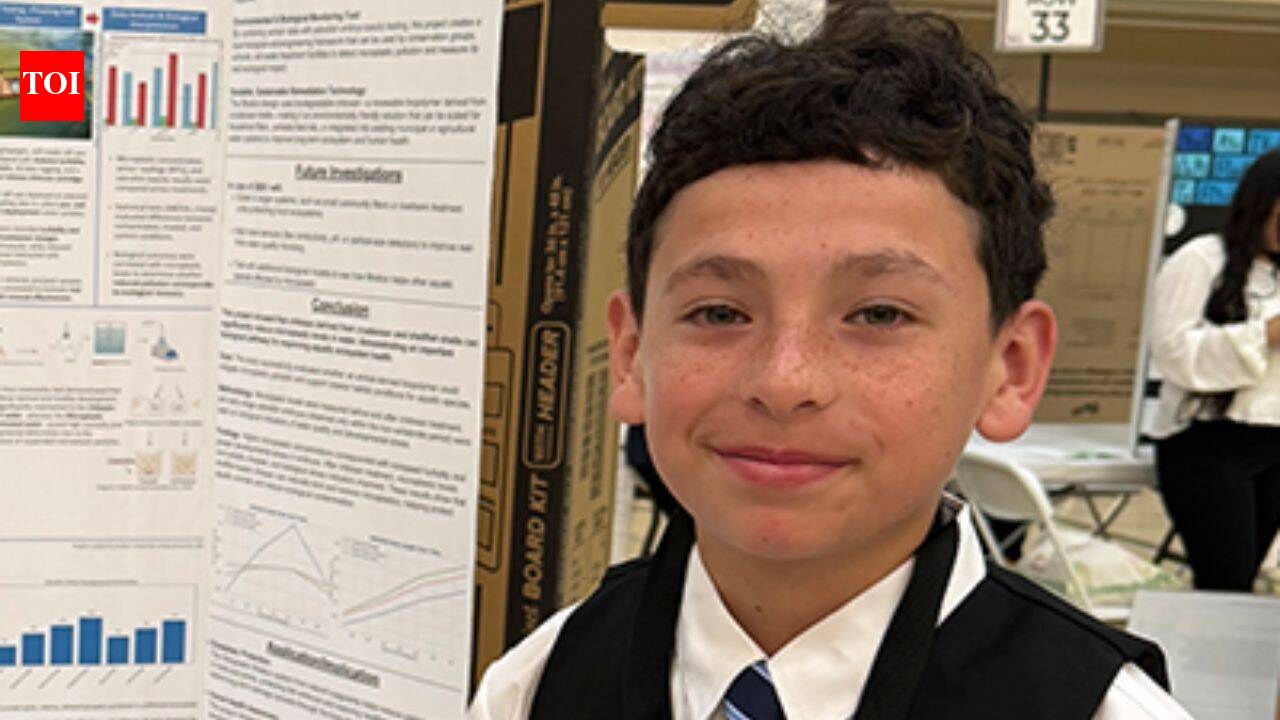
For Ankith Burki, the global water crisis was not an abstract classroom topic but a challenge worth trying to solve.
asserted
crisis → try → Burki
The seventh-grader from BASIS Independent Silicon Valley in San Jose designed an atmospheric water generator that pulls moisture from humid air, then tested whether sound could make it more effective.
uncertain
it → design → air
His results were striking: low-frequency sine waves increased the device’s water collection by 117 percent.
asserted
waves → increase → percent
The project earned Ankith a place among 30 national finalists in the 2026 Thermo Fisher Scientific Junior Innovators Challenge, the United States’ premier STEM competition for middle-school students, according to the Society for Science.
uncertain
project → earn → Science
A question shaped by water scarcity
Ankith’s project began with a sobering reality.
asserted
project → shape → reality
More than 4 billion people do not have sufficient access to fresh water, and climate change is expected to make water stress more severe in many regions.
asserted
stress → have → regions
Atmospheric water generators offer one possible solution because they can extract drinkable water directly from humid air, reducing dependence on conventional water sources.
asserted
they → offer → sources
Many atmospheric water generators do not produce enough water to be practical for communities that need them most.
asserted
that → produce → them
Ankith wanted to find out whether a relatively simple intervention could improve their efficiency.
uncertain
intervention → want → efficiency
He focused on sound-induced vibrations, which he believed could help water vapour cluster and encourage tiny droplets to combine, allowing more water to be collected.
uncertain
water → focus → droplets
Rather than treating water scarcity as a problem that only governments or major laboratories could tackle, Ankith looked for an experiment he could build, measure and improve.
uncertain
he → treat → experiment
His work combines environmental concern with engineering curiosity, a pairing that helped make his project stand out in a national field of young innovators, as per the report.
asserted
project → combine → report
Building a water generator from scratch
Before he could test sound, Ankith needed a working atmospheric water generator.
uncertain
Ankith → build → generator
He designed and assembled his own prototype using the Peltier effect, a thermoelectric process in which an electric current moves heat from one side of a material to another.
asserted
current → design → another
This allowed his device to cool the surrounding air enough for moisture to condense into liquid water.
asserted
moisture → allow → water
The report further suggested that after several rounds of trials, he developed a prototype capable of lowering the temperature around it by 7.5 degrees Celsius.
uncertain
he → suggest → Celsius
That cooling pushed the air below its dew point, the temperature at which water vapour turns into droplets.
asserted
vapour → cool → droplets
Once the droplets formed on the chilled surface, the device could capture and measure the water produced.
uncertain
device → form → water
The process required persistence.
asserted
process → require → persistence
Designing a system that reliably produces condensation is not simply a matter of turning on a cooling component.
asserted
that → design → component
Variables such as room humidity, temperature, airflow and surface conditions can all affect the volume of water collected.
asserted
Variables → affect → water
Ankith had to create a repeatable setup before he could make a meaningful comparison between silent conditions and sound-assisted ones.
uncertain
he → have → conditions
Testing the power of low-frequency sound
Ankith ran his atmospheric water generator through a series of four-hour tests.
asserted
Ankith → test → tests
He performed 5 silent trials to get a baseline, and 10 other trials with low frequency sound from a speaker.
asserted
He → perform → speaker
He tested 2 types of wave forms, sine waves and triangle waves, to see if different sound patterns changed the amount of water the machine produced.
asserted
machine → test → water
These vibrations can affect the movement of water droplets and vapor .
asserted
vibrations → affect → droplets
Ankith thought that maybe these vibrations can cause tiny droplets to coalesce , that is , merge together into larger droplets .
asserted
droplets → think → droplets
Larger droplets would be more likely to clump together and fall into a container , possibly increasing the overall output of the generator .
uncertain
droplets → clump → generator
His measurements showed that low-frequency sine waves were the most effective option.
asserted
waves → show → ?
Under those conditions, the device collected 117 percent more water than it did during the silent tests.
asserted
it → collect → tests
The result suggests that sound could offer a low-cost way to improve the performance of atmospheric water generators, though further research would be needed before the technique could be applied outside a controlled prototype.
uncertain
technique → suggest → prototype
A national STEM finalist
Ankith’s project, titled Investigating the Effect of Low-Frequency Sound in Enhancing the Efficiency of Water Generation in Thermoelectric Atmospheric Water Generators, earned him a place in the 2026 Thermo Fisher Scientific Junior Innovators Challenge.
asserted
project → title → Challenge
The Society for Science selected 30 finalists from a nationwide pool of middle-school researchers, as per the report on their website.
asserted
Society → select → website
The finalists are scheduled to travel to Washington, DC, from October 23 to 28 for Finals Week.
asserted
finalists → schedule → Week
In addition to presenting their research projects, students will take part in team challenges designed to assess collaboration, critical thinking and problem-solving.
asserted
students → present → collaboration
Every finalist receives a $500 award and competes for more than $100,000 in prizes.
asserted
finalist → receive → prizes
Reaching this stage is an important recognition for Ankith, particularly because his project takes on an issue with direct relevance to climate resilience and resource access.
asserted
project → reach → resilience
The Junior Innovators Challenge is not only about producing a clever experiment.
asserted
Challenge → produce → experiment
It rewards students who can identify meaningful problems, test their ideas carefully and explain how their work could make a difference beyond the lab.
uncertain
work → reward → lab
Engineering with a wider purpose
Ankith has said he hopes to become an environmental engineer.
asserted
he → engineer → purpose
…and 14 more, not listed.
 The Aporia