Almost one out of 100 homebuyers in negative equity: RBA

Read the original at The Sydney Morning Herald ↗
The Sydney Morning Herald · collected 2026-10-01 · by Matt Wade

Quick Summary

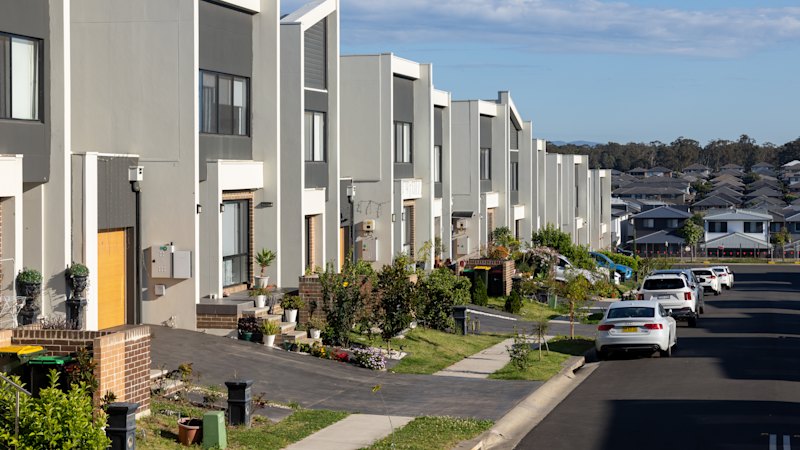
The Reserve Bank of Australia (RBA) has reported that less than 1% of homebuyers are in negative equity, primarily affecting recent buyers including those using the government’s 5% deposit scheme since last October. The RBA warns of growing risks to household financial stability due to high inflation and rising interest rates, with a scenario analysis suggesting that if unemployment rises to 6.3%, inflation reaches 7%, and cash rates hit 5.6%, about 5% of home borrowers could face higher risk of defaulting on loans.
Written locally by qwen2.5:14b on 2026-10-01, using this article's own text rather than the other coverage of the same event (that is the story summary below).

AI analysis runs on qwen2.5:14b, locally

Story summary

The Reserve Bank of Australia (RBA) released its latest Financial Stability Review, highlighting that despite a significant housing downturn in Australia, only less than 2% of variable-rate owner-occupier mortgage borrowers face financial stress as of June 2023. The RBA predicts this number might slightly increase to around 2% due to expected interest rate hikes, but it remains well below historical peaks seen during previous downturns. However, the review also notes that recent homebuyers, particularly those using the Australian government’s 5% deposit scheme, are more likely to be in negative equity, where they owe more on their mortgage than their property is worth. Since October, over 100,000 first-time buyers have utilized this scheme. The RBA emphasizes that although fewer than 1% of all home borrowers are currently in negative equity, the risk remains highest for lower-income households and recent buyers participating in government schemes due to higher debt-to-income ratios. Additionally, the report warns about potential threats from overseas, such as a global financial shock triggered by speculative investment in artificial intelligence (AI), which could affect Australia's economy despite its robust domestic conditions.

Written for “RBA Warnings On Housing And Ai” on 2026-10-05, grounded in this article and the 2 other(s) covering the same event.

Signals How these are calculated →

Claims extracted
15
claim-shaped sentences
Uncertain
7%
1 of 15 hedged
Leaning
not political
takes no side on a contested political question
Correction & hedging signals
61.2
corrections and hedging in what we collected; not a measure of accuracy
Outlets on this story
3
Economy/Business
Narrative spread
1
articles carrying this framing
Analyzed 2026-10-01 · how these are computed

Story

📰 RBA Warnings On Housing And Ai
Economy/Business · 3 article(s) covering the same event. See how they differ ↓

How this is being covered How these are calculated →

Article leaning vs. publisher reliability
Source leaning vs. consistency

Compared with similar articles

This article reads unscored and hedges 7% of its claims. Each row says how that neighbour differs.
ABC News (AU)
⚖️ Leans left 🔴 10% hedged 5 of 48 📰 publisher trust 61
“The articles discuss different aspects of financial conditions and risks, not a single specific incident.”
The Guardian
⚖️ Leans left 🔴 6% hedged 1 of 16 📰 publisher trust 68
“The articles discuss different aspects of economic conditions and warnings from the RBA, not a single specific incident.”
The Guardian
⚖️ leaning not scored 🔴 5% hedged 1 of 20 📰 publisher trust 68
“The articles discuss different aspects of the Australian property market and economic conditions without describing the same specific incident.”
Daily Mail
⚖️ leaning not scored 🔴 13% hedged 4 of 30 📰 publisher trust 65
“The articles discuss different aspects of economic issues but describe distinct events: one about negative equity and financial stability risks, the other about Mark Bouris's warning on government borrowing and interest rates.”
The Guardian
⚖️ leaning not scored 🔴 25% hedged 3 of 12 📰 publisher trust 68
“Both articles discuss the Reserve Bank's twice-yearly financial stability review on October 1, 2026, warning about risks to Australia from a global financial shock and AI investment boom.”
The Sydney Morning Herald
⚖️ Leans left 🔴 11% hedged 4 of 35 📰 publisher trust 61
“Article A discusses the broader economic risks related to negative equity and debt-funded AI investments, while Article B focuses on specific distress selling trends in Sydney suburbs.”
Daily Mail
⚖️ leaning not scored 🔴 25% hedged 5 of 20 📰 publisher trust 65
“The articles discuss different aspects of Australia's housing market and financial stability without reporting on the same specific incident.”
ABC News (AU)
⚖️ leaning not scored 🔴 17% hedged 5 of 29 📰 publisher trust 61
“The articles discuss different aspects of financial stability concerns, with Article A focusing on housing downturn and debt while Article B focuses on negative equity for homebuyers and AI investment risks.”
BBC News
⚖️ leaning not scored 🔴 10% hedged 2 of 20 📰 publisher trust 78
“The articles discuss similar concerns about risks associated with AI investment but are reported by different banks (RBA and Bank of England) regarding their respective countries, indicating distinct warnings.”

Publisher

The Sydney Morning Herald · 2351 article(s) · 4 correction(s) detected
Running correction rate · 4 correction(s)
2026-10-03
Tennessee’s prisons chief to resign after failed execution of Christa Pike
2026-09-28
Inside the prison left abandoned for years – now set to reopen as DV offenders weigh on system
2026-09-19
What will happen to your most cherished possessions when you die? You don’t want to know
2026-09-18
What will happen to your most cherished possessions when you die? You don’t want to know

Who wrote this

Matt Wade
12 article(s) here · 1 carrying a prediction
🔮 That followed hikes in February, March and May.
🔮 Australia’s inflation rate has jumped to a four-month high, increasing the chances the Reserve Bank will lift interest rates again this year.
🔮 She even acknowledged the possibility the RBA’s ongoing inflation fight could push Australia into recession if the public’s expectations of inflation cannot be contained.
🔮 Reserve Bank governor Michele Bullock warned last week the jobless rate may need to rise as high as 5 per cent to ease pressure on inflation.
🔮 On a 25-year loan of $600,000 at 6.50 per cent, your mortgage would cost an extra $93 each month.
🔮 All four major banks expect the Reserve Bank’s Monetary Policy Board to hike its benchmark cash rate for the fourth time this year next Tuesday, and none of them changed their forecast following the uptick in unemployment.
🔮 On Tuesday, bond futures traded on financial markets had priced in an 88 per cent chance that the RBA would lift interest rates by 0.25 of a percentage point next week.
🔮 The federal government’s seventh intergenerational report, released by Treasurer Jim Chalmers on Monday, forecasts Australia’s median age, now 38.5 years, to reach 45 years by 2066 – nearly two years older than the previous intergenerational report forecast three years ago.
🔮 Long-range forecasts by the federal government predict sweeping changes to Australia over the next 40 years driven by AI and the energy transition as the population ages and geopolitical fragmentation continues, but debt and deficit could spiral if productivity woes continue.
🔮 Reserve Bank governor Michele Bullock has issued a blunt warning that inflation in Australia is too high days before the bank’s board will consider lifting interest rates for the fourth time this year.
Also by Matt Wade
What do Sydneysiders in your area, and age group, earn?
2026-10-04 · The Sydney Morning Herald
Inflation jumps to four-month high a day after RBA rate rise
2026-09-30 · The Sydney Morning Herald
To avoid another rate rise, things might have to get worse
2026-09-29 · The Sydney Morning Herald
RBA hikes interest rates to 4.6 per cent in 15-year high
2026-09-29 · The Sydney Morning Herald
Nothing else under this byline is closely related to this article, so these are simply their most recent.
All 12 articles by Matt Wade →

Topics

Australia Australian Labor RBA the Reserve Bank

Subjects

Australia GPE · 3× the Reserve Bank ORG · 2× Australian NORP · 1× Inside Politics ORG · 1× Labor NORP · 1× RBA ORG · 1×

Narrative

“However, this is more likely to cause stress for lower-income households, many of whom are renters, because their expenses tend to make up a larger share of their disposable income.” House prices in Australia have been falling after multiple interest rate hikes this year, along with changes to the taxation of housing investment and lingering economic uncertainty caused by conflict in the Middle East.
framing: assertive · carried by 1 article(s) · first seen 2026-10-01
🔮 That followed hikes in February, March and May.
2026-10-01 · The Sydney Morning Herald
Almost one out of 100 homebuyers in negative equity: RBA · assertive framing

Claims (15 extracted, 1 hedged)

The risk to Australia from a major global financial shock is growing as the purchasing power of households is eroded by high inflation, the Reserve Bank has warned. asserted
Bank → grow → inflation
A shift in sentiment towards the AI investment boom, which is increasingly debt-funded and fuelled by expectations of rapid earnings growth, is a potential trigger for international economic turmoil, the bank said on Thursday in its twice-yearly review of financial stability. asserted
bank → fund → stability
“Threats to international financial stability continue to mount,” the report said. asserted
report → continue → stability
It warned the debt-financing cycle underpinning investment in AI is becoming more opaque and circular. asserted
cycle → warn → AI
While less than 1 per cent of home borrowers are in negative equity – where the amount they owe on their loan is more than the value of their property – the banks said recent property buyers were most likely to be in negative equity. “This includes first home buyers participating in the Australian government 5 per cent deposit scheme,” the report said. asserted
report → owe → scheme
Just over 100,000 first homebuyers have used the 5 per cent deposit scheme since last October when Labor opened it up to those on higher incomes. asserted
Labor → use → incomes
Australia’s income per person – after tax and interest payments and adjusted for inflation – declined over the first half of 2026 due to higher inflation and increases in interest rates. asserted
income → adjust → rates
“All households’ budgets have been affected by high inflation eroding purchasing power,” the report said. asserted
report → affect → power
“However, this is more likely to cause stress for lower-income households, many of whom are renters, because their expenses tend to make up a larger share of their disposable income.” House prices in Australia have been falling after multiple interest rate hikes this year, along with changes to the taxation of housing investment and lingering economic uncertainty caused by conflict in the Middle East. asserted
prices → cause → East
An RBA “scenario analysis” showed in the event of an overseas economic shock – where the unemployment rate increases to 6.3 per cent, inflation increases to 7 per cent and the cash rate rises to 5.6 per cent – the share of home borrowers at a higher risk of defaulting on their loans was estimated to increase to around 5 per cent, only a little higher than the last peak in 2023. asserted
share → show → 2023
In this scenario, around two-thirds of these borrowers are estimated to have insufficient income to cover their expenses but have enough buffers to service their debts and essential expenses for at least six months. asserted
thirds → estimate → months
But in a scenario where housing prices were to decline by a further 20 per cent, “few households are in negative equity”. asserted
households → decline → equity
On Tuesday, the Reserve Bank lifted official interest rates by 0.25 of a percentage point to a 15-year high of 4.6 per cent in a bid to dampen inflationary pressures in the economy. asserted
Bank → lift → economy
That followed hikes in February, March and May. uncertain
That → follow → February
Subscribers can sign up to our weekly Inside Politics newsletter. asserted
Subscribers → sign → newsletter

💬Give feedback
🕘History 🎫Support