The Senate passes the Protect College Sports Act, but the bill's future is unclear
WASHINGTON —
uncertain
future → pass → Act
The Protect College Sports Act, a bill aiming to rein in what its supporters call a "Wild West" era of college athletics, cleared its most significant hurdle yet on Monday when the Senate passed it by a bipartisan vote of 77-22.
asserted
Senate → aim → 77
The bill would grant the NCAA a limited antitrust exemption in order to restore its five-year eligibility rule and transfer limits.
asserted
bill → grant → rule
The legislation would also codify the regulation of name, image and likeness deals that have transformed college athletics in recent years by allowing athletes to be paid — some of them as much as millions of dollars per season.
asserted
some → codify → season
Among the bill's most vocal supporters are the NCAA itself, a long list of powerhouse schools and conferences and President Trump, who on Sept. 17 called for the bill's passage on Truth Social.
asserted
who → call → Social
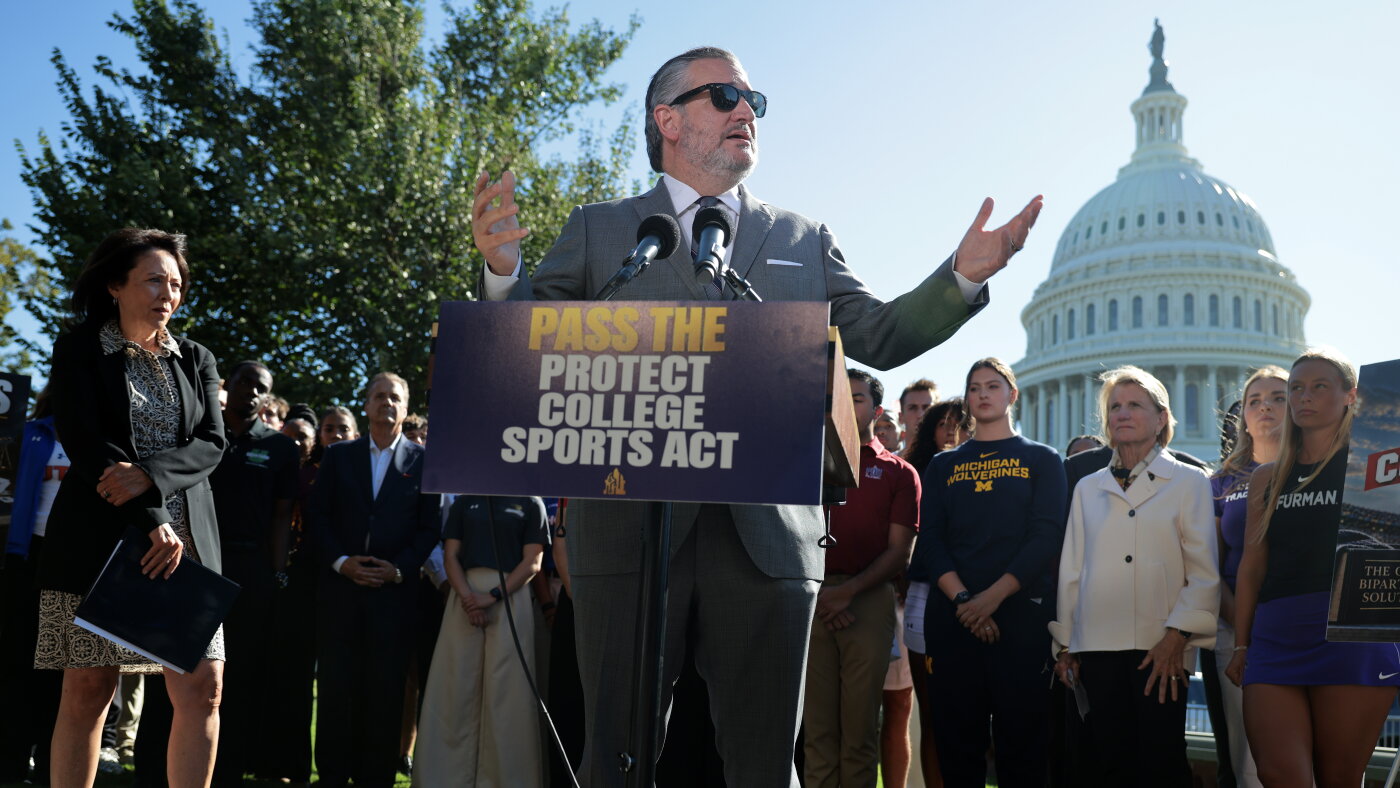
Negotiations led by Sens. Ted Cruz, R-Texas, and Maria Cantwell, D-Wash., lasted for more than a year and picked up co-sponsors from both parties along the way.
asserted
Negotiations → lead → way
Television commercials featuring the likes of Alabama great Nick Saban have peppered college football broadcasts this month, and Cruz appeared on ESPN's College GameDay to promote the bill.
asserted
Cruz → feature → bill
The Protect College Sports Act is bipartisan legislation designed to bring order to the chaos," Cruz said at a news conference in mid-September.
asserted
Cruz → protect → September
The legislation now moves to the House, which is on recess until after the November midterm elections.
asserted
which → move → elections
Its chances of passing are unclear.
uncertain
chances → pass → passing
For roughly the past decade, a flood of litigation has chipped away at many long-standing rules governing college sports — from the tradition of amateurism to rules around transfers and who is eligible to compete at all.
asserted
who → chip → transfers
"We're not turning back the clock, and whether you loved or hated the old system, we shouldn't try.
asserted
we → turn → system
The problem is that college sports entered this new era without a stable framework to govern it," said Sen. Eric Schmitt, R-Mo., on the floor of the Senate on Monday before the vote.
asserted
Schmitt → enter → vote
Opponents of the bill — from labor groups to athletes organizations to the NAACP, along with the 22 senators who voted against it — say it unfairly places limits on athletes without allowing them an equal seat at the table alongside powerful institutions.
asserted
it → vote → institutions
"I think the better way to frame it is 'The Protect the NCAA Act,'" said Sam Ehrlich, an associate professor at Boise State University who tracks college sports litigation.
asserted
who → think → litigation
"It gives the NCAA significant institutional power to be able to continue to control college sports at the expense of athletes who have been able to push the NCAA on some of their illegal business practices over the years.
asserted
who → give → years
More than half a million athletes compete in college sports each academic year, across all of the NCAA's divisions.
asserted
athletes → compete → divisions
Most of those who earn money compete in revenue-generating sports, such as football and basketball, in Division I.
asserted
who → earn → I.
Only a small percentage of athletes earn six figures or more, most of them football and men's basketball players in the four "power" conferences: the SEC, Big Ten, ACC and Big 12.
asserted
most → earn → conferences
Athletic department budgets have ballooned over the years.
asserted
budgets → balloon → years
Compensation for coaches and administrators has grown exponentially.
asserted
Compensation → grow → coaches
On Sept. 15, Cantwell released a report citing major increases in costs from 2005 to 2023: "322% in recruiting costs, nearly 300% in sports equipment, around 250% in both medical and gameday expenses, and more than 200% in travel.
asserted
Cantwell → release → travel
Coaching salaries increased a whopping 370% over the same time period."
asserted
salaries → increase → period
Big-league athletic departments have increasingly added positions like general managers and in-house video production crews that were once the exclusive domain of professional teams.
asserted
that → add → teams
Yet critics of the bill say that the legislation does little to rein in runaway spending in any of those areas, even as it seeks to cap athlete compensation.
"That's what frustrates me — is we have a bill that's going to protect the wealth and the gravy train for a lot of folks but puts burdens on college athletes," said Sen. Cory Booker, who played tight end at Stanford University, speaking in an interview with NPR last week.
asserted
who → say → NPR
The New Jersey Democrat voted against the bill.
asserted
Democrat → vote → bill
Meanwhile, athletic programs that do not generate revenue — like most women's and Olympic sports programs — have felt a pinch.
asserted
that → generate → pinch
Schools have eliminated more than 100 women's and Olympic sports teams since 2023, Cantwell's report notes.
asserted
report → eliminate → 2023
Supporters of the bill say the legislation is needed to rein in spending before schools are forced to wind down even more such programs.
asserted
schools → say → programs
"In the strongest-possible terms, there's no reason why that needs to happen," said Dionne Koller, a University of Baltimore School of Law professor who co-chaired a recent bipartisan congressional commission on the state of the U.S. Olympic and Paralympic movements.
asserted
who → be → movements
"There's lots of other ways we could address the financial piece without saying that necessarily we would have to cut Olympic, Paralympic — which is a small number of college programs, but growing — and women's sports."
uncertain
which → be → programs
The bill's supporters point to provisions around women's and Olympic sports that require schools to maintain scholarships and roster spots for such programs.
asserted
schools → point → programs
But those provisions expire after nine years for large schools and after four years for midsize schools, and exemptions could be made for schools with falling athletics revenues or other "demonstrable financial hardship."
uncertain
exemptions → expire → revenues
The Senate bill tackles a variety of other issues, including a 5% cap on compensation for agents handling athlete name, image and likeness (NIL) deals and a provision that would allow conferences to pool their media rights.
asserted
conferences → tackle → rights
It sets out health and safety guidelines for schools to implement.
asserted
schools → set → guidelines
It would cap conference membership at 20 schools — a provision seen as an attempt to keep the formation of any "super leagues" at bay.
asserted
It → cap → bay
A rule to disincentivize conference realignment could prove an obstacle as the legislation moves to the House.
uncertain
legislation → disincentivize → House
As passed, the Senate bill would require any school jumping from one power conference to another to first compete as an independent for three academic years, which would likely represent a major financial penalty.
asserted
which → pass → penalty
One of Florida's senators, Rick Scott, who represents schools like Florida State University and the University of Miami, preferred to keep their conference alignment options as open as possible, voted no on the bill.
asserted
who → represent → bill
Similar opposition could materialize in the House, from Florida to the Carolinas to California.
uncertain
opposition → materialize → California
 The Aporia