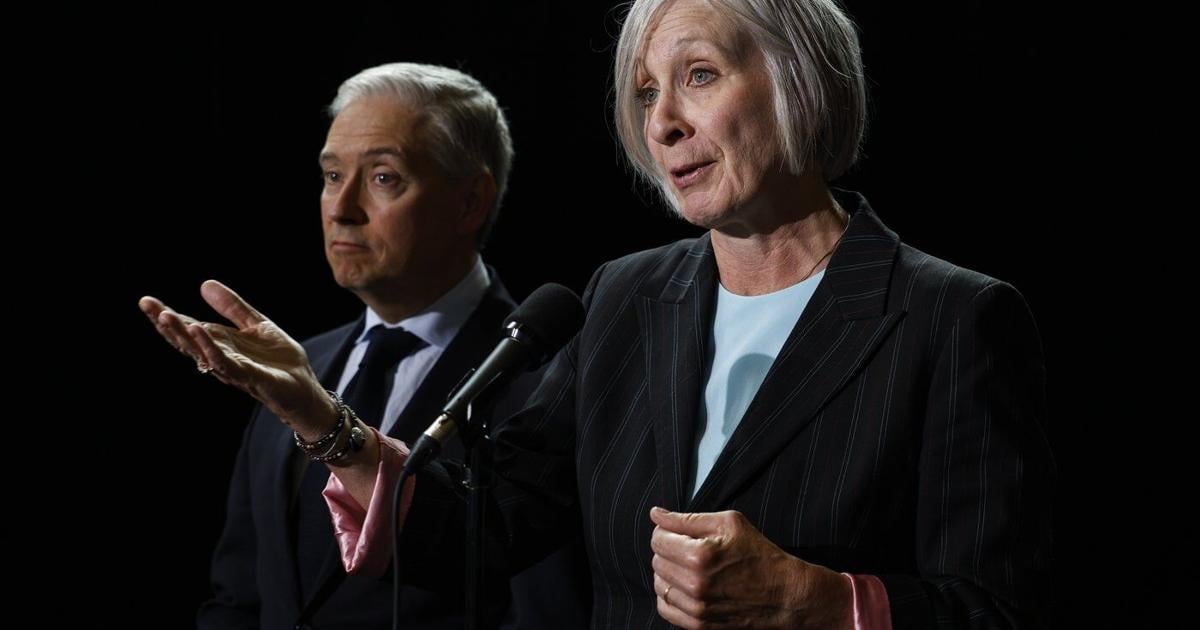
Photo via The Globe and Mail

Bill C-39 impedes right to strike, unions say

Read the original at The Globe and Mail ↗
Cite

Bill C-39 impedes right to strike, unions say. (2026, September 22). The Globe and Mail. https://www.theglobeandmail.com/canada/video-bill-c-39-impedes-right-to-strike-unions-say/

Dated when The Aporia collected the article, usually within hours of publication. Check the original for its exact date and byline.

The Globe and Mail · collected 2026-09-22

Quick Summary

Bea Bruske, president of the Canadian Labour Congress, claims that the Liberal government's proposed Bill C-39 will restrict workers' rights to strike. In response, Jobs Minister Patty Hajdu stated that the bill aims to promote negotiation between unions and employers rather than encouraging strikes. The article presents opposing views without additional analysis or data.
Written by AI on 2026-09-22, from this article's own text only (the story summary below draws on all the coverage).
See how they differ ↓

AI analysis

Story summary

Patty Hajdu, Canada’s Jobs Minister, stated that the federal government will not interfere with workers’ right to strike despite considering legal changes to improve labour relations. The minister emphasized that upcoming legislation aims to reduce the number of times the government has to intervene in strikes under Section 107 of the Canada Labour Code. This section allows Ottawa to refer disputes to the Canada Industrial Relations Board, a measure employers and unions have differing views on. While most employers advocate for greater federal power to intervene during labour disruptions that could harm national interests, unions argue against any measures that might compromise their right to strike. Hajdu added that government intervention is a last resort and encouraged parties to resolve issues themselves at the negotiating table. The proposed amendments include introducing a special mediator role who will document arguments in acrimonious negotiations and publish reports identifying sticking points.

Written for “Canada Labour Law Changes” on 2026-11-18, grounded in this article and the 23 other(s) covering the same event.

How they differ

5 outlets covered “Canada Labour Law Changes”.

What each outlet says

One AI summary per outlet of its latest article on this story, written from that article alone and checked against it. Open the article for the outlet's own words.

The Globe and MailThis outlet22 Sep

Bea Bruske, president of the Canadian Labour Congress, claims that the Liberal government's proposed Bill C-39 will restrict workers' rights to strike. In response, Jobs Minister Patty Hajdu stated that the bill aims to promote negotiation between unions and employers rather than encouraging strikes. The article presents opposing views without additional analysis or data.

Bill C-39 impedes right to strike, unions say (this article)4 articles from The Globe and Mail on this story

Toronto Star27 Sep

Prime Minister Mark Carney’s government has introduced Bill C-39, which includes changes to Section 107 of Canada’s labour code, allowing the minister to end strikes or lockouts without parliamentary approval. This move faces significant opposition from unions and legal challenges, putting Conservative leader Pierre Poilievre in a difficult position as he tries to balance his party's pro-labour stance with its…

Carney government's energy and labour bill puts Conservative leader in a 'pickle' →12 articles from Toronto Star on this story
Global News23 Sep

Jobs Minister Patty Hajdu states that proposed changes to the Canada Labour Code will increase transparency in collective bargaining processes, aiming to reduce the need for government intervention by identifying and publishing negotiation sticking points before disputes escalate. The legislation includes a new mediator role who will file public reports during contentious negotiations. Despite support for increased…

Labour law changes are the ‘sunlight’ collective bargaining needs: minister →4 articles from Global News on this story
CBC28 Sep

Ottawa has introduced the Building Canada Strong Act, which aims to accelerate major project approvals. Prime Minister Mark Carney claims this is one of the most significant economic measures in a generation, targeting threats to Canada's economy from U.S. President Donald Trump. However, environmental experts like Gretchen Fitzgerald from Sierra Club Canada Foundation warn that the bill may undermine protections…

Speed over species? What experts are saying about Ottawa's new major projects bill →2 articles from CBC on this story
National Post28 Sep

Jamie Sarkonak critiques Mark Carney’s proposed revamp of Canada's federal infrastructure approvals process, outlined in Bill C-39. The bill aims to simplify and expedite project approval by consolidating multiple assessments into one year under the guise of “One project, one decision, one year.” However, Sarkonak argues that this streamlined approach may be more aspirational than practical due to potential…

Jamie Sarkonak: Mark Carney’s ‘one project, one year’ mirage →2 articles from National Post on this story

Where they agree and split

Framing

How the first headlines put it

Attributed to a source3
The headlines (3)

Ottawa will not interfere with workers’ right to strike, Hajdu says The Globe and Mail · attributed to a source

Liberals looking to give minister explicit authority to end strikes: sources CBC · attributed to a source

Bill will help reduce government interventions during strikes: Hajdu Toronto Star · attributed to a source

Words to watch (1)

Minister touts transparency measures in labour bill The Globe and Mail

The full story: what happened, how it changed, and all 24 articles →

Compared with similar articles

This article reads unscored and hedges 0% of its claims. Each row says how that neighbour differs.
Global News
Leans left Hedges 1 of 6 claims Outlet record 63/100
Toronto Star
Leans right Hedges 0 of 5 claims Outlet record 64/100
CBC News
Leans left Hedges 1 of 21 claims Outlet record 72/100
“The articles discuss related policy developments but describe different stages or perspectives of an ongoing legislative process, not the exact same incident.”
Toronto Star
Hedges 0 of 7 claims Outlet record 64/100
“While both articles discuss proposed labour reforms, Article A describes Hajdu's announcement about reducing government interventions in strikes, while Article B focuses on union reactions to a specific bill (Bill C-39) that has been introduced.”
Toronto Star
Centre Hedges 1 of 7 claims Outlet record 64/100
“Article A describes the expected unveiling of new labour-related legislation, while Article B reports reactions after its introduction under Bill C-39.”
Toronto Star
Leans right Hedges 2 of 18 claims Outlet record 64/100
“While both articles discuss the proposed labour legislation, Article A focuses on Hajdu's comments about when Ottawa would end strikes under the new law, while Article B highlights unions' concerns and Hajdu's broader statement on the purpose of the legislation.”
CBC News
Hedges 3 of 28 claims Outlet record 72/100
“The articles discuss different perspectives and interpretations of Bill C-39 and its impact on labour rights, but they are not describing the same specific incident or happening.”
CBC News
Leans left Hedges 3 of 32 claims Outlet record 72/100
“The articles discuss different perspectives on Bill C-39 but describe distinct statements and reactions occurring at separate times.”
The Globe and Mail
Hedges 2 of 42 claims Outlet record 51/100
“Article A discusses upcoming legislation without details, while Article B refers specifically to Bill C-39 and reactions to it.”
The Globe and Mail
Leans left Hedges 1 of 21 claims Outlet record 51/100
“While both articles discuss the federal government's stance on workers' right to strike, Article A focuses on Minister Hajdu's statement that Ottawa will not interfere with striking rights, while Article B reports unions' concerns about Bill C-39 impeding those rights.”

Story

Canada Labour Law Changes
Politics · 24 article(s) covering the same event. Compare every outlet's account →
How this article was measured signals, leaning charts, publisher record, byline, topics and claims

Signals How these are calculated →

Claims extracted
2
sentences that state something as happening or true
Uncertain
0%
0 of 2 hedged ("reportedly", "may", "according to")
Leaning
withheld
no quote in the article backed the model's score
Publisher signals
51/100
The Globe and Mail's corrections and hedging, across everything collected from it. Not a measure of accuracy.
Outlets on this story
24
Politics
Same framing elsewhere
1
articles that frame the event the way this one does
Analyzed 2026-09-22 · how these are computed

How this is being covered How these are calculated →

Article leaning vs. publisher reliability
Source leaning vs. consistency

Publisher

The Globe and Mail · 1259 article(s) · 48 correction(s) detected
Running correction rate · 48 correction(s)

Who wrote this

No reporter is named on this article.

Topics

Bill C-39 would Jobs Liberal The Canadian Press the Canadian Labour Congress

Subjects

Bea Bruske PERSON · 1× Jobs PERSON · 1× Liberal NORP · 1× Patty Hajdu PERSON · 1× The Canadian Press ORG · 1× the Canadian Labour Congress ORG · 1×

Narrative

Bea Bruske, president of the Canadian Labour Congress, said the Liberal government’s proposed Bill C-39 would roll back the right to strike.
framing: assertive · carried by 1 article(s) · first seen 2026-09-22
Bea Bruske, president of the Canadian Labour Congress, said the Liberal government’s proposed Bill C-39 would roll back the right to strike.
2026-09-22 · The Globe and Mail
Bill C-39 impedes right to strike, unions say · assertive framing

Claims (2 extracted, 0 hedged)

Bea Bruske, president of the Canadian Labour Congress, said the Liberal government’s proposed Bill C-39 would roll back the right to strike. asserted
Bruske → say → right
Jobs Minister Patty Hajdu said the legislation is meant to encourage unions and employers to focus on getting a negotiated deal. asserted
legislation → say → deal
Give feedback · no sign-in needed

No sign-in needed for now. Your note is sent without a name, so it cannot be answered.

History Support