Liberals looking to give minister explicit authority to end strikes: sources

Read the original at CBC News ↗
CBC News · collected 2026-09-19 · by Kate McKenna

Quick Summary

The Liberal government is planning to amend the Canada Labour Code to give the minister explicit authority to end strikes and order arbitration, according to two senior government sources speaking to CBC News. This proposed change to Section 107 of the Labour Code aims to increase private sector confidence by ensuring Canada remains a secure place for investment, particularly in industries crucial for exports like ports and railways. The legislation, part of the upcoming Building Canada Strong Act, will also include provisions for trade corridors and faster federal project approvals. Unions have criticized past use of this section as heavy-handed and argue it undermines workers' rights.
Written locally by qwen2.5:14b on 2026-09-19, using this article's own text rather than the other coverage of the same event (that is the story summary below).

AI analysis runs on qwen2.5:14b, locally

Story summary

Patty Hajdu, Canada’s Jobs Minister, stated that the federal government will not interfere with workers’ right to strike despite considering legal changes to improve labour relations. The minister emphasized that upcoming legislation aims to reduce the number of times the government has to intervene in strikes under Section 107 of the Canada Labour Code. This section allows Ottawa to refer disputes to the Canada Industrial Relations Board, a measure employers and unions have differing views on. While most employers advocate for greater federal power to intervene during labour disruptions that could harm national interests, unions argue against any measures that might compromise their right to strike. Hajdu added that government intervention is a last resort and encouraged parties to resolve issues themselves at the negotiating table. The proposed amendments include introducing a special mediator role who will document arguments in acrimonious negotiations and publish reports identifying sticking points.

Written for “Canada Labour Law Changes” on 2026-10-05, grounded in this article and the 23 other(s) covering the same event.

Signals How these are calculated →

Claims extracted
21
claim-shaped sentences
Uncertain
5%
1 of 21 hedged
Leaning
Leans left
of the writing, not the subject · beta estimate
Correction & hedging signals
76.7
corrections and hedging in what we collected; not a measure of accuracy
Outlets on this story
24
Politics
Narrative spread
1
articles carrying this framing
Analyzed 2026-09-19 · how these are computed

Story

📰 Canada Labour Law Changes
Politics · 24 article(s) covering the same event. See how they differ ↓

How this is being covered How these are calculated →

Article leaning vs. publisher reliability
Source leaning vs. consistency

Compared with similar articles

This article reads leans left and hedges 5% of its claims. Each row says how that neighbour differs.
Toronto Star · 0.85 cosine similarity
⚖️ leaning not scored 🔴 0% hedged 0 of 7 📰 publisher trust 63
“While both articles discuss potential changes to the Canada Labour Code regarding strikes, Article A indicates sources stating that the government plans to explicitly allow ministerial authority to end strikes, while Article B quotes Minister Hajdu suggesting legislation will help reduce interventions during strikes.”
National Post
⚖️ Leans right further right than this 🔴 8% hedged 3 of 40 📰 publisher trust 60
“The articles discuss different aspects related to economic conditions in Canada but do not describe the same specific incident or occurrence.”
Toronto Star
⚖️ Leans left 🔴 5% hedged 1 of 20 📰 publisher trust 63
“The articles describe different political actions by opposing parties regarding labor laws, not a single specific incident.”
Daily Mail
⚖️ leaning not scored 🔴 4% hedged 1 of 25 📰 publisher trust 65
“The articles describe different legislative initiatives by political parties related to workers' rights and strikes, not a single specific incident.”
Toronto Star
⚖️ leaning not scored 🔴 5% hedged 1 of 21 📰 publisher trust 63
“Article A discusses a union's plan to hold a strike vote, while Article B talks about potential government legislation to end strikes. These describe different actions related to labor disputes but do not refer to the same specific event.”
The Globe and Mail
⚖️ leaning not scored 🔴 5% hedged 2 of 42 📰 publisher trust 51
“Article A discusses plans to give explicit authority to end strikes, while Article B focuses on reducing strike interventions and does not mention giving new powers.”
Global News
⚖️ leaning not scored 🔴 12% hedged 4 of 32 📰 publisher trust 64
“Both articles discuss the Liberal government's plan to amend Section 107 of the Canada Labour Code to give ministers explicit authority to end strikes and order arbitration, indicating they are reporting on the same specific event.”
Toronto Star
⚖️ Leans right further right than this 🔴 11% hedged 4 of 37 📰 publisher trust 63
“Article A discusses a specific amendment to Section 107 of the Labour Code regarding ministerial authority over strikes, while Article B mentions broader changes in the Building Canada Strong Act that include but are not limited to labour code amendments. They describe different phases or aspects of related legislative activities rather than the same event.”
Toronto Star
⚖️ Leans right further right than this 🔴 0% hedged 0 of 5 📰 publisher trust 63
“Article A discusses sources reporting on expected government plans, while Article B provides a statement from FETCO regarding the actual legislation introduced (Bill C-39). They describe different stages of the same general topic but not the same specific event.”
Toronto Star
⚖️ Leans left 🔴 0% hedged 0 of 40 📰 publisher trust 63
“Both articles discuss the introduction of new legislation by the Liberal government aimed at strengthening Section 107 of the Labour Code to give more power to the minister to end strikes through binding arbitration.”

Publisher

CBC News · 935 article(s) · 4 correction(s) detected
Running correction rate · 4 correction(s)
2026-09-28
Alleged drug trafficker denied bail again in Toronto police corruption case
2026-09-19
She pressed charges against a Mountie for sex assault, but says court delays robbed her of justice
2026-09-17
Toronto cop charged in Project South allegedly didn't care if selling information harmed people
2026-09-15
Edmonton mayor calls for province to address release protocols after detainees dropped off in Chinatown

Who wrote this

Kate McKenna
5 article(s) here · 1 carrying a prediction
🔮 Liberal MP says he was demoted for supporting NDP bill targeting arms export controls P.E.I. MP says he was warned that move would mean losing parliamentary secretary role Charlottetown MP Sean Casey says he was removed from his position as parliamentary secretary to the minister of veterans affairs because he supported an NDP private member's bill that targeted arms exports to Israel. In March, Casey said he was warned by the Liberal whip that if he supported NDP MP Jenny Kwan's Bill C-233, known as the No More Loopholes Act, then he would be relieved of his duties.
🔮 Government criticized in past for using existing Labour Code authority to force arbitration The Liberal government's marquee fall legislation is expected to strengthen a controversial section of the Labour Code, two senior government sources tell CBC News.
🔮 It remains unclear whether LeBlanc will meet again with his counterpart, U.S. Trade Representative Jamieson Greer.
🔮 Senior government official says LeBlanc will meet with U.S. senators, industry leaders Canada-U.S. Trade Minister Dominic LeBlanc is back in Washington, D.C., for another slate of meetings as the latest U.S. tariff threat is just over two weeks away.
Also by Kate McKenna
Nothing else under this byline is closely related to this article, so these are simply their most recent.

Topics

Canada Labour Code Liberal Liberals Section 107

Subjects

Liberals NORP · 4× Canada GPE · 3× Carney PERSON · 3× Hajdu PERSON · 3× CBC News ORG · 2× CIRB ORG · 2× Liberal NORP · 2× Government House ORG · 1× Steve MacKinnon PERSON · 1× the Canada Industrial Labour Relations Board ORG · 1×

Narrative

The section of the law, which has been on the books since 1984, was rarely used until recently, when the Liberals under Prime Minister Justin Trudeau used it to end disputes including between the Teamsters union and Canada's two largest railway companies, as well as other instances, including sending employees back to work at ports in Montreal and Vancouver.
framing: assertive · carried by 1 article(s) · first seen 2026-09-19
🔮 Government criticized in past for using existing Labour Code authority to force arbitration The Liberal government's marquee fall legislation is expected to strengthen a controversial section of the Labour Code, two senior government sources tell CBC News.

Claims (21 extracted, 1 hedged)

Liberals looking to give minister explicit authority to end strikes: sources asserted
Liberals → look → strikes
Government criticized in past for using existing Labour Code authority to force arbitration The Liberal government's marquee fall legislation is expected to strengthen a controversial section of the Labour Code, two senior government sources tell CBC News. asserted
sources → criticize → News
The Carney government plans to amend the Canada Labour Code to explicitly allow the minister responsible to direct the Canada Industrial Labour Relations Board (CIRB) to end work stoppages and order arbitration. asserted
minister → plan → arbitration
Changes to Section 107 of the Labour Code are expected to be part of the Carney government's bill, set to be called the Building Canada Strong Act and tabled next week. asserted
Changes → expect → bill
"We will have very significant economic legislation as a centrepiece of this session," said Government House leader Steve MacKinnon on Friday ahead of a two-day Liberal caucus retreat. asserted
MacKinnon → have → retreat
The changes to Section 107 will codify a power the government already has and uses: the ability to end a strike and take over arbitration of a labour dispute by directing it to the CIRB. asserted
government → codify → CIRB
However, sources say writing it into law could increase private sector confidence, as Ottawa seeks to reassure that Canada is a safe place to invest. uncertain
Canada → say → confidence
The sources say the focus is on "high-potential disruptive labour issues" in industries that have serious implications for Canada's exports, like ports and railways. asserted
that → say → ports
Two senior government sources shared some details of the legislation, expected to include sections on trade corridors, collective bargaining and proposals to speed up federal project approvals. asserted
sources → share → approvals
CBC News is not naming the sources because they were not authorized to speak publicly. asserted
they → name → sources
The section of the law, which has been on the books since 1984, was rarely used until recently, when the Liberals under Prime Minister Justin Trudeau used it to end disputes including between the Teamsters union and Canada's two largest railway companies, as well as other instances, including sending employees back to work at ports in Montreal and Vancouver. asserted
Liberals → use → Montreal
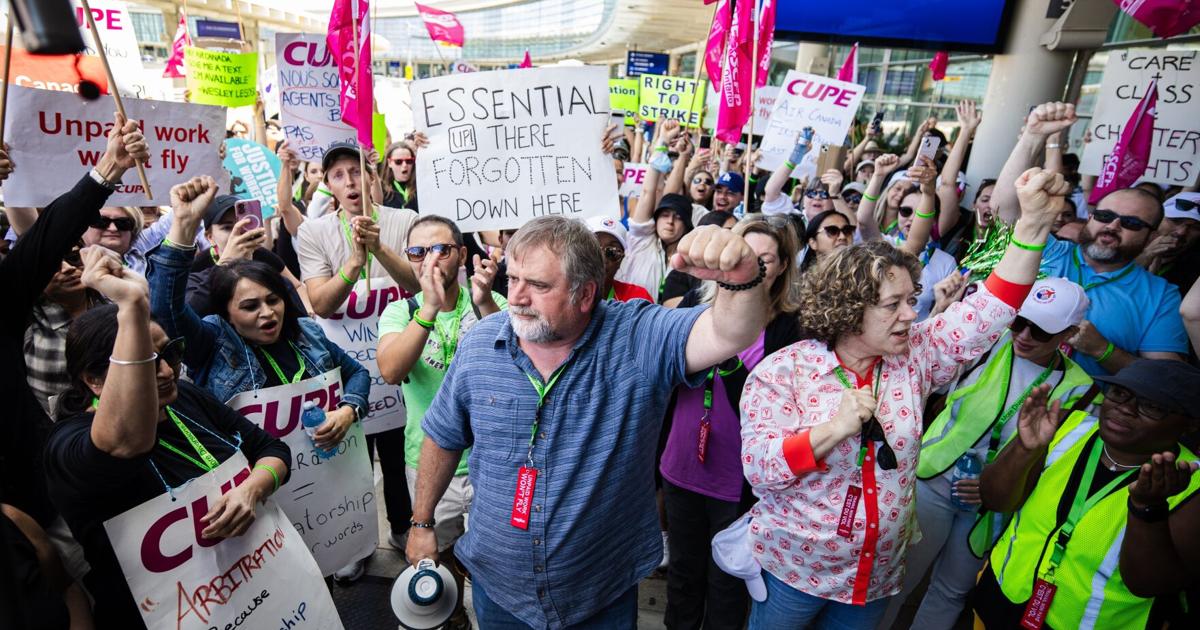
Jobs and Families Minister Patty Hajdu invoked Section 107 to force Air Canada flight attendants back to work after they walked out in August 2025. asserted
they → invoke → August
The federal Liberals have increasingly used the once-obscure section of the legislation to force picketing workers back on the job. asserted
Liberals → use → job
Unions warn Carney government considering sweeping changes to labour law Heavy-handed use of Labour Code painted Liberals in a corner: unions However, unions contend that this heavy-handed use of the law undermines their ability to bargain and violates workers' rights. asserted
use → warn → rights
The move has been challenged in Federal Court. asserted
move → challenge → Court
The new measures will also empower the labour minister to appoint a "special mediator" who will issue a report in instances where unions in federally regulated industries can't come to an agreement with the employer. asserted
unions → empower → employer
The sources said that the use of Section 107 will be a "last resort" following reports from the special mediator. But any move to strengthen the section of the Labour Code is likely to upset unions. asserted
move → say → unions
Speaking to CBC's Power and Politics on Friday, Hajdu said the coming legislation won't contain anything to limit the ability of unions to strike and will focus on a fraction of cases that lead to a "labour disruption." asserted
that → speak → disruption
"But there are some relationships between employers and unions that have become increasingly fractious, and the tools in the Canada Labour Code just aren't strong enough to actually help people get to those agreements together without a high degree of risk around labour disruption asserted
people → be → disruption
," Hajdu said. asserted
Hajdu → say → ?
Still, Hajdu said the Labour Code's tools to mediate disputes need to be modern, robust and include the ability to "put the pressure where it belongs, which is at the table between the parties." asserted
which → say → parties

💬Give feedback
🕘History 🎫Support