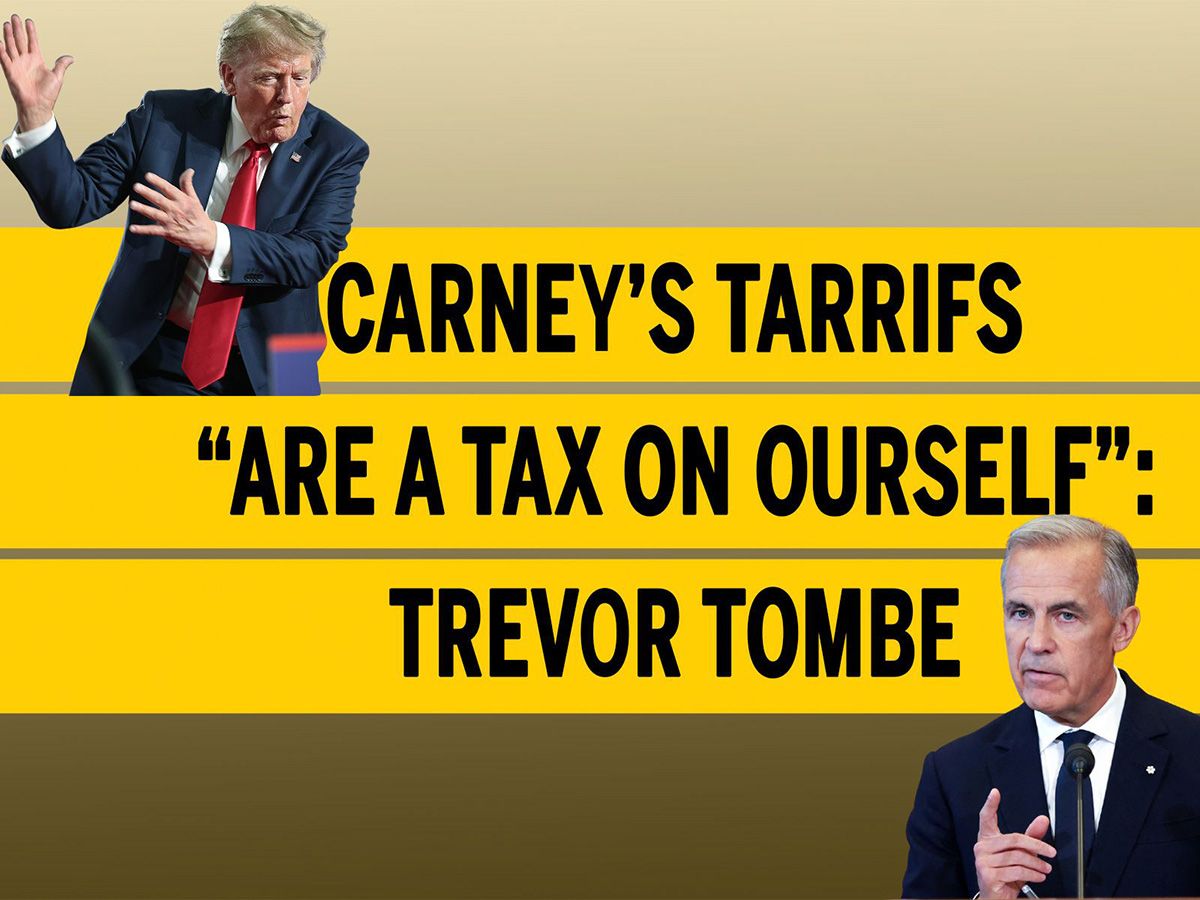
Carney’s retaliatory tariffs ‘are very much a tax on ourself’: Trevor Tombe

Read the original at National Post ↗
Cite

Jerema, C. (2026, August 26). Carney’s retaliatory tariffs ‘are very much a tax on ourself’: Trevor Tombe. National Post. https://nationalpost.com/opinion/carneys-retaliatory-tariffs-are-very-much-a-tax-on-ourself-trevor-tombe

Dated when The Aporia collected the article, usually within hours of publication. Check the original for its exact date and byline.

National Post · collected 2026-08-26 · by Carson Jerema

Quick Summary

Economist Trevor Tombe argues in an opinion piece that Canadian retaliatory tariffs against US trade restrictions are effectively a self-imposed tax on Canadians, with both consumers and businesses bearing the cost of Ottawa's response. The US has already imposed higher tariffs on Canadian goods, which came into effect recently, while Canada's retaliatory tariffs are set to take effect on September 8. Tombe does not provide specific numbers on the expected economic impact of these tariffs, but suggests that a more effective approach for Canada might be tax reform aimed at boosting competitiveness and productivity. The article appears to be an analysis piece rather than a straightforward news report.
Written locally by qwen2.5:14b on 2026-08-26, using this article's own text rather than the other coverage of the same event (that is the story summary below).

AI analysis runs on qwen2.5:14b, locally

Story summary

Here's a summary of the news story:

Naheed Nenshi, the leader of the Alberta NDP, has urged Premier Danielle Smith to cancel or postpone the upcoming referendum on separating from Canada due to the ongoing trade war with the US. The referendum is scheduled for October 19 and will ask voters whether they want to start the process of holding a future binding vote on separation.

Nenshi's demand was met with skepticism by some, who noted that he had previously opposed the idea of a separation referendum. Premier Smith rejected Nenshi's request, saying that the trade war was an opportunity for Alberta and Canada to stand together against the US.

Meanwhile, other provinces are also considering their stance on the trade war. Alberta and Saskatchewan have rejected suggestions that they impose export levies on natural resources such as oil and potash in retaliation for US tariffs, with Premier Smith saying that such a move would be "disastrous" and would harm not just Albertans but also other provinces.

The federal government has announced its plan to impose countertariffs on hundreds of US exports, including clothing and apparel, appliances, and dairy products. However, it has removed seafood and fish products from the list of counter-tariffs due to concerns about broader economic harms. The US has warned that further Canadian retaliation will not be tolerated.

The trade war is also being used as a rallying cry by some who are opposed to separation. A pro-unity group called Forever Canadian has seen an increase in support and interest in its patriotic lawn signs, with over 11,000 viewers attending an online town hall meeting last weekend.

Written for “Canada US Trade Dispute Escalation” on 2026-10-16, grounded in this article and the 53 other(s) covering the same event.

Story

📰 Canada US Trade Dispute Escalation
Politics · 54 article(s) covering the same event. Compare every outlet's account →

Compared with similar articles

This article reads centre and hedges 14% of its claims. Each row says how that neighbour differs.
Reason
⚖️ Leans strongly left further left than this 🔴 0% hedged 0 of 19 📰 publisher trust 94
“Both articles report on the imposition of US tariffs (Section 338) against Canadian imports, which has led to retaliatory measures by Canada.”
The Bulwark
⚖️ Leans left further left than this 🔴 17% hedged 1 of 6
“Both articles report on the collapse of trade talks between Canada and the US, citing new tariffs imposed by both sides”
CBC News
⚖️ Leans left further left than this 🔴 19% hedged 7 of 36 📰 publisher trust 77
“Both articles report on the announcement of retaliatory Canadian tariffs on $27.6 billion worth of U.S. goods, with a specific effective date and context”
August 25, 2026 same event · 100%
Letters from an American
⚖️ Leans left further left than this 🔴 4% hedged 2 of 50
“Both articles report on the imposition of US tariffs on Canadian goods and Canada's planned retaliatory tariffs, mentioning the same specific date (September 8) and similar products”
BBC News
⚖️ Leans left further left than this 🔴 10% hedged 3 of 29 📰 publisher trust 69
“Both articles describe Canada announcing retaliatory tariffs in response to US tariffs on Canadian goods, with identical details such as the date of effect and type of products targeted”
The Guardian
⚖️ Leans left further left than this 🔴 15% hedged 4 of 26 📰 publisher trust 68
“Both articles mention the trade war between US and Canada, specifically the introduction of retaliatory tariffs by Canada on September 8, which is described in similar terms”
Los Angeles Times
⚖️ Leans left further left than this 🔴 21% hedged 8 of 38 📰 publisher trust 95
“Both articles report on Canada's retaliatory tariffs against the US trade war, with matching dates and details about the escalation”
Al Jazeera
⚖️ leaning not scored 🔴 0% hedged 0 of 5 📰 publisher trust 60
“Both articles discuss the Canada-US trade dispute, including the retaliatory tariffs and Prime Minister Carney's stance, with matching dates (Aug 26-27) indicating they cover a single occurrence”
National Post
⚖️ Leans strongly right further right than this 🔴 10% hedged 3 of 31 📰 publisher trust 60
“Both articles mention the retaliatory tariffs on Sept. 8, indicating they are discussing the same impending trade dispute.”
The Globe and Mail
⚖️ Leans left further left than this 🔴 0% hedged 0 of 6 📰 publisher trust 52
“Both articles describe the Canadian government's response to new US tariffs and list the goods that will be subject to counter-tariffs, which suggests they are covering the same specific event.”
How this article was measured signals, leaning charts, publisher record, byline, topics and claims

Signals How these are calculated →

Claims extracted
7
sentences that state something as happening or true
Uncertain
14%
1 of 7 hedged ("reportedly", "may", "according to")
Leaning
Centre
of the writing, not the subject · beta estimate
Publisher signals
60/100
National Post's corrections and hedging, across everything collected from it. Not a measure of accuracy.
Outlets on this story
54
Politics
Same framing elsewhere
1
articles that frame the event the way this one does
Analyzed 2026-08-26 · how these are computed

How this is being covered How these are calculated →

Article leaning vs. publisher reliability
Source leaning vs. consistency

Publisher

National Post · 938 article(s) · 2 correction(s) detected
Running correction rate · 2 correction(s)

Who wrote this

Carson Jerema
48 article(s) here · 1 carrying a prediction
🔮 It’s a curious position for innovators who have made grand claims about their products’ potential and who could, presumably, simply drop their efforts if they believe the risks outweigh the benefits.
🔮 Monday night, Quebec may have created its own three-party problem.
🔮 Not that anyone would necessarily question Harper’s commitment to the country, but his entry into the debate was one federalists have been eagerly awaiting.
🔮 David Eby has looked at his election campaign struggling to find its feet and decided that while socialism is good, even more socialism would be better.
🔮 Looking at the polls, it is almost certain that Quebeckers will wake up on Tuesday to a Parti Québécois government.
🔮 This followed months of internal strife with several high-profile staff and MLAs either quitting or saying they wouldn’t run again.
🔮 The Coalition Avenir Québec was founded because a huge number of Quebecers wanted something neither the Parti Québécois nor the Quebec Liberals could give them.
🔮 Projected to rise to 5.4 per cent of GDP in 2026, the €43 billion ($68.7 billion) in proposed cuts for 2027 are designed to reduce the deficit to five per cent of GDP next year.
🔮 It would be difficult to disagree with that assessment.
🔮 We’ll also touch on Poilievre’s proposal for meaningful and lasting steps to address affordability, whether the Conservatives might support Bill C-39, and what they want to see and hear from the prime minister when it comes to the trade standoff with the U.S.
Also by Carson Jerema
Nothing else under this byline is closely related to this article, so these are simply their most recent.
All 48 articles by Carson Jerema →

Topics

Canada Canadian The National Post’s U.S. the University of Calgary

Subjects

Canada GPE · 3× Canadian NORP · 3× Ottawa GPE · 1× Rob Breakenridge PERSON · 1× The National Post’s ORG · 1× Tombe PERSON · 1× Trevor Tombe PERSON · 1× U.S. GPE · 1× the School of Public Policy ORG · 1× the University of Calgary ORG · 1×

Narrative

The National Post’s Rob Breakenridge speaks with Trevor Tombe, professor of economics at the University of Calgary and director of fiscal and economic policy at the School of Public Policy, about the economic consequences of this escalating trade war.
framing: assertive · carried by 1 article(s) · first seen 2026-08-26
🔮 The new, higher U.S. tariffs on Canadian goods have come into effect, and Canada has officially confirmed the retaliatory tariffs that will come into effect on Sept. 8.

Claims (7 extracted, 1 hedged)

Just when it seemed like a trade deal was close at hand, the Canada-U.S. trade relationship has taken a sharp turn for the worse. asserted
relationship → seem → worse
The new, higher U.S. tariffs on Canadian goods have come into effect, and Canada has officially confirmed the retaliatory tariffs that will come into effect on Sept. 8. asserted
that → come → Sept.
So what will all of this mean for the Canadian economy? asserted
all → mean → economy
And is our retaliation worth the cost that it will impose on our economy? asserted
it → impose → economy
The National Post’s Rob Breakenridge speaks with Trevor Tombe, professor of economics at the University of Calgary and director of fiscal and economic policy at the School of Public Policy, about the economic consequences of this escalating trade war. asserted
Breakenridge → speak → war
As Tombe outlines, tariffs are essentially a tax, meaning Canadian consumers and businesses will bear much of the cost of Ottawa’s retaliation. asserted
consumers → outline → retaliation
We’ll take a closer look at what the fallout from this trade war could look like, as well as the sort of tax reform the Carney government could deploy to mitigate the damage, while still boosting Canada’s competitiveness and productivity. uncertain
government → take → competitiveness
💬Give feedback
🕘History 🎫Support