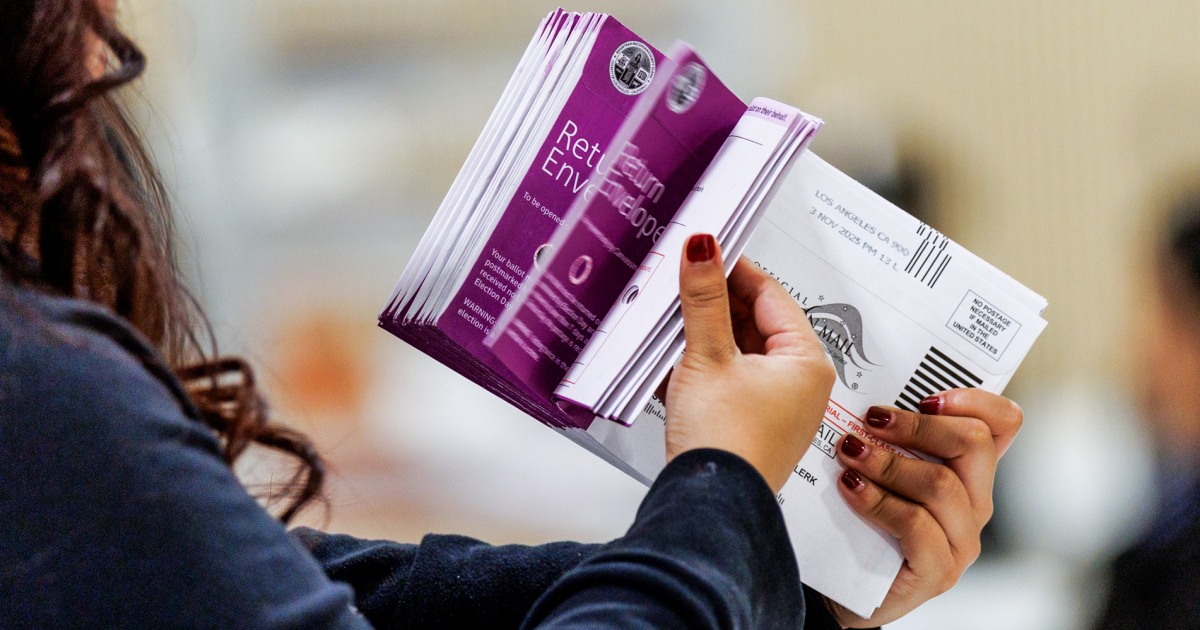
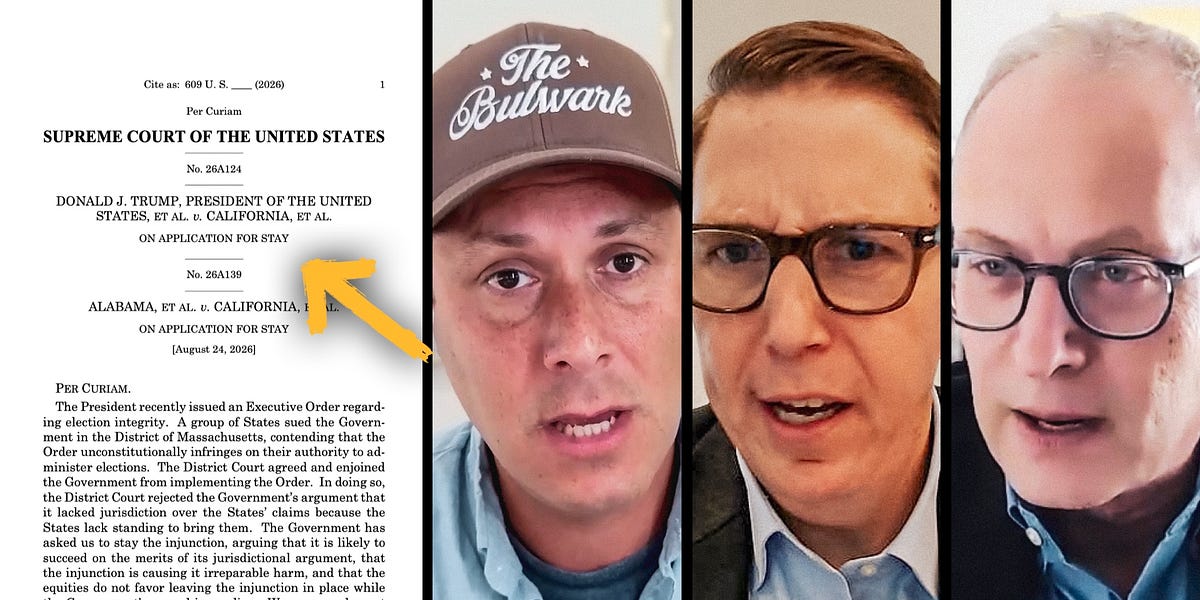
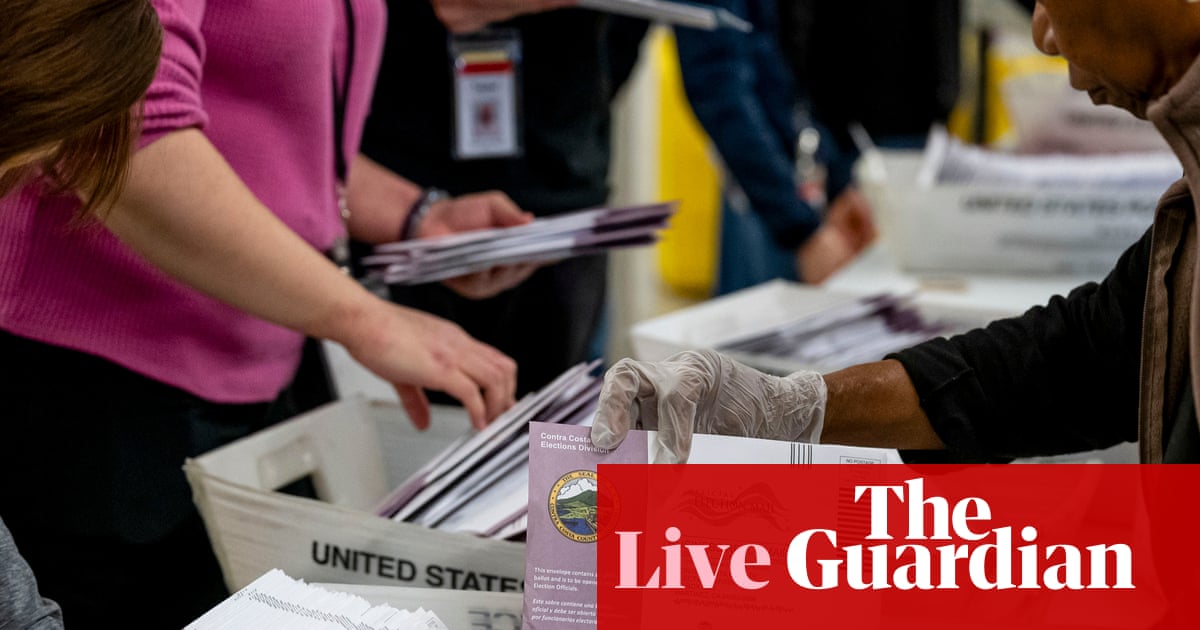
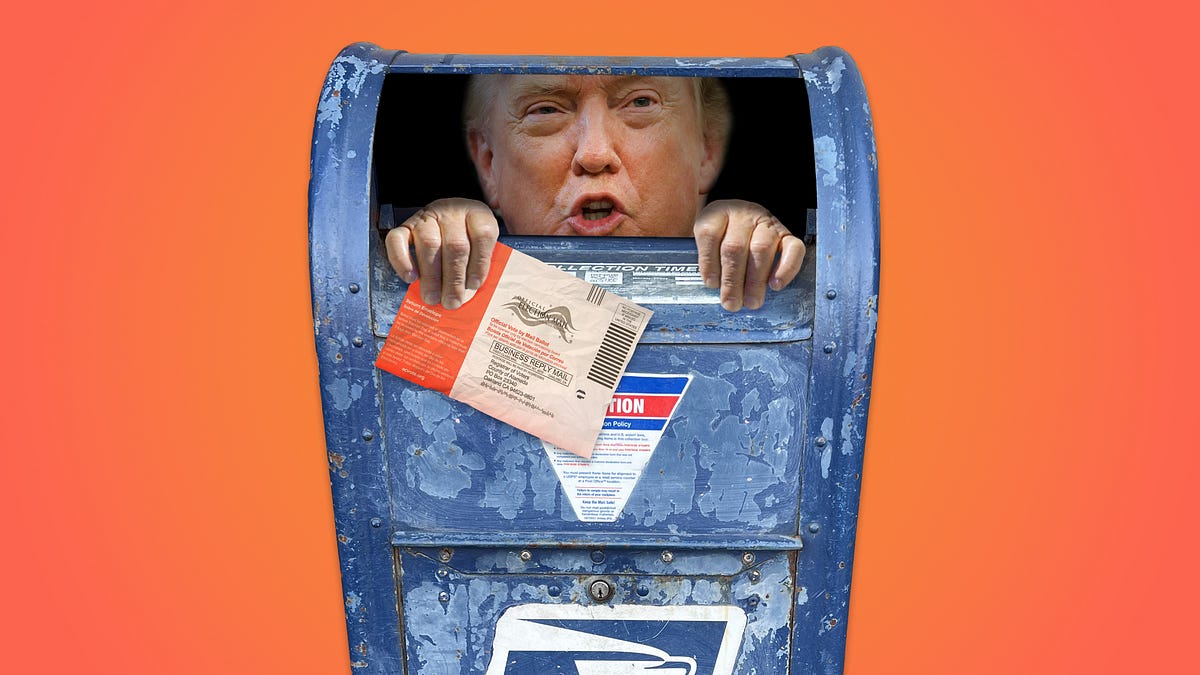
The Supreme Court on Monday temporarily handed President Trump a key victory in his crusade to restrict mail-in voting.
asserted
Court → hand → voting
The unsigned opinion by the court’s conservative majority, issued over dissents from the three Democratic appointees, said it was too soon for states to challenge Trump’s executive order from March 2026 severely restricting mail-in voting because they had not shown how they would be harmed by it.
asserted
they → issue → it
“This ruling violates well-established precedents concerning this Court’s equitable discretion and needlessly injects chaos and uncertainty into the upcoming midterm elections,” Justice Ketanji Brown Jackson wrote in dissent.
asserted
Jackson → violate → dissent
“It also lets another shoe drop in the Kafkaesque nightmare that our precedents have been steadily creating for certain plaintiffs who seek to bring election-related challenges.
asserted
who → let → challenges
The Court has held for a while now that even valid election-related legal claims can come too late.
uncertain
claims → hold → while
Today’s revelation is that such claims can also come too early—never mind that an election is looming and related harms
are presently occurring.
uncertain
election → come → ?
Never mind, too, that the Government (which controls the timing of proposed and final rules) can easily game the system.”
While not a ruling on the merits of the executive order, the Court’s decision still overrules a series of federal court rulings blocking that order, which represents an unprecedented attempt by the Trump administration to seize control of election administration from the states, based on Trump’s demands for Republicans to “nationalize the voting” and “take over” the voting system.
asserted
Republicans → mind → system
It instructs the Department of Homeland Security to create lists of voters it deems citizens in each state, essentially overriding state voter rolls, and directs the Postal Service to only deliver mail-in ballots to voters on those lists, leading to the possibility that a significant number of voters will not receive mail-in ballots if the lists are inaccurate.
asserted
lists → instruct → ballots
(Trump, despite his frequent tirades against the practice, voted by mail in Florida’s primary last month, the second time this year he has done so in Florida.)
asserted
he → vote → Florida
“The consequences of allowing such transformative changes to take effect so close to this fall’s elections would be extreme,” wrote the 23 states, led by California, that are challenging the executive order.
asserted
that → allow → order
“Because of the high risk of errors and the limited window for correcting mistakes, many of the millions of voters who rely on mail voting—especially voters with disabilities and those in rural areas—would likely be denied mail ballots and, as a result, disenfranchised.
asserted
who → correct → result
would be confused—either because they wouldn’t receive their mail ballots or would fear that USPS would fail to deliver their voted ballots to state officials for tabulation.
asserted
USPS → confuse → tabulation
The Postal Service subsequently issued a new rule on August 21 specifying that it will only deliver mail-in ballots if states hand over their voter rolls to DHS—a form of extortion that has generated furious pushback from election officials.
asserted
that → issue → officials
(The Department of Justice has sued 30 states to get access to their voter rolls and is 0-23 in federal court so far.)
asserted
Department → sue → court
The executive order also specifies that election officials could be criminally prosecuted if they don’t comply with the administration’s demands.
uncertain
they → specify → demands
“The EO directs unprecedented levels of involvement by federal officials in how states administer elections,” a majority of judges on the First Circuit Court of Appeals ruled last month.
asserted
majority → direct → Appeals
“Regardless of the details of how federal officials implement the EO, at its core, the EO contemplates that states will have to coordinate with DHS and USPS to ensure that various lists, whether maintained by the agencies or the states, reflect current mail-voter information (which can change daily up until Election Day), or else risk disenfranchisement for certain voters and penalties for states and their officials.
asserted
which → implement → states
As the Supreme Court considered the case for weeks, a federal district court issued a nationwide injunction on August 11 against the executive order, halting the Postal Service from taking any steps to implement it.
asserted
court → consider → it
That injunction remains in effect despite the Supreme Court’s order on Monday.
asserted
injunction → remain → Monday
Voting rights groups argued in court over the weekend that the Postal Service’s decision in late August to finalize the rule specifying that mail-in ballots can only be delivered in states that hand over their voter rolls to the administration violated that injunction.
asserted
that → argue → injunction
“By issuing this final rule, the Trump administration has flouted the court’s injunction,” those voting rights groups, including the ACLU and League of Women Voters, said in a statement.
asserted
groups → issue → statement
“The final rule threatens further chaos for voters, civic organizations, and election officials by seeking to impose last-minute changes to mail voting rules.
asserted
rule → threaten → rules
Enforcement of the court’s preliminary injunction is necessary to hold this administration accountable for its unlawful action and make clear that voters can confidently cast their mail ballot free from federal interference this November.”
asserted
cast → hold → interference
“The Court’s disposition of this application does not mean that any measure taken by the Government to implement the Order will necessarily be lawful,” the Court wrote.
asserted
Court → mean → Order
“On that score, time will tell.”
asserted
time → tell → score
States can renew their legal challenges to the executive order once DHS and USPS finalize their plans to implement it—and it may be too late to implement the order regardless, with the midterms roughly 70 days away.
uncertain
it → renew → midterms
However, the Court’s decision allowing the executive order to proceed “contributes to pre-election chaos instead of quashing it,” Justice Jackson wrote.
asserted
Jackson → allow → it
“To be sure, the Court has not foreclosed States from challenging this blatantly unconstitutional Order,” Jackson continued.
asserted
Jackson → foreclose → Order
“But it declines to explain when, exactly, is the right time to bring a meritorious election-rule claim challenging unconstitutional interference with electoral processes.
uncertain
time → decline → processes
The majority
just signals that these claimants had to wait—even though the election cycle had started and despite facing pocketbook costs, threats of prosecution, and an affront to their sovereignty—before receiving the relief to which they are likely entitled.
asserted
they → signal → which
Trump’s two executive orders restricting ballot access, in 2025 and 2026, were both blocked for violating the Constitution’s clear mandate that states, with oversight from Congress, have the authority to run their elections.
asserted
states → restrict → elections
“The Constitution does not grant the President any specific powers over elections, ” District Judge Indira Talwani, a Barack Obama appointee, wrote in June.
asserted
Talwani → grant → June
Talwani may soon issue a new injunction blocking the Postal Service’s new rule.
uncertain
Talwani → issue → rule
The Supreme Court’s decision nonetheless comes at a time when Trump is escalating his attempts to interfere in the midterm elections.
asserted
Trump → come → elections
Though his primetime speech on “election integrity” last month was widely regarded as a dud, the president’s false accusation that China interfered in the 2020 election has led to renewed fears that he could use fake claims of foreign interference as a basis to declare a national emergency so that he can attempt to seize control of the voting system.
uncertain
he → regard → system
And the Supreme Court has already green-lit a key part of Trump’s effort to tilt the midterms in the GOP’s favor by destroying the Voting Rights Act and approving the unprecedented mid-decade gerrymandering that has allowed Republicans to draw 10 more GOP-friendly seats in the race for the House of Representatives.
asserted
Republicans → light → Representatives
That has made it much harder for Democrats to retake the chamber despite Trump’s record-low approval ratings.
asserted
Democrats → make → ratings
On Monday, Justice Jackson perfectly summed up how the Court’s GOP-appointed majority has enabled Trump’s efforts to interfere in the midterms.
asserted
majority → sum → midterms
“Taking its eye off the ball, the majority misses the Government’s actual objective: to secure our imprimatur for its effort to foment chaos ahead of the November elections,” she wrote.
asserted
she → take → elections
 The Aporia