— The Sun Also Rises
Lots of people are worried about rising long-term interest rates.
asserted
Lots → rise → rates
Short-term interest rates are controlled by the central bank.
asserted
rates → control → bank
But the Fed doesn’t usually intervene in the market for longer-term bonds, so when these interest rates move around, it means the market is telling us something.
asserted
market → intervene → something
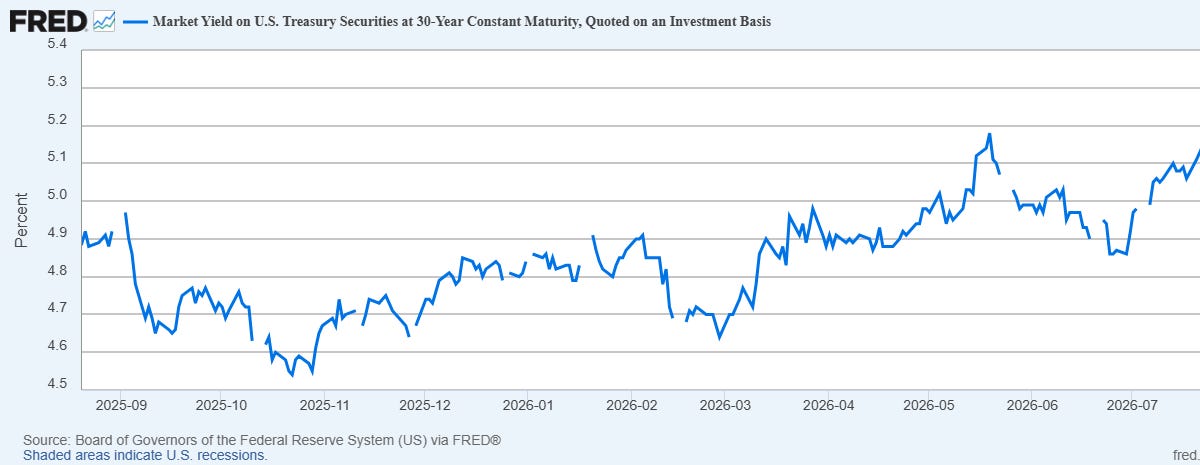
So a lot of people were worried when the yield on 30-year U.S. Treasury bonds jumped by 6 basis points (0.06%) the other day.
asserted
yield → worry → points
Well, remember that when interest rates go up, it means bond prices went down.
asserted
prices → remember → ?
Which means that fewer people wanted to buy U.S. government bonds.
asserted
people → mean → bonds
It could signal expectations of higher inflation.
uncertain
It → signal → inflation
When future money will be worth less, bond investors demand higher interest rates today.
asserted
investors → demand → rates
Higher inflation also means the Fed will probably raise interest rates.
asserted
Fed → mean → rates
It could signal a loss of confidence in the U.S. government.
uncertain
It → signal → government
If people think there’s a possibility that the U.S. won’t repay its debts, they will charge a higher risk premium to hold that debt.
asserted
they → think → debt
These doubting investors are sometimes called “bond vigilantes”.
asserted
investors → doubt → ?
Bond vigilantes could be scared by soaring U.S. debt levels and deficits, and/or by irresponsible geopolitical and economic policies from the Trump administration.
uncertain
vigilantes → scar → administration
Here’s John Cochrane on the specter of the bond vigilantes:
asserted
Cochrane → ’ → vigilantes
Unsustainable fiscal policies can only go on so long.
asserted
policies → go → ?
Eventually bond investors decide that the US will not in the end do the right thing after trying everything else, and default, expropriation, taxation, capital controls, or sharp inflation is on its way.
asserted
default → decide → way
They stop buying long-term bonds especially, and look to the comfort of short term bonds…
asserted
They → stop → bonds
The beginning of a global sovereign debt retrenchment would show up first in a feeling of limited demand…Investors, seeing trouble demand a larger risk premium for longer term debt…Moving to short maturity structures is a classic symptom of trouble ahead.
asserted
Moving → show → trouble
Among the people who were scared by the rise in interest rates, apparently, were the Trump administration.
asserted
administration → scar → rates
Higher long-term interest rates mean higher mortgage rates,1 which make American voters mad.
asserted
voters → mean → ?
They also make it harder for the U.S. government to finance its enormous deficits.
asserted
government → make → deficits
So Treasury Secretary Scott Bessent announced that the government was intervening in the bond market, with a program to buy long-term U.S. Treasury bonds.
asserted
government → announce → bonds
This pushed up bond prices — and pushed down interest rates — for exactly one day, but then the bond markets bounced right back:2
asserted
markets → push → day
US Treasuries fell a day after the Trump administration’s surprise decision to increase buybacks of longer-dated bonds…
asserted
Treasuries → fall → bonds
The 30-year yield on Thursday rose over seven basis points to as much as 5.27%, where it was just ahead of the US Treasury Department’s announcement early Wednesday.
asserted
it → rise → announcement
So are we watching the collapse of confidence in the U.S. government?
asserted
we → watch → government
The underlying trends of excessive borrowing and boneheaded policies do bear keeping an eye on, and collapses of investor confidence can happen fast once they begin.
asserted
they → underlie → confidence
But it’s unlikely that a true sovereign debt crisis has begun.
asserted
crisis → ’ → ?
One reason I’m not terrified by the rise in long-term rates is that it’s not actually that big of a rise!
asserted
it → terrify → rise
In stories about rising rates, you see a lot of charts about how it’s a global phenomenon:
asserted
it → rise → charts
This has interesting implications, but first, notice that except for Japan, most of the rise was actually in 2021-2023.
asserted
most → have → 2021
So whatever happened to make bond investors demand higher rates, most of it happened years ago.
asserted
most → happen → it
Here’s just the U.S., zoomed out to cover the last decade:
asserted
U.S. → ’ → decade
Long-term rates fell in 2019 and bottomed out during the pandemic, then in 2022 and 2023 they had a big sustained rise.
asserted
they → fall → rise
That could be the beginning of a catastrophic rise, and of course when you’re carrying as much debt as the U.S. government is, even a small increase in borrowing costs can be a headache if it’s sustained over a long period of time.
uncertain
it → carry → time
But I just can’t look at that little wiggle in 2026 and see evidence of a bond market collapse.
asserted
I → look → collapse
You should be very worried about the U.S. national debt, but this rise in rates should only make you a tiny bit more worried, if at all.
asserted
you → make → rates
 The Aporia