Can the U.S. Avoid a Dangerous Debt Spiral?

The Dispatch · collected 2026-08-28 · by Jessica Riedl
Read the original at The Dispatch ↗

Summary

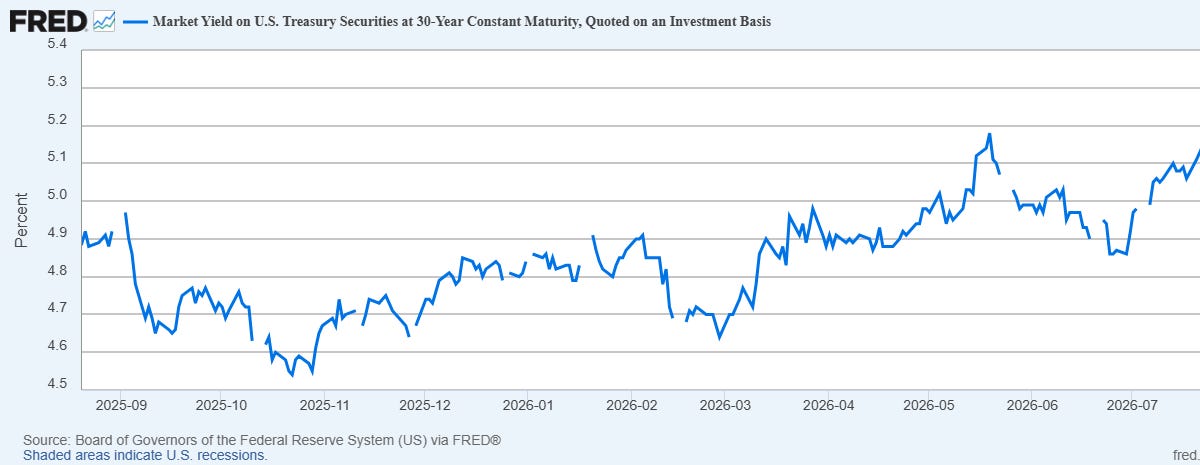
The U.S. government attempted to sell 30-year bonds and was met with reluctance from investors, resulting in a 5.2 percent interest rate, the highest in two decades. The Treasury Department's auction of these bonds sold for $22 billion. In response to investor unease, Washington announced bond buybacks worth billions of dollars to calm the market. This move suggests that instead of reducing its borrowing, the government is trying to mitigate investor concerns through other means.
Written by the local model on 2026-08-28, using this article's own text rather than the other coverage of the same event (that is the story summary below).

Signals How these are calculated →

Claims extracted
3
claim-shaped sentences
Uncertain
0%
0 of 3 hedged
Leaning
Leans right
of the writing, not the subject
Publisher trust
95.6
red-flag proxy, not a credibility rating
Outlets on this story
6
Politics
Narrative spread
1
articles carrying this framing
Analyzed 2026-08-28 · how these are computed

AI analysis (generated at analysis time, not now)

Story summary

The US national debt has surpassed $40 trillion, reaching $40.047 trillion on Tuesday afternoon, according to the Treasury Department, marking the highest level of debt in US history. It took nearly 200 years for America's gross debt to reach $1 trillion for the first time in 1981, said Maya MacGuineas, president of the Committee for a Responsible Federal Budget. The government deficit has doubled over the last decade, and $8.4 trillion of debt was added during Donald Trump's first term, while $4.3 trillion was added under Joe Biden's presidency. $1.8 trillion in new debt has been added since October 2025, with a significant portion going towards tariff refunds totaling $100 billion, according to the Bipartisan Policy Center. Experts warn that this high level of debt could lead to a loss of confidence in the US government and higher interest rates, potentially signaling expectations of higher inflation or even a global sovereign debt retrenchment.

Written for “US National Debt Crisis” on 2026-08-31, grounded in this article and the 5 other(s) covering the same event.
Why this leaning score
The article's own words the score was based on. Each is quoted verbatim and was checked against the article text before being stored, so you can find it in the original.
Score +0.35 Confidence high
Leaning score +0.35 for article 3022 (high confidence, 1 verified quote) · logged 2026-08-28

Story

📰 US National Debt Crisis
Politics · 6 article(s) covering the same event. This is the one the site leads with.

How this is being covered How these are calculated →

Article leaning vs. publisher reliability
Source leaning vs. consistency

Compared with similar articles

This article reads leans right and hedges 0% of its claims. Each row says how that neighbour differs.
Reason.com
⚖️ Leans right 🔴 17% hedged 2 of 12 📰 publisher trust 94
“Both articles discuss the recent issue with the US government selling 30-year bonds and the high interest rate offered, indicating they are reporting on the same specific event.”
New York Post
⚖️ leaning not scored 🔴 24% hedged 7 of 29 📰 publisher trust 95
“Article A mentions Bessent's plan to address investors, while Article B describes a recent bond auction with a higher interest rate than expected”
Noahpinion
⚖️ Leans strongly right further right than this 🔴 11% hedged 4 of 37
“Both articles mention the high interest rate offered on 30-year U.S. Treasury bonds and the reluctance of investors to lend, indicating they are reporting on the same occurrence.”
The Dispatch
⚖️ Leans right 🔴 0% hedged 0 of 15 📰 publisher trust 96
“Although both articles discuss the US national debt, Article A focuses on a general discussion of the $40 trillion debt threshold and potential solutions, while Article B specifically reports on a recent bond auction where investors were reluctant to lend at high interest rates.”

Publisher

The Dispatch · 35 article(s) · 0 correction(s) detected
SignalValueWeight
Correction rate 0.000 0.4
Uncertainty density 0.088 0.25
Assertive mismatch rate 0.000 0.35
No corrections detected for this publisher. That may mean careful reporting, or simply that nothing has been checked.

Who wrote this

Jessica Riedl
1 article(s) here · 0 carrying a prediction
The only article under this byline in the corpus.

Topics

Getty Images The Dispatch Treasury U.S. Washington

Subjects

Getty Images ORG · 1× Noah Hickey PERSON · 1× The Dispatch ORG · 1× Treasury ORG · 1× U.S. GPE · 1× Washington GPE · 1×

Narrative

Washington responded not by curbing its insatiable appetite for borrowing but by announcing a few billion dollars in bond buybacks to calm investors.
framing: assertive · carried by 1 article(s) · first seen 2026-08-28
2026-08-28 · The Dispatch
Can the U.S. Avoid a Dangerous Debt Spiral? · assertive framing

Claims (3 extracted, 0 hedged)

Recently, the U.S. government tried to borrow money by selling 30-year bonds and found investors reluctant to lend. asserted
investors → try → bonds
That reluctance forced the Treasury to offer a 5.2 percent interest rate to sell its bonds, the highest auction rate in two decades. asserted
reluctance → force → decades
Washington responded not by curbing its insatiable appetite for borrowing but by announcing a few billion dollars in bond buybacks to calm investors. asserted
Washington → respond → investors
💬 Give feedback
🕘 History 🎫 Support