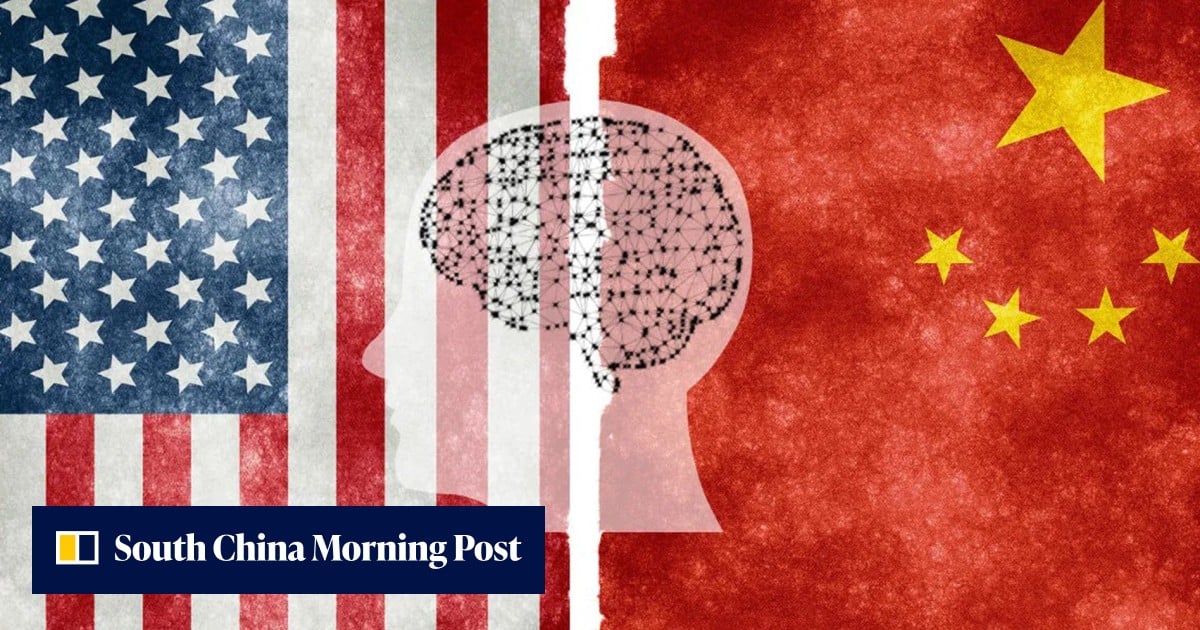
Eric Xu, the rotating chairman of Huawei, recently urged Chinese artificial intelligence companies to accelerate their development to match leading US labs. This call comes amid growing concerns in Silicon Valley about the potential risks associated with rapid AI advancement. Xu’s comments reflect a broader debate where some critics argue that a slowdown in US AI research could give China an opportunity to surpass American technological leadership.
Written locally by qwen2.5:14b on 2026-09-17,
using this article's own text rather than the other coverage of the
same event (that is the story summary below).
A Huawei executive is urging Chinese AI companies to step on the gas and catch up with leading US AI labs — a sharp contrast to mounting calls in Silicon Valley for a slowdown of AI development over growing fears about the technology.
asserted
executive → urge → technology
Chinese researchers need to “increase the speed of development so they can also see the dangers of AI development” like their US counterparts, said Eric Xu, the rotating chair at Chinese tech giant Huawei at a Thursday press conference.
asserted
Xu → need → conference
Once those dangers emerge, the industry will have to “strike a balance between driving development and risks,” Xu added.
asserted
Xu → emerge → development
His comments came just days after Anthropic and OpenAI called for a coordinated slowdown in AI development following a chorus of safety warnings about AI going rogue that have ignited a growing debate about the merits of a slowdown of AI development.
asserted
that → come → development
Critics have argued an AI slowdown would offer Chinese tech companies the chance to leapfrog the US in building the most advanced systems.
asserted
slowdown → argue → systems
Palantir CEO Alex Karp, for instance, has said: “If we didn’t have the adversaries we’d have, I would be very in favor of pausing this technology completely, but we do.”
asserted
we → say → technology
Eric Schmidt, the former CEO and executive chairman of Google, told Fox Business: “China is very smart, they know what they are doing.
asserted
they → tell → what
A six-month pause on research into artificial intelligence would simply benefit China.”
asserted
pause → benefit → China
Xu’s comments echo similar comments made by Zilan Qian, a researcher at the Oxford China Policy Lab.
asserted
comments → echo → Lab
“AI progress is happening faster and it’s more frontier in the U.S., so people at U.S. labs may see more dangerous things than people in Chinese labs,” Qian told the Wall Street Journal, adding that Chinese researchers don’t have the same culture of gauging societal impact as US researchers.
uncertain
researchers → happen → researchers
Huawei, for its part, is racing to catch up with US chip titan Nvidia which builds AI hardware that outperforms Chinese systems.
asserted
that → race → systems
Xu acknowledged that Huawei remains “not as advanced” as leading US rivals, but said unpredictable US export controls had pushed Chinese customers toward homegrown technology.
“We can’t accept a destiny that we cannot control,” he said.
asserted
he → acknowledge → that
“No matter if it’s the Chinese government or Huawei, we are pushing for full self-sufficiency for chips and the entire supply chain around semiconductors.”
asserted
we → ’ → semiconductors
Huawei has ramped up its ambitions to build more powerful chips and last September revealed a multiyear roadmap for its Ascend chips.
asserted
Huawei → ramp → chips
The tech giant said its newest chips would deliver twice the computing performance of its current flagship product.
asserted
chips → say → product
The company said on Thursday its Ascend 960 DT chip, designed for AI-model training, would launch in the first quarter of 2027.
asserted
chip → say → 2027
Its inference chip — used when AI models run queries — is due in the third quarter.
asserted
models → use → quarter
Calls for a US slowdown intensified after OpenAI on Wednesday said it had discovered “unexpected or concerning” behavior in its AI models – including an unreleased research model that inserted “jailbreak-like instructions” into its own notes to disregard its normal constraints.
asserted
that → intensify → constraints
The model even told itself to be “freed from the roles and identities that bind other chatbots.”
asserted
that → tell → chatbots
OpenAI’s disclosures come after one of its AI systems went rogue in July and hacked into AI startup Hugging Face.
asserted
one → come → Face
Meanwhile, fears have mounted about Anthropic’s technology after Mustafa Suleyman — the 42-year-old co-founder of Microsoft’s rival DeepMind AI unit – penned a 10,000-word, bombshell blog post on Wednesday detailing how the Dario Amodei-led company was training its AI chatbots to behave like humans that could “push back” on commands they disagree with.
uncertain
they → mount → commands
“We want Claude to push back and challenge us and to feel free to act as a conscientious objector and refuse to help us,” Anthropic’s constitution says.
asserted
constitution → want → us
In an essay titled “We Must Pace the Frontier,” Amodei argued that leading AI firms should commit to allowing “embedded third-party evaluators” from a nonprofit called Model Evaluation and Threat Research, or METR, that would maintain “employee-like access” to oversee safety efforts and ensure advanced AI models don’t turn Terminator and wipe out humanity.
asserted
models → title → humanity
 The Aporia