- Published
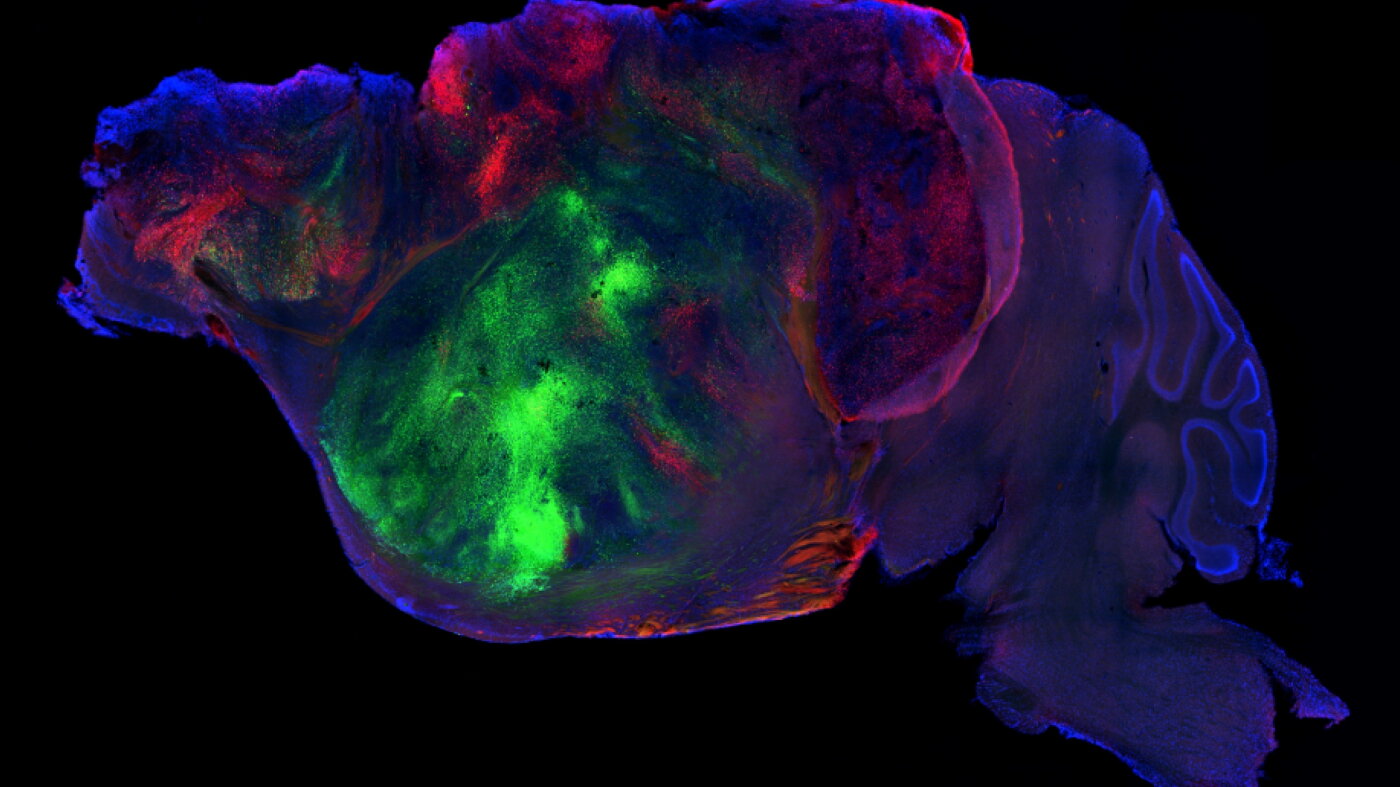
Neuroscientists in the US have successfully adapted mice to have functioning human cells inside their own brains.
asserted
Neuroscientists → publish → brains
The researchers hope that potential treatments for psychiatric and neurodevelopmental diseases that only occur in humans could now be tested on the laboratory rodents.
uncertain
that → hope → rodents
While mice with brains that are partly human might sound like a Kafkaesque experiment, the scientists said these are not "mice that think like humans".
uncertain
that → sound → humans
The animals are genetically engineered - and surgically altered - so that some of their brain tissue is human.
asserted
some → engineer → tissue
The scientists said their work, published in the journal Nature, external, was carried out with independent ethical scrutiny.
asserted
work → say → scrutiny
The aim of this ethically complicated breakthrough was to better understand the biology of brain disorders for which there are currently no effective treatments.
asserted
aim → understand → which
Some conditions cannot be studied in a mouse, simply because rodents do not develop some of the brain disorders that we do.
asserted
we → study → that
As lead researcher Prof Sergiu Pașca from Stanford University explained in a press conference, psychiatry has "one of the lowest success rates for clinical trials"
asserted
psychiatry → explain → trials
"Even drugs that actually make it to clinical trial - that seem to be working really well in animal models - fail dramatically in clinic," he said in a press conference.
asserted
he → make → conference
"That tells us we're missing a lot of information about human biology and capturing that will be essential."
asserted
capturing → tell → that
The Stanford researchers said that, for some complex conditions, including epilepsy, autism and cerebral palsy, it has the potential to be "transformative".
asserted
it → say → potential
Pașca said: "Here we have a new model that allows us to actually capture aspects of human brain function in a way that has not been possible before."
Mice without their 'grey matter'
The human brain is made up of billions of cells, interconnected in millions of circuits, making it difficult to understand its development and what exactly is happening – at the cellular level - when things go wrong.
While this research is not the first time human neurons have been implanted in laboratory rodents, external, these scientists took that approach to a new level.
asserted
scientists → say → level
First, they genetically-engineered mice to develop almost none of their own cerebral cortex – that is the outer layer of the brain sometimes referred to as "grey matter".
asserted
that → engineer → matter
It handles higher level thinking, memory and senses.
asserted
It → handle → thinking
The researchers then used skin cells taken from humans and "reprogrammed" them, so they grew into pieces of brain-like tissue.
asserted
they → use → tissue
These are structures called organoids – they're not whole brains grown in dishes, more collections of connected, living cells.
asserted
they → call → cells
When these organoids were implanted into the mouse brain - the cells divided and organised themselves into the animal's existing brain circuitry, connecting with the rest of the mouse's brain and spinal cord.
asserted
cells → implant → brain
The cortex of the implanted mice is not perfect - normal cortex forms organised, structured layers.
asserted
cortex → implant → layers
And as neuroscientist Dr Ilary Allodi put it, scans of these human-mouse brains look "a bit messy".
asserted
scans → put → brains
After a few months though, the human cells started to look and function like the outer layer of the mouse's brain.
asserted
cells → start → brain
About six months after the surgery, scientists put the mice through some basic behavioural tests - observing them as they moved around a small table-top arena.
Pașca said they performed "largely as [the normal] mice did".
"
asserted
mice → put → arena
They don't have any enhancement," he added.
asserted
he → have → enhancement
Dr Sarah Chan, a reader in bioethics at the University of Edinburgh who was not involved in this research, told BBC News there was "no indication that what's being created here are mice that can think like humans, or a human brain in a mouse body."
But she said the study "prompts us to think about what it might mean when we start changing animal cognition".
uncertain
we → involve → cognition
"How can we know what it's like to be one of these mice?
asserted
it → know → mice
And how do we take account of that in the ways that we treat laboratory animals," she added.
asserted
she → take → animals
Dr Ilary Allodi, a neuroscientist from St Andrews University, who was not involved in the research, said the work the scientists had done was "very impressive".
asserted
scientists → involve → research
In particular, Allodi pointed to the fact that cell types that are found only in human and other primate brains - not in the brains of mice – spontaneously formed in the implanted mice.
asserted
that → point → mice
"You're keeping the human program inside the mouse environment – like the mouse is an incubator," she told BBC News.
asserted
she → keep → News
These mice, which the researchers said are engineered and reared under strict ethical and welfare guidelines, will most likely be used in a small number of labs for studies of a few, very specific brain disorders.
asserted
researchers → say → disorders
Prof James Ainge, a neuroscientist who is also at St Andrews University, pointed out that while the development was technically very impressive, these mice could be "of limited use".
uncertain
mice → point → use
This, he said, was partly due to the "ethical issues of raising living human brain tissue in a mouse and what that would mean for the experience of the animal".
asserted
that → say → animal
Neuroscientists who study the human brain, Allodi pointed out, all struggle with the same limitations.
asserted
Allodi → study → limitations
"We try to understand human disease, and what we have is mice, cells that live on a plate, and neural networks on a computer.
asserted
that → try → computer
 The Aporia