- Published
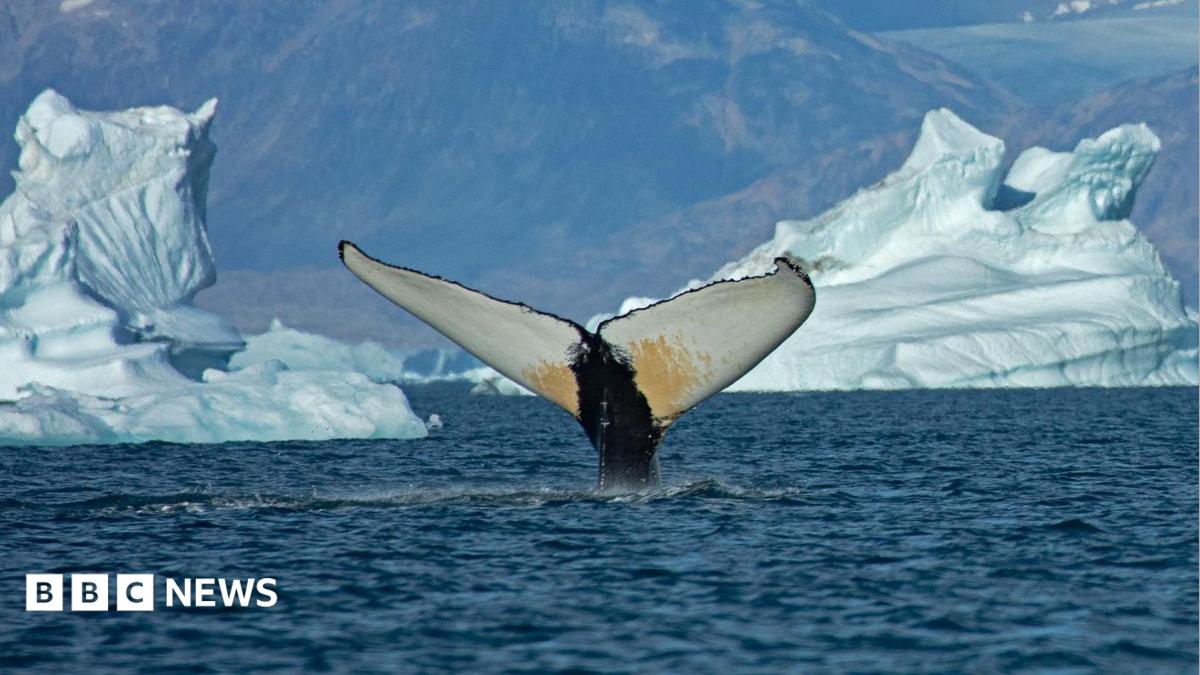
Sea ice has been disappearing from East Greenland, allowing giant whales to take advantage and move into previously inaccessible areas.
asserted
whales → publish → areas
That is the conclusion of a decades-long study that has recorded - and filmed - hundreds of the world's biggest whales including humpbacks, minke and fin whales, feeding in ice-free seas along the coast in summer.
asserted
that → record → summer
None of these marine mammals were historically found here as they have been locked out of the coastal waters by ice.
asserted
they → find → ice
Now, as climate change warms the sea and melts that ice, they have adapted.
asserted
they → warm → ice
Scientists describe the result as seasonal Arctic "feeding frenzies" - part of a major regime shift in the ocean environment along East Greenland.
asserted
Scientists → describe → Greenland
The change is dramatic: ship-based surveys in the region did not record a single humpback whale sighting there until 2006.
asserted
surveys → base → 2006
In 2007, seven humpbacks were seen, and by 2024, there were 150 ship-based sightings of these giant whales.
asserted
humpbacks → see → whales
The first systematic aerial surveys of baleen whales - a group that includes fin, minke and humpbacks - off the East Greenland coast were carried out by the researchers during the summers of 2015 and 2024.
asserted
that → include → 2015
They combined that information with the tracks of 15 satellite-tagged whales and testimony from Inuit hunters - all building a picture of what the lead researcher Prof Mads Peter Heide-Jørgensen called a "major ecological regime shift".
asserted
researcher → combine → what
An estimated 4,000 humpback whales, 6,000 fin whales and 6,000 minke whales visited the Greenland Sea in the summer of 2024.
asserted
whales → visit → 2024
Prof Heide-Jørgensen, from the Greenland Institute of Natural Resources, told BBC News that the changes in the region were "probably the most radical we can see anywhere in the subarctic".
asserted
we → tell → subarctic
That shift is driven by rising sea temperatures and food availability.
asserted
shift → drive → temperatures
The whales appear to be feeding on fish that have moved into the warming waters of East Greenland.
asserted
that → appear → Greenland
They estimated that the three whale species would consume at least 800,000 tonnes of fish and krill during a summer feeding season.
asserted
species → estimate → season
It is not clear from this study whether the change reflects an overall increase in the populations of these whale species, or just a redistribution from other areas.
asserted
change → reflect → areas
Other experts the BBC spoke to were concerned that the study suggested there was an influx of the animals from West Greenland.
uncertain
study → speak → Greenland
That is a sensitive issue in Greenland, a country where some whales are hunted.
asserted
whales → hunt → Greenland
But the scientists said that their findings do suggest that these "opportunistic" baleen whales appear to be adapting and might even be benefiting from the change.
uncertain
whales → say → change
Other Arctic species, however, are "in trouble now", explained Prof Heide-Jørgensen.
asserted
Jørgensen → explain → trouble
Animals including narwhals and belugas are sharing habitat with - or even being displaced by - these other whales.
"
asserted
Animals → include → whales
For some species, climate change is not necessarily a problem - it opens up new opportunities," said Prof Heide-Jørgensen, "but other species are losing their habitat".
asserted
species → open → habitat
The study is published in the journal Frontiers in Marine Science, external.
asserted
study → publish → Science
 The Aporia